Unisciti a noi in un viaggio nel mondo dei libri!
Aggiungi questo libro allo scaffale
Grey
Scrivi un nuovo commento Default profile 50px
Grey
Iscriviti per leggere l'intero libro o leggi le prime pagine gratuitamente!
All characters reduced
Lucy's Nose - cover

Lucy's Nose

Cecily Mackworth

Casa editrice: Honno Press

  • 0
  • 0
  • 0

Sinossi

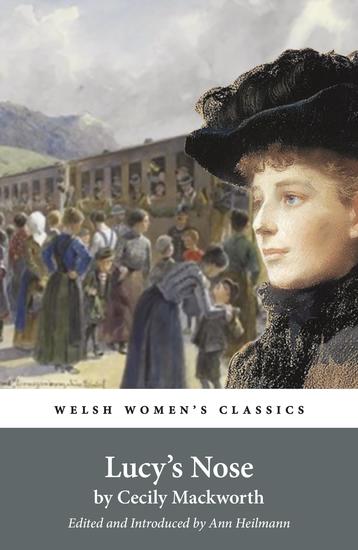
Lucy's Nose is a richly layered narrative that blends historical fiction, life writing, psychoanalysis and socio-political history to explore the intersections of memory, the imagination, and identity.


At its heart is a detective-like quest to uncover the story of Freud's elusive patient 'Lucy R.', a 30-year-old Scottish governess in Vienna who sought Freud's help in the early 1890s for olfactory hallucinations.


As the contemporary author-narrator visits Vienna in the 1980s to search for traces of the woman who inspired Freud's case study, she reflects on Lucy's resistance to Freud's sexual theories and begins imaginatively to reconstruct her voice and life.


Set against the symbolic backdrop of a historic Viennese train station, the text becomes both a meditation on time and a neo-Victorian experiment in autofiction, merging personal memory with cultural history and blurring the lines between fact, fiction, and self-creation.
Disponibile da: 27/03/2026.
Lunghezza di stampa: 290 pagine.

Altri libri che potrebbero interessarti

  • The Secret Garden - cover

    The Secret Garden

    Frances Hodgson Burnett

    • 0
    • 0
    • 0
    Unlock the magic of "The Secret Garden" by Frances Hodgson Burnett, a timeless tale of renewal and discovery. Mary Lennox, a spoiled and lonely orphan, finds herself in her uncle's gloomy Yorkshire estate. Her curiosity leads her to an abandoned and hidden garden. As she breathes life back into it, Mary, along with newfound friends Colin and Dickon, experiences a profound transformation. Through nature's healing power, the garden becomes a sanctuary of hope, friendship, and inner growth.
    Mostra libro
  • The Jungle - cover

    The Jungle

    Upton Sinclair

    • 0
    • 0
    • 0
    The Jungle by Upton Sinclair follows Jurgis Rudkus, a Lithuanian immigrant who arrives in Chicago seeking the American Dream. Instead, he faces brutal working conditions in the meatpacking industry, exploitation, poverty, and corruption. As he struggles to support his family, he becomes disillusioned with the system that exploits immigrant labor. Sinclair’s novel exposes the dark side of industrial capitalism, ultimately sparking public outcry and reforms in food safety laws.
    Mostra libro
  • The Pickwick Papers - cover

    The Pickwick Papers

    Charles Dickens

    • 0
    • 0
    • 0
    The Pickwick Papers was Charles Dickens' first novel. Because of his success with Sketches by Boz published in 1836 Dickens was asked by the publisher Chapman & Hall to supply descriptions to explain a series of comic "cockney sporting plates" by illustrator Robert Seymour,[and to connect them into a novel. The book became Britain's first real publishing phenomenon, with bootleg copies, theatrical performances, Sam Weller joke books, and other merchandise. On its cultural impact, Nicholas Dames in The Atlantic writes, “Literature” is not a big enough category for Pickwick. It defined its own, a new one that we have learned to call “entertainment.” Published in 19 issues over 20 months, the success of The Pickwick Papers popularized serialised fiction and cliffhanger endings.Seymour's widow claimed the idea for the novel was originally her husband's, but Dickens strenuously denied any specific input in his preface to the 1867 edition: "Mr. Seymour never originated or suggested an incident, a phrase, or a word, to be found in the book."Charles Dickens was an English writer and social critic. He created some of the world's best-known fictional characters and is regarded by many as the greatest novelist of the Victorian era. His works enjoyed unprecedented popularity during his lifetime and, by the 20th century, critics and scholars had recognized him as a literary genius. His novels and short stories are widely read today.
    Mostra libro
  • The Sphinx - cover

    The Sphinx

    Edgar Allan Poe

    • 0
    • 0
    • 0
    The Sphinx is a short story written by Edgar Allan Poe about a man who decides to visit a relative living near the Hudson River north of New York City for two weeks during a cholera epidemic that occurred during the summer of 1832. One day during this visit, the man is reading a book near the window revealing a scenic view of the Hudson River. His attention is focused upon the cholera epidemic nevertheless, and when he glances up from th pages of his novel, the man sees a ghastly sight in the distant hills--there an enormous creature larger than any oceangoing ship is climbing down!
    Mostra libro
  • Anna Karenina Part 3 - cover

    Anna Karenina Part 3

    Leo Tolstoy

    • 0
    • 0
    • 0
    In Part 3 of Anna Karenina, the divide between Anna and society deepens as her affair with Vronsky intensifies. Isolated from friends and family, Anna struggles with jealousy and despair, while Vronsky faces his own dilemmas balancing love and duty. Meanwhile, Levin marries Kitty, finding joy in domestic life and rural simplicity. Their contrasting paths highlight the tension between societal expectations and personal fulfillment. As autumn arrives, Tolstoy explores themes of sacrifice, identity, and the search for meaning, setting the stage for further emotional turmoil and reflection.
    Mostra libro
  • In the Steppe - From their pens to your ears genius in every story - cover

    In the Steppe - From their pens...

    Maxim Gorky

    • 0
    • 0
    • 0
    Alexei Maximovich Peshkov was born on 28th March 1868, in Nizhny Novgorod, Russia. 
    Better known as Maxim Gorky he was orphaned at 11 and ran away from home at 12.  At 19 he had already attempted suicide and thereafter travelled, by foot, across the Russian Empire for 5 years. 
    His first book ‘Essays & Stories’ in 1898 was a sensation and so began a long career as an author of short stories, novels and plays.  Gorky saw writing as a moral and political act that would help to change the unjust world around him.  He was an ardent early advocate of the emerging Marxist movement and publicly opposed the Tsarist regime leading several times to his arrest.  
    In 1904 he began his own theatre but the censor banned every play and Gorky was forced to abandon the project. 
    But Gorky was a financially successful author, editor, and playwright and gave monies to political parties as well as for civil rights and social reform.  The brutal shooting of workers, which set in motion the Revolution of 1905, pushed Gorky more decisively toward radical solutions.  
    In 1906 he went to the United States to raise funds for the Bolsheviks. Those experiences including a scandal over travelling with his lover and not his wife deepened his contempt for the ‘bourgeois soul.’ 
    Gorky now moved to Capri in Italy, both for health reasons and to escape the increasingly repressive times in Russia.  
    An amnesty for the 300th anniversary of the Romanov dynasty saw him return to Russia in 1914. His politics remained close to the Bolshevik cause.  But soon, after the 1918 revolution, his essays referred to Lenin as a tyrant for his senseless arrests and repression.  He was soon appealing to the outside world for food aid after the catastrophic crop failure. 
    In October 1921 Gorky returned to Italy, now in Fascist hands, and settled in Sorrento until 1932.  His health worsened with the onset of tuberculosis. 
    He wrote several successful books there but now decided to find an understanding with the communist regime. Stalin invited him home and his return was hailed as a major propaganda victory.  He was decorated with the Order of Lenin, and a province, a park, and various streets re-named in his honour. 
    But he had his faults too.  In 1933, Gorky co-edited a book on the White Sea-Baltic Canal and denied even a single prisoner died during its construction, but thousands had. As well, knowing that some Nazis were homosexual, a phrase was attributed to him that said ‘exterminate all homosexuals and fascism will vanish’.  Although he was himself was quoting another he was decidedly homophobic. 
    With the increase of Stalinist repression in 1935 Gorky was placed under unannounced house arrest. 
    Maxim Gorky died on the 18th June 1936 from pneumonia.  He was 68. 
    Stalin and Molotov were among those who carried Gorky's urn of ashes at his funeral.
    Mostra libro