Unisciti a noi in un viaggio nel mondo dei libri!
Aggiungi questo libro allo scaffale
Grey
Scrivi un nuovo commento Default profile 50px
Grey
Iscriviti per leggere l'intero libro o leggi le prime pagine gratuitamente!
All characters reduced
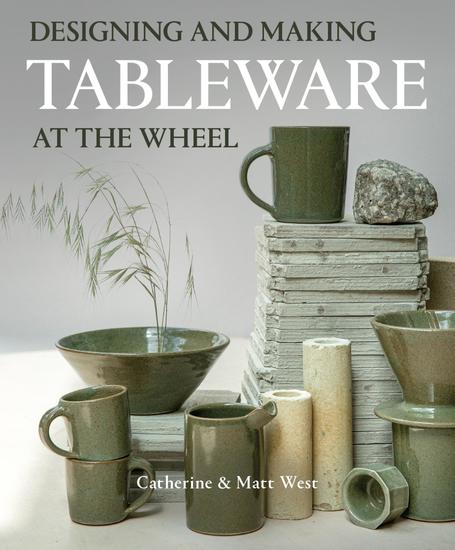
Designing and Making Tableware at The Wheel - cover

Designing and Making Tableware at The Wheel

Catherine West, Matt West

Casa editrice: The Crowood Press

  • 0
  • 0
  • 0

Sinossi

Master the art of designing and throwing pottery for the table, and enjoy the unique relationship between food and tableware
Practical and accessible, personal and technical, this inspiring book is invaluable for all makers, whatever their experience, who want to create wheel-thrown tableware. It is written by Catherine and Matt West who share the knowledge and passion so evident in their own work, and explores the overlapping notions of craft, design and small-batch production. Richly illustrated with over 300 photos and with detailed step-by-step sequences, it celebrates the slow-nature of making by hand and explains how to make consistent pieces that add joy and meaning to the table.
Disponibile da: 26/11/2024.
Lunghezza di stampa: 144 pagine.
Altri libri che potrebbero interessarti

  • Blade Runner - The Ultimate Trivia Collection - From The Movie Directed By Ridley Scott - cover

    Blade Runner - The Ultimate...

    Film Trivia Metaverse

    • 0
    • 0
    • 0
    BLADE RUNNER 
    THE ULTIMATE TRIVIA COLLECTION 
      
    FROM THE MOVIE DIRECTED BY RIDLEY SCOTT 
      
    CREATED BY FILM TRIVIA METAVERSE 
      
    ABOUT THE FILM 
    Blade Runner is a 1982 science fiction film directed by Ridley Scott, set in a dystopian future Los Angeles. It follows Rick Deckard, a former police officer tasked with hunting down and "retiring" rogue replicants—biologically engineered humans. The replicants, led by Roy Batty, have escaped to Earth seeking longer lifespans. As Deckard pursues them, he grapples with questions about humanity, identity, and morality. The film blends neo-noir, cyberpunk, and philosophical themes, exploring artificial intelligence, empathy, and the boundaries between human and machine. With its atmospheric visuals and haunting score by Vangelis, Blade Runner became a cult classic. 
      
    TRIVIA SAMPLES: 
      
    "Director Ridley Scott and director of photography Jordan Cronenweth achieved the famous 'shining eyes' effect by using a technique invented by Fritz Lang known as the 'Schüfftan Process.' Light is bounced into the actors' eyes off of a piece of half-mirrored glass mounted at a 45-degree angle to the camera." 
      
    "Sir Ridley Scott regards this movie as probably his most personal and complete work." 
      
    "According to Rutger Hauer's biography, the final confrontation between Rick Deckard and Roy Batty was initially planned to be a fight in an old gym using martial arts, like kung-fu. Hauer disliked the idea, saying it was 'too Bruce Lee', and proposed Batty chasing Deckard instead."
    Mostra libro
  • IFR Flight Theory - cover

    IFR Flight Theory

    Facundo Conforti

    • 0
    • 0
    • 0
    Carrying out a successful instrument flight not only requires the technical and operational skills to maneuver an aircraft in conditions of reduced visibility or adverse weather, but also requires a set of theoretical knowledge and flight techniques that help minimize the margin of error and try to ensure the success of an instrumental flight. 
    In this new book of the most successful Aeronautical Library in America, we will try to cover all the theoretical and operational technical content to provide each reader with the necessary tools with which they can develop a safe and efficient instrumental flight. 
    Flight physiology, basic and operational theoretical concepts of instrumental flights, basic regulatory concepts and a whole series of recommended techniques to carry out this type of flight without losing sight of the main objective, to operate the aircraft safely. 
    Instrument flight theory is one of the main subjects of the commercial pilot career since it forms one of the most solid pillars that a pilot in training must have.
    Mostra libro
  • The Shocking Truth about Public Transportation - cover

    The Shocking Truth about Public...

    Zoey Fraisers

    • 0
    • 0
    • 0
    Public transportation is often presented as the backbone of modern cities, a vital system that connects people to jobs, schools, and essential services. Advocates promote it as an affordable, eco-friendly, and efficient alternative to private vehicles, reducing congestion and improving urban mobility. Governments and transit agencies highlight its benefits, claiming it serves the public good while advancing sustainability goals. However, beyond the polished image of well-maintained buses, sleek trains, and promises of convenience, there lies a far more complicated and often troubling reality.  
      
    The public is frequently told that mass transit is the key to reducing traffic and lowering pollution, yet many systems fail to deliver on these promises. Trains break down, buses run late, and commuters find themselves packed into overcrowded vehicles, often feeling unsafe. Meanwhile, taxpayers pour billions into these systems, only to see fare increases, service cuts, and poorly maintained infrastructure. The question arises: If public transportation is supposed to be a solution, why does it so often feel like a problem?  
      
    Another significant issue is safety. Crime rates on buses, subways, and train platforms have become a growing concern, with riders facing theft, assault, and harassment. Many transit systems lack sufficient security measures, leaving passengers vulnerable. The psychological stress of commuting through unsafe environments can be overwhelming, particularly for women, the elderly, and other vulnerable populations. Despite these risks, officials frequently downplay crime statistics, insisting that public transit remains a safe option. 
    Mostra libro
  • A History of Ancient Egypt’s Most Famous Sites - cover

    A History of Ancient Egypt’s...

    Editors Charles River

    • 0
    • 0
    • 0
    Africa may have given rise to the first humans, and Egypt probably gave rise to the first great civilizations, which continue to fascinate modern societies across the globe nearly 5,000 years later. From the Library and Lighthouse of Alexandria to the Great Pyramid at Giza, the Ancient Egyptians produced several wonders of the world, revolutionized architecture and construction, created some of the world’s first systems of mathematics and medicine, and established language and art that spread across the known world.  
    For almost four millennia, the Great Pyramids of Ancient Egypt have been widely hailed as the single greatest archeological feat man has ever accomplished. The Great Pyramid at Giza is the only one of the seven wonders of the ancient world to have survived into the modern age. Unlike so many pieces of the historical record which have been “re-discovered,” relatively recently (in the grand scheme of things,” in their four thousand years of existence, the Great Pyramids have never allowed themselves to be truly forgotten by the human civilization which has never ceased to regard them with wonder and awe. 
    Egypt also impressed its contemporaries. The 5th century B.C. Greek historian Herodotus wrote that Egypt was “the gift of the Nile” because the river made its soil so fertile and thus helped create one of the first great civilizations. Indeed, the land of Egypt so impressed the Greeks that when Alexander the Great conquered the Nile Valley in the 4th century B.C., he decided that he would build a new city on its soil and name it Alexandria. After Alexander, the city of Alexandria grew and became the most important city in the world for centuries as it watched and played a role in the rise and fall of numerous dynasties. The city also became home to one of the Seven Wonders of the Ancient World – the Lighthouse of Alexandria – and a center of culture and learning, which was exemplified by the Library of Alexandria.
    Mostra libro
  • Heart Dog - Surviving the Loss of Your Canine Soul Mate - cover

    Heart Dog - Surviving the Loss...

    Roxanne Hawn

    • 0
    • 0
    • 0
    The death of any dog is hard. The death of a Heart Dog – a canine soul mate – is much, much worse … Even if you’ve experienced pet loss before, losing your canine soul mate is different. Typical grief advice isn’t nearly enough. Heart Dog answers all the big questions about canine soul mates, offers practical ideas for coping with each day’s dose of grief, and provides inspiration for finding your place in the world after such a profound loss. Others have survived the grief. You can too. Let Heart Dog be your guide.
    Mostra libro
  • Egyptian Trade and Diplomacy - Relations with Neighboring Civilizations - cover

    Egyptian Trade and Diplomacy -...

    Omar Khalil

    • 0
    • 0
    • 0
    Ancient Egypt’s prosperity and cultural richness were significantly shaped by its early trade networks and exchanges with neighboring regions. From the very beginnings of Egyptian civilization, trade played a crucial role in building economic strength and fostering diplomatic relationships. The development of trade networks allowed Egypt not only to obtain essential resources but also to influence and be influenced by surrounding cultures. 
    The origins of Egyptian trade practices can be traced back to the Predynastic period, when local communities exchanged goods such as pottery, beads, and tools. As Egyptian society evolved and centralized under powerful pharaohs, trade became more organized, enabling long-distance interactions. By the time of the Old Kingdom, Egypt had established a network of trade routes that stretched beyond its borders, connecting it to various civilizations across the ancient world. 
    One of the earliest and most vital trade routes was the Nile River, serving as a natural highway that facilitated the movement of goods and people. The Nile connected southern and northern Egypt while also linking the civilization to Nubia and further into sub-Saharan Africa. This route allowed the exchange of gold, ivory, ebony, and exotic animal products, which were crucial to the Egyptian economy and the creation of luxury goods. Additionally, maritime trade across the Red Sea connected Egypt to the Arabian Peninsula and even the distant lands of Punt, where incense, spices, and other valuable commodities were sourced.
    Mostra libro