Join us on a literary world trip!
Add this book to bookshelf
Grey
Write a new comment Default profile 50px
Grey
Subscribe to read the full book or read the first pages for free!
All characters reduced
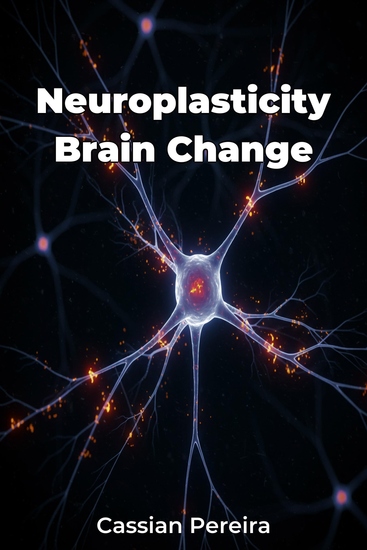
Neuroplasticity Brain Change - cover

Neuroplasticity Brain Change

Cassian Pereira

Translator A AI

Publisher: Publifye

  • 0
  • 0
  • 0

Summary

Neuroplasticity Brain Change explores the remarkable ability of the brain to reorganize itself by forming new neural connections throughout life. This concept, known as neuroplasticity, challenges the traditional view of the brain as a fixed entity, revealing its dynamic potential for change and adaptation.

 
For example, the book explains how learning a new skill or breaking a bad habit physically alters the structure of the brain, rewiring neural pathways. This offers practical implications for cognitive enhancement and rehabilitation.

 
The book progresses by first laying the groundwork with fundamental concepts like synaptic plasticity and neurogenesis. It then delves into how experiences and environment shape the brain. Finally, it presents practical applications of neuroplasticity, such as stroke recovery and overcoming learning disabilities.

 
By translating complex neuroscience into actionable strategies, Neuroplasticity Brain Change provides readers with the tools to actively influence their own brain development, improve memory, and enhance learning speed.
Available since: 03/15/2025.
Print length: 80 pages.

Other books that might interest you

  • Domestication of Dogs and Cats The: The History and Legacy of People’s Favorite Pets - cover

    Domestication of Dogs and Cats...

    Editors Charles River

    • 0
    • 0
    • 0
    As the oft-repeated and invariably accurate pearl of wisdom goes, a dog truly is man's best friend. For a long time, people have almost universally loved dogs, and it seems to have been that way for at least tens of thousands of years. When affection is abundantly and consistently expressed, this pure, unspoken, wholesome love is one that is very much requited, and then some. This bond can be demonstrated by the mere existence of pet keepers who unironically refer to themselves as “dog parents,” not merely “dog owners.” 
    Of course, this camaraderie between man and dog did not materialize overnight. Quite the contrary, the relationship between people and dogs gradually evolved and steadily strengthened over several millennia, following a premise best summed up by the dog's metamorphosis from a predator to a lifelong companion. Apart from friendship and companionship, dogs may have been the first animal to be domesticated, and they have been trained to provide loyal and competent service in a variety of fields, ranging from seeing-eye dogs to vest-wearing police partners, among other lines of work. 
    People's obsession with felines is an enigma in and of itself. Unlike dogs, famously known as man's most excitable, trustworthy, and loyal friend, cats are oftentimes indifferent, guarded, and yet finicky little furry creatures who only yearn for attention and affection when one is neck-deep in work or otherwise preoccupied. And still, people adore them all the same. 
    In a recent poll that surveyed 600 American college students, 60% of the participants identified themselves as “dog lovers,” whereas only 11% pledged their love for cats. The remaining 29% regarded themselves as fans of both critters or fans of neither. Be that as it may, there is said to be anywhere between a staggering 88=94 million pet cats in the United States alone, which eclipses the roughly 84-90 million pet dogs in the country.
    Show book
  • Taming the Octopus - The Long Battle for the Soul of the Corporation - cover

    Taming the Octopus - The Long...

    Kyle Edward Williams

    • 0
    • 0
    • 0
    The untold story of how efforts to hold big business accountable changed American capitalism. 


    In this vivid and surprising history, we meet twentieth-century activists, investors, executives, and workers who fought over a simple question: Is the role of the corporation to deliver profits to shareholders, or something more? On one side were "business statesmen" who believed corporate largess could solve social problems. On the other were libertarian intellectuals such as Milton Friedman and his oft-forgotten contemporary, Henry Manne, whose theories justified the ruthless tactics of a growing class of corporate raiders. But Kyle Edward Williams reveals that before the "activist investor" emerged as a capitalist archetype, Civil Rights groups used a similar playbook for different ends, buying shares to change a company from within. 


    As a rising tide of activists pushed corporations to account for societal harms from napalm to environmental pollution to inequitable hiring, a new idea emerged: that managers could maximize value for society while still turning a maximal profit. This elusive ideal, "stakeholder capitalism," still dominates our headlines today. Williams's necessary history equips us to reconsider democracy's tangled relationship with capitalism.
    Show book
  • Greek Mythology for Teens: Enthralling Tales and Myths from Ancient Greece - cover

    Greek Mythology for Teens:...

    Billy Wellman

    • 0
    • 0
    • 0
    Did you know that Zeus was considered to be both the youngest and the oldest brother? 
     Thanks to their enthralling narratives and relatable characters, Greek myths have captured our imagination for millennia. Despite being thousands of years old, these tales still manage to touch on something in the core of our souls, connecting humans from across all time periods and all stages of life. That is because myths speak to raw truths that are felt and observed by us all, and to study them is to study that which shapes our world and that which makes us human. 
    This audiobook is divided into six chapters and explores the most famous narrative of four famous heroes of Greek mythology. While it is impossible to gather all the most important Greek myths in their entirety in one short collection, this audiobook provides the interested listener with a nice, if somewhat modest, assortment of narratives that have greatly influenced our culture to this day.  
    Some of the myths you’ll discover by listening to this audiobook are:The rise of the OlympiansTheseus’s epic fight against the MinotaurPerseus beheading the Gorgon MedusaJason and Medea’s murderous affairThe bloody curse of the House of AtreusAnd so much more! 
    Scroll up and click the “add to cart” button to learn more about Greek mythology!
    Show book
  • Short stories (Early works 1837-1852) - cover

    Short stories (Early works...

    Elizabeth Cleghorn Gaskell

    • 0
    • 0
    • 0
    "Delve into the early works of Elizabeth Cleghorn Gaskell with this audiobook collection of short stories. Before she became a celebrated novelist, Gaskell penned a series of captivating tales that showcase her budding talent as a storyteller.These early works, written between 1837 and 1852, offer a glimpse into the formative years of a literary genius. Gaskell's stories are a reflection of the society and culture of her time, exploring themes of love, class, and social dynamics.As you listen to these tales, you'll witness the development of Gaskell's distinctive narrative style and her ability to create vivid, relatable characters. Her insights into human nature and her skill at conveying the complexities of human relationships are already apparent in these early writings.This audiobook is a literary treasure trove for both Gaskell enthusiasts and those new to her work, providing a fresh perspective on the evolution of a great author's craft."
    Show book
  • Science for a Green New Deal - Connecting Climate Economics and Social Justice - cover

    Science for a Green New Deal -...

    Eric A. Davidson

    • 0
    • 0
    • 0
    Since it was first proposed in the US House of Representatives, the Green New Deal has been hotly debated. The intent was not simply to fight climate change or address a specific environmental concern, but rather to tackle how climate change and other environmental challenges affect the economy, the vulnerable, and social justice—and vice versa. 


    In Science for a Green New Deal, Eric Davidson dissects this legislative resolution. He also shows how green new deal thinking offers a framework for a convergence of the natural sciences, social science, economics, and community engagement to develop holistic policy solutions to the most pressing issues of our day. Davidson weaves the case for linkages among multiple global crises, including a pandemic that has reversed progress on fighting poverty and hunger, an acceleration of climate change, and a renewed awareness of profound social injustices highlighted by the Black Lives Matter movement. 


    Illustrating these points with his personal life experiences as a child growing up in Montana and as a famed researcher leading a large scientific society, Davidson relates these complex challenges to our everyday lives and decision-making. Science for a Green New Deal is a realistic and optimistic look at how we can attain a more sustainable, prosperous, and just future.
    Show book
  • Hearing Happiness - Deafness Cures in History - cover

    Hearing Happiness - Deafness...

    Jaipreet Virdi

    • 0
    • 0
    • 0
    Weaving together lyrical history and personal memoir, Virdi powerfully examines society’s—and her own—perception of life as a deaf person in America. 
     
    At the age of four, Jaipreet Virdi’s world went silent. A severe case of meningitis left her alive but deaf, suddenly treated differently by everyone. Her deafness downplayed by society and doctors, she struggled to “pass” as hearing for most of her life. Countless cures, treatments, and technologies led to dead ends. Never quite deaf enough for the Deaf community or quite hearing enough for the “normal” majority, Virdi was stuck in aural limbo for years. It wasn’t until her thirties, exasperated by problems with new digital hearing aids, that she began to actively assert her deafness and reexamine society’s—and her own—perception of life as a deaf person in America. 
      
    Through lyrical history and personal memoir, Hearing Happiness raises pivotal questions about deafness in American society and the endless quest for a cure. Taking us from the 1860s up to the present, Virdi combs archives and museums in order to understand the long history of curious cures: ear trumpets, violet ray apparatuses, vibrating massagers, electrotherapy machines, airplane diving, bloodletting, skull hammering, and many more. Hundreds of procedures and products have promised grand miracles but always failed to deliver a universal cure—a harmful legacy that is still present in contemporary biomedicine. 
     
    Weaving Virdi’s own experiences together with her exploration into the fascinating history of deafness cures, Hearing Happiness is a powerful story that America needs to hear.
    Show book