Unisciti a noi in un viaggio nel mondo dei libri!
Aggiungi questo libro allo scaffale
Grey
Scrivi un nuovo commento Default profile 50px
Grey
Iscriviti per leggere l'intero libro o leggi le prime pagine gratuitamente!
All characters reduced
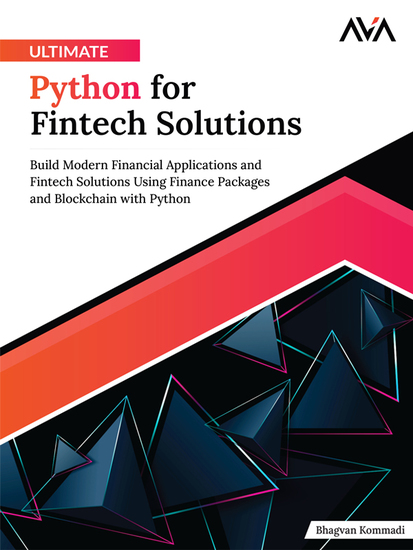
Ultimate Python for Fintech Solutions - Build Modern Financial Applications and Fintech Solutions Using Finance Packages and Blockchain with Python - cover

Ultimate Python for Fintech Solutions - Build Modern Financial Applications and Fintech Solutions Using Finance Packages and Blockchain with Python

Bhagvan Kommadi

Casa editrice: Orange Education Pvt. Ltd

  • 0
  • 0
  • 0

Sinossi

Creating Next Gen Apps in Finance

Book Description
Dive into the dynamic world where finance meets fintech with Python's versatile capabilities in this 'Ultimate Python for Fintech Solutions'. Whether you're aiming to build secure trading platforms, conduct deep statistical analysis, or pioneer next-generation financial technologies, this book quips you with the knowledge, tools, and practical insights to succeed. 
This book starts with Python's foundational programming techniques, essential for understanding financial principles and laying the groundwork for robust applications. You will learn to build scalable solutions that handle complex financial data with ease by using Python for analysis, forecasting, and data visualization. 
Next, it moves to explore advanced topics like AI/ML applications tailored for finance, enabling you to unlock predictive insights and streamline decision-making processes. You will discover how Python integrates cutting-edge technologies such as Big Data and Blockchain, to offer innovative solutions for modern fintech challenges. 
By the end of this expansive book, you will gain the expertise needed to develop sophisticated financial applications, visualize data effectively across desktop and web platforms, and drive innovation in fintech. 

Table of Contents

1. Getting Started on Python Infrastructure and Building Financial Apps
2. Learning Financial Concepts Using Python
3. Data Structures and Algorithms Using Python
4. Object Oriented Programming Using Python
5. Building Simulation and Mathematical Analysis Tools Using Python
6. Stochastic Mathematics and Building Models Using Python
7. Prediction Algorithms Using Python
8. Data Science and Statistical Algorithms Using Python
9. Desktop and Web Charting Using Python
10. AI/ML Apps Using Python
11. Big Data/Blockchain-Based Solutions Using Python
12. Next Generation FinTech Apps Using Python with Financial Singularity   
Index
Disponibile da: 07/12/2024.

Altri libri che potrebbero interessarti

  • Being a Surgeon and Being a Surgeon's Wife - cover

    Being a Surgeon and Being a...

    Peter Sykes, Jane Sykes

    • 0
    • 0
    • 0
    An easy to read, honest and personal account of the life of a surgeon and the effect that it has on his wife and family. The reader is taken behind the scenes as fascinating patient stories are used to illustrate what the job entails and the pressures and emotions that result; the child with life-threatening injuries or the patient needing end of life care. Incidents of medical malpractice, sexism and other problems encountered within the NHS are also related, again exemplified by authentic clinical stories.
    Mostra libro
  • Superintelligence on the Horizon - Steering the Course of Cybersecurity - cover

    Superintelligence on the Horizon...

    Felipe Chavarro Polanía

    • 0
    • 0
    • 0
    As we stand at the precipice of an era marked by unprecedented technological advancement, the emergence of superintelligent AI systems heralds both transformative opportunities and profound risks for the future of humanity. In "Superintelligence on the Horizon: Navigating the Future of AI Governance and Cybersecurity," Felipe Chavarro Polanía offers a comprehensive and thought-provoking exploration of the complex challenges and possibilities that lie ahead. 
    With a keen eye for detail and a deep understanding of the technical, ethical, and societal implications of superintelligent AI, Polanía guides readers through the intricate landscape of AI governance and cybersecurity. From the potential risks of AI-powered cyberattacks and the need for proactive defensive measures, to the critical importance of developing adaptive legal frameworks and fostering public trust, this book provides a nuanced and multifaceted analysis of the key issues at stake.
    Mostra libro
  • Physics - A Very Short Introduction - cover

    Physics - A Very Short Introduction

    Sidney Perkowitz

    • 0
    • 0
    • 0
    Physics, the fundamental science of matter and energy, encompasses all levels of nature from the subatomic to the cosmic, and underlies much of the technology around us. Understanding the physics of our universe is an essential aspect of humanity's quest to understand our environment and our place within it. Doing physics enables us to explore the interaction between environment and human society, and can help us to work towards the future sustainability of the planet. 


    This Very Short Introduction provides an overview of how this pervasive science came to be and how it works: who funds it, how physicists are trained and how they think, and how physics supports the technology we all use. Sidney Perkowitz presents the theories and outcomes of pure and applied physics from ideas of the Greek natural philosophers to modern quantum mechanics, cosmology, digital electronics, and energy production. Considering its most consequential experiments, including recent results in elementary particles, gravitational waves and materials science, he also discusses outside the lab, the effects of physics on society, culture, and humanity's vision of its place in the universe.
    Mostra libro
  • Ultimate Transformer Models Using PyTorch 20 - Master Transformer Model Development Fine-Tune Pretrained Models and Deploy AI Solutions with PyTorch 20 - cover

    Ultimate Transformer Models...

    Abhiram Ravikumar

    • 0
    • 0
    • 0
    Build Real-World AI with Transformers Powered by PyTorch 2.0.
    Book Description
    Transformer models have revolutionized AI across natural language processing, computer vision, and speech recognition. "Ultimate Transformer Models Using PyTorch 2.0" bridges theory and practice, guiding you from fundamentals to advanced implementations with hands-on projects that build a professional AI portfolio.
    This comprehensive journey spans 11 chapters, beginning with transformer foundations and PyTorch 2.0 setup. With this book, you will master self-attention mechanisms, tackle NLP tasks such as text classification and translation, and then expand into computer vision and speech processing. Advanced topics include BERT and GPT models, the Hugging Face ecosystem, training strategies, and deployment techniques. Each chapter features practical exercises that reinforce learning through real-world applications.
    By the end of this book, you will be able to confidently design, implement, and optimize transformer models for diverse challenges. So, whether revolutionizing language understanding, advancing computer vision, or innovating speech recognition, you will possess both theoretical knowledge and practical expertise to deploy solutions effectively across industries like healthcare, finance, and social media, positioning yourself at the AI revolution's forefront.
    Table of Contents
    1. Understanding the Evolution of Neural Networks
    2. Fundamentals of Transformer Architecture
    3. Getting Started with PyTorch
    4. 
    5. Natural Language Processing with Transformers
    6. Computer Vision with Transformers
    7. Speech Processing with Transformers
    8. Advanced Transformer Models
    9. Using HuggingFace with PyTorch
    10. Training and Fine-Tuning Transformers
    11. Deploying Transformer Models
    12. Transformers in Real-World Applications       
    
    Index
    Mostra libro
  • Medical Genetics - Understanding Hereditary Diseases - cover

    Medical Genetics - Understanding...

    Ava Westwood

    • 0
    • 0
    • 0
    Medical genetics is the branch of medicine that focuses on the role of genetic variations in human health and disease. It encompasses the study of inherited disorders, genetic predisposition to diseases, and the application of genetics in medical practice. Understanding the fundamentals of medical genetics is crucial for diagnosing, treating, and preventing genetic conditions. 
    Genes, composed of DNA, serve as the blueprint for the development and functioning of the human body. DNA is organized into chromosomes, with humans typically having 46 chromosomes arranged in 23 pairs. Of these, 22 pairs are autosomes, and one pair consists of sex chromosomes (XX in females and XY in males). Each parent contributes one chromosome per pair, ensuring genetic diversity. 
    Mutations, or changes in DNA sequences, play a key role in medical genetics. These mutations can be inherited or acquired and may lead to genetic disorders. Some mutations are benign, while others can disrupt normal biological functions, leading to conditions such as cystic fibrosis, sickle cell anemia, and Huntington’s disease. Mutations can be classified into different types, including point mutations, insertions, deletions, and chromosomal abnormalities.
    Mostra libro
  • The Shocking Truth about Emergency Preparedness - cover

    The Shocking Truth about...

    Zoey Fraisers

    • 0
    • 0
    • 0
    Emergency preparedness is no longer an option—it is a necessity. With the increasing frequency of natural disasters, pandemics, and unforeseen crises, individuals and communities must be ready to respond at a moment’s notice. Whether it’s a hurricane, wildfire, power outage, or civil unrest, the ability to react swiftly can mean the difference between safety and catastrophe. Unfortunately, too many people remain unprepared, relying on the assumption that government agencies or emergency responders will handle everything. While these organizations play a crucial role, personal preparedness is the first line of defense in any crisis.  
      
    One of the most significant misconceptions about emergency preparedness is that disasters are rare or unlikely to happen. However, global trends suggest otherwise. Climate change has intensified storms, heatwaves, and flooding events, making them more frequent and severe. Earthquakes and wildfires continue to threaten communities worldwide. Beyond natural disasters, cyberattacks, supply chain disruptions, and public health emergencies have highlighted vulnerabilities in modern societies. The COVID-19 pandemic was a stark reminder of how quickly daily life can be upended, leaving many scrambling for essential supplies and reliable information.  
      
    Preparedness goes beyond simply stocking up on food and water. It involves understanding risks, developing an action plan, and ensuring that essential resources are available when needed. A well-thought-out emergency plan includes knowing evacuation routes, securing important documents, and maintaining a communication strategy with family and friends. In an emergency, panic and confusion can lead to dangerous decisions. Those who prepare in advance are better equipped to make rational choices and protect themselves and their loved ones. 
    Mostra libro