Unisciti a noi in un viaggio nel mondo dei libri!
Aggiungi questo libro allo scaffale
Grey
Scrivi un nuovo commento Default profile 50px
Grey
Iscriviti per leggere l'intero libro o leggi le prime pagine gratuitamente!
All characters reduced
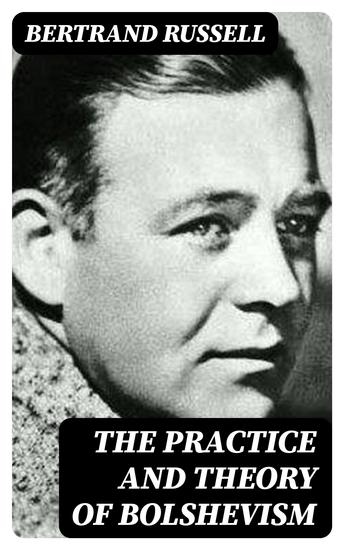
The Practice and Theory of Bolshevism - cover

The Practice and Theory of Bolshevism

Bertrand Russell

Casa editrice: DigiCat

  • 0
  • 0
  • 0

Sinossi

In "The Practice and Theory of Bolshevism," Bertrand Russell provides a critical examination of the political, social, and economic ideologies underpinning the Bolshevik Revolution of 1917. Through a blend of philosophic rigor and keen observational analysis, Russell explores the principles of Marxism, the implications of revolutionary action, and the inherent tensions between individual liberty and collective governance. His engagement with the theoretical constructs of Bolshevism is framed within a historical context, revealing the complexities and contradictions of Soviet aims versus reality. The text serves not only as a socio-political commentary but also as a philosophical inquiry into the nature of authority and freedom in the modern age. Russell, a renowned philosopher and social critic, was deeply influenced by the tumult of his time. His pacifist ideals and commitment to democratic socialism were juxtaposed with his concerns over the rise of totalitarian regimes. Drawing on his background in mathematics and logic, Russell's analytical approach allows him to dissect Bolshevism's underlying motives, ultimately revealing his profound apprehension toward extreme ideological movements. Recommended for scholars, political theorists, and general readers alike, Russell's work is indispensable for understanding the implications of Bolshevism not only in the context of the early 20th century but also in illuminating contemporary discussions around governance and freedom. A rich, thought-provoking text, it invites readers to grapple with the perennial struggle between authority and autonomy.
Disponibile da: 11/10/2022.
Lunghezza di stampa: 114 pagine.

Altri libri che potrebbero interessarti

  • The Wannabe Fascists - A Guide to Understanding the Greatest Threat to Democracy - cover

    The Wannabe Fascists - A Guide...

    Federico Finchelstein

    • 0
    • 0
    • 0
    Meet today's almost fascists and learn the warning signs to intercept them on the road from populism to dictatorship. 


    With The Wannabe Fascists, historian Federico Finchelstein offers a precise explanation of why Trumpism and similar movements across the world belong to a new political breed, the last outcome of the combined histories of fascism and populism: the wannabe fascists. This new type of populist politician is typically a legally elected leader who, unlike previous populists who were eager to distance themselves from fascism, turns to totalitarian lies, racism, and illegal means to destroy democracy from within. 


    Drawing on almost three decades of research on the histories of fascism and populism around the world, this book lays out in clear language what the author calls the "four pillars of fascism"—xenophobia, propaganda, political violence, and ultimately dictatorship. Finchelstein carefully explains how and why wannabe fascists like Trump, Bolsonaro, and Modi embrace the first three pillars but don't quite succeed in dictatorship and total suppression of the popular vote. The Wannabe Fascists stresses the importance of preventing despots from reaching this tipping point and offers a clear warning for what's at stake.
    Mostra libro
  • Communism in Practice - Case Studies of Communist Governments and Their Societal Impact - cover

    Communism in Practice - Case...

    Arlo Holders

    • 0
    • 0
    • 0
    Communism, as an ideology and political movement, seeks to create a classless society where the means of production are owned collectively. Rooted in the works of Karl Marx and Friedrich Engels, communism advocates for the abolition of private property and aims to establish a system where wealth is distributed according to need, not individual ownership. This chapter explores the foundational principles of communism, its historical development, and its responses to capitalism and social inequality. 
    At the heart of communism lies the idea of economic equality. Marx and Engels argued that capitalism inherently exploits workers, who sell their labor for wages while capitalists profit from the value produced. The solution, according to communism, is the overthrow of capitalist systems and the establishment of a proletarian (working class) dictatorship. This revolutionary phase would transition into a classless society in which private property is abolished, and wealth is shared among all members of society. 
    The key principles of communism emphasize collective ownership, state control of resources, and the idea of class struggle. In Marxist theory, history is understood through the lens of class conflict, where different social classes—such as the bourgeoisie (capitalists) and the proletariat (workers)—are in perpetual opposition. The ultimate goal is to establish a society free of these class distinctions, where everyone has access to the same resources and opportunities.
    Mostra libro
  • Understanding anarchism - cover

    Understanding anarchism

    Marcelino Viera, Maxime Foerster

    • 0
    • 0
    • 0
    What are the founding principles of anarchism? What links the philosophy of Proudhon, who introduced this notion in France in 1840, to the act of the Italian Sante Geronimo Caserio, who assassinated President Sadi Carnot in 1894?
    This introduction to anarchism helps us understand the issues and tensions that run through this movement, and to grasp why it could establish itself today as a response to the moral and economic crisis of contemporary societies.
    Mostra libro
  • Ghost in the Criminal Justice Machine - Reform White Supremacy and an Abolitionist Future - cover

    Ghost in the Criminal Justice...

    Emile Suotonye DeWeaver

    • 0
    • 0
    • 0
    Despite reform efforts that have grown in scope and intensity over the last two decades, the machine of American mass incarceration continues to flourish. In this powerful polemic, formerly incarcerated activist, essayist, and organizer Emile Suotonye DeWeaver argues that the root of the problem is white supremacy. 


    During his twenty-one years in prison, DeWeaver covertly organized to pass legislation impacting juveniles in California's criminal legal system; was a culture writer for Easy Street Magazine; and cofounded Prison Renaissance, an organization centering incarcerated voices and incarcerated leadership. DeWeaver draws on these experiences to interrogate the central premise of reform efforts, including prisoner rehabilitation programs, arguing that they demand self-abnegation, entrench white supremacy, and ignore the role of structural oppression. 


    With lucid, urgent prose, DeWeaver intervenes in contemporary debates on criminal justice and racial justice efforts with his eye-opening discussion of the tools we need to end white supremacy—both within and outside the carceral setting. For readers of Mariame Kaba, Susan Burton, and Derecka Purnell, Ghost in the Criminal Justice Machine adds a sharp and unique perspective to the growing discourse on racial justice, incarceration, and abolition.
    Mostra libro
  • Psychological Warfare - Using Psychological Tactics to Undermine or Control - cover

    Psychological Warfare - Using...

    Cito Harder

    • 0
    • 0
    • 0
    Psychological warfare is the deliberate use of tactics designed to influence, manipulate, and control the thoughts, emotions, and behaviors of individuals or groups. It involves the strategic deployment of psychological tactics to achieve specific objectives, often with the goal of weakening the will, confidence, and decision-making abilities of an opponent. Unlike physical warfare, which relies on the use of force and violence, psychological warfare focuses on undermining an adversary’s mental state, creating doubt, confusion, fear, or anxiety. The concept of psychological warfare spans across military, political, social, and personal domains, and its methods are utilized to achieve both large-scale and individual objectives. 
    At its core, psychological warfare operates by exploiting the weaknesses of human perception, beliefs, and emotions. It seeks to manipulate how people think, feel, and act, often in ways that are subtle and hard to detect. Through the strategic use of information, misinformation, fear, and emotional appeals, psychological warfare can alter the course of events and influence outcomes in a way that physical force alone cannot achieve. This manipulation can be direct, as in the use of propaganda, or more covert, as in the use of gaslighting to distort reality and create confusion. 
    Psychological warfare can be seen in many contexts, from international conflict and military operations to corporate competition, political campaigns, and even personal relationships. For example, in warfare, psychological tactics are employed to break the enemy’s morale, instill fear, and create division within their ranks. In the political arena, psychological warfare is often used to manipulate public opinion, spread propaganda, and discredit opponents.
    Mostra libro
  • The Lantern Bearers - cover

    The Lantern Bearers

    Robert Louis Stevenson

    • 0
    • 0
    • 0
    'The essence of this bliss was to walk by yourself in the black night, the slide shut, the top-coat buttoned, not a ray escaping, whether to conduct your footsteps or to make your glory public – a mere pillar of darkness in the dark; and all the while, deep down in the privacy of your fool's heart, to know you had a bull's-eye at your belt, and to exult and sing over the knowledge.'
    
    One of Robert Louis Stevenson's bestselling works of his time, 'The Lantern Bearers' is a charming essay on the joys underlying realist literature.
    
    Sometimes mistakenly taken as a fictional narrative, the essay begins with three boys – of which Stevenson is one – who reside in a seaside town during the summer. Stevenson describes the various splendours of existence in the town, such as fishing, tide pools and the open sea air. The three boys begin a nighttime ritual in which they attach lanterns to their belts, hidden by their overcoats, meandering in the dark and engaging in discussions only for their own ears – a simple, but profound source of pleasure. It becomes an allegory for the importance of romance in realism; why writers ought to seek where joy lies in the everyday. This audiobook edition is brilliantly read by Robin Laing.
    Robert Louis Stevenson (1850 – 1894) was a Scottish novelist, poet and travel writer. Best known for his novels Treasure Island and Strange Case of Dr Jekyll and Mr Hyde, his worked spanned from romance and adventure writing to gothic dark realism. He remains one of the most translated authors in the world.
    Mostra libro