Unisciti a noi in un viaggio nel mondo dei libri!
Aggiungi questo libro allo scaffale
Grey
Scrivi un nuovo commento Default profile 50px
Grey
Iscriviti per leggere l'intero libro o leggi le prime pagine gratuitamente!
All characters reduced
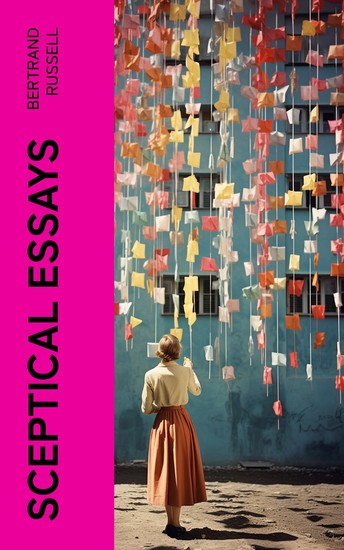
Sceptical Essays - cover

Sceptical Essays

Bertrand Russell

Casa editrice: e-artnow

  • 0
  • 0
  • 0

Sinossi

Sceptical Essays by Bertrand Russell is a compelling exploration into the depths of human thought and belief. Renowned philosopher Bertrand Russell invites readers on an intellectual journey through a collection of essays that challenge conventional wisdom, encouraging skepticism and critical examination of the world around us. In this thought-provoking work, Russell delves into a myriad of subjects, ranging from philosophy and science to social issues and human nature. With a keen and incisive mind, he questions established norms, offering readers a unique perspective that challenges preconceptions and stimulates intellectual curiosity. Throughout the essays, Russell employs clarity of thought and a lucid writing style, making complex ideas accessible to a wide audience. As he navigates the landscape of skepticism, readers are prompted to engage in a process of critical thinking, questioning assumptions and reconsidering long-held beliefs. "Sceptical Essays" is not merely a collection of intellectual inquiries; it is a testament to Russell's commitment to fostering a culture of rigorous examination and open-mindedness. Whether delving into matters of religion, politics, or the human condition, Russell's essays are a timeless exploration of the boundaries of human knowledge and the enduring pursuit of truth.
Disponibile da: 01/01/2024.
Lunghezza di stampa: 181 pagine.

Altri libri che potrebbero interessarti

  • Fighting After the War: A History of the Most Famous American Battles that Took Place after the Wars Had Ended - cover

    Fighting After the War: A...

    Editors Charles River

    • 0
    • 0
    • 0
    There are countless examples of battles that take place in wars after a peace treaty is signed. The last battle of the Civil War was a skirmish in Texas that Confederate forces won, nearly a month after Lee’s surrender at Appomattox. As fate would have it, the last fighting of the Civil War took place two days after Confederate President Jefferson Davis had been captured in Georgia 
    It’s certainly rare for the most famous battle of a war to take place after the peace treaty is signed, but luckily for Andrew Jackson, the War of 1812 was that unique exception. Less than a year after his victory in the Battle of Horseshoe Creek, Jackson led his forces into a more important battle at the Battle of New Orleans. The British hoped to grab as much of the land on the western frontier as they could, especially New Orleans, which had a prominent position on the Mississippi River for trading. With more than 8,000 soldiers aboard a British fleet sailing in from Jamaica in early January 1815, the attack on New Orleans promised to be a significant one, while Jackson’s men defended New Orleans with about half that number. This went on despite the fact that the two sides had signed the Treaty of Ghent on Christmas Eve 1814, which was supposed to end the war.  
    Despite the fact the French & Indian War had recently concluded, Pontiac led the first major attack of Pontiac’s War in May 1763, when he and 300 of his men attacked Fort Detroit in what is now the city by the same name. Unfortunately for his cause, Pontiac failed to gauge just how strong the British presence there was, and his attack was quickly repelled. On the other hand, he was not a man who gave up easily, so instead of retreating, he and his warriors would lay siege to the British stronghold. In the days that followed, word spread of his efforts, and in short order nearly 1,000 men from various tribes in the area had joined him.
    Mostra libro
  • Making Space for What Matters - Find Freedom from Clutter and Hoarding with Acceptance and Commitment Therapy - cover

    Making Space for What Matters -...

    PhD Clarissa W. Ong, PhD...

    • 0
    • 0
    • 0
    If you hoard—or have a loved one who hoards—you may feel helpless, hopeless, or ashamed. The thought of letting go of belongings may fill you with anxiety, dread, or grief. And you may wonder if you’ll ever experience the freedom of living without the weight of this debilitating behavior. It’s important to know you are not alone, and that hoarding isn’t your fault. This book will help you find your way out of the clutter and chaos, and into the life you truly want. 
    Written by a team of mental health professionals and grounded in evidence-based acceptance and commitment therapy (ACT), this book offers a values-based approach to finding lasting freedom from hoarding. Based on cutting-edge research, this book will help you unravel the stories your mind has created about you and your belongings. You’ll also discover how emotions and thoughts play a role in hoarding behaviors, and how you can declutter to live a life more closely aligned with your deepest values. 
    Most importantly, you’ll learn to move beyond feelings of shame and guilt that are associated with hoarding, and cultivate the self-compassion, self-awareness, and self-understanding needed to make real, lasting changes.
    Mostra libro
  • The Collapse of the Soviet Union - How the Superpower Disintegrated and the New World Order Emerged - cover

    The Collapse of the Soviet Union...

    Fredrich Hazelton

    • 0
    • 0
    • 0
    The Soviet Union, once the most powerful socialist state on the planet, dominated global politics and economics for much of the 20th century. From its establishment in 1922 until its disintegration in 1991, the USSR stood as a superpower, rivaling the United States in military strength, technological innovation, and ideological influence. The Soviet Union was not just a political entity; it was the manifestation of a grand vision of socialist governance that sought to reshape the world. Its rise to power was marked by revolution, war, and the forging of a unique socio-economic structure that stood in stark contrast to the capitalist world. 
      
    However, by the late 1980s, the Soviet Union faced insurmountable challenges. The centralized economy, which had initially driven industrial growth, was beginning to falter under the weight of inefficiency and stagnation. The military and political dominance the USSR had long enjoyed began to erode, and the ideological tenets that had once inspired its citizens no longer resonated with the younger generation. The political leadership, while still powerful, was marked by infighting, and the population grew disillusioned with the government’s inability to reform. Amid this turmoil, Mikhail Gorbachev ascended to the position of General Secretary of the Communist Party of the Soviet Union in 1985. Gorbachev’s policies of perestroika (restructuring) and glasnost (openness) sought to address the growing dissatisfaction and revive the Soviet state, but they inadvertently exposed the deep-rooted problems that had been festering for decades. 
      
    The decision to allow greater political freedom and economic flexibility unintentionally sparked a wave of unrest throughout the Soviet republics. Nationalist movements, long suppressed, began to rise, and demands for greater autonomy became louder...
    Mostra libro
  • A Rare Recording of Film Icon Burt Lancaster - cover

    A Rare Recording of Film Icon...

    Burt Lancaster

    • 0
    • 0
    • 0
    Burton Stephen Lancaster (November 2, 1913 - October 20, 1994), born in New York City, was an American actor, producer and director. Initially known for playing tough guys with a tender heart, he went on to achieve success with more complex and challenging roles over a 45-year career in films and television. He was a four-time Academy Award Best Actor nominee, winning the Oscar and Golden Globe for the 1960 film, Elmer Gantry, and BAFTA award winner for Birdman of Alcatraz (1963) and Atlantic City (1982). The following recordings are from tv interviews from 1963 and 1973.
    Mostra libro
  • Brain Training: 8-in-1 Bundle to Master Memory Speed Reading Concentration Accelerated Learning Study Skills Mind Mapping Mental Models & Neuroplasticity - cover

    Brain Training: 8-in-1 Bundle to...

    Troye Bates

    • 0
    • 0
    • 0
    BRAIN TRAINING - 8 MANUSCRIPTS IN 1 BOOK: 
      
    1) 
    HOW TO IMPROVE MEMORY: 
    7 Steps to Master Memory Improvement, Memorization Techniques & Photographic Memory. 
      
    2) 
    HOW TO READ FASTER: 
    7 Steps to Master Speed Reading Techniques, Reading Comprehension & Fast Reading. 
      
    3) 
    HOW TO FOCUS YOUR MIND: 
    7 Steps to Master Concentration Techniques, Attention Management & Staying Focused. 
      
    4) 
    HOW TO LEARN FASTER: 
    7 Steps to Master Accelerated Learning Techniques, Learning Strategies & Fast Self-learning. 
      
    5) 
    HOW TO STUDY EFFECTIVELY: 
    7 Steps to Master Effective Study Skills, Student Success, Note Taking & Exam Preparation. 
      
    6) 
    HOW TO MIND MAP: 
    7 Steps to Master Mind Mapping Techniques, Note-taking, Creative Thinking & Brainstorming Skills. 
      
    7) 
    HOW TO THINK DIFFERENTLY: 
    7 Steps to Master Mental Models, Critical Thinking, Decision Making & Problem Solving. 
      
    8) 
    HOW TO REWIRE YOUR BRAIN: 
    7 Steps to Master Neuroplasticity, Mind Hacking, Think Habits & Practical Neuroscience. 
      
    TRAIN YOUR BRAIN TODAY!
    Mostra libro
  • In the Penal Colony - cover

    In the Penal Colony

    Franz Kafka

    • 0
    • 0
    • 0
    "In the Penal Colony" is a short story by Franz Kafka written in German in October 1914, revised in November 1918, and first published in October 1919. As in some of Kafka's other writings, the narrator in this story seems detached from, or perhaps numbed by, events that one would normally expect to be registered with horror. Internal clues and the setting on an island suggest Octave Mirbeau's The Torture Garden as an influence. The story is set in an unnamed penal colony and describes the last use of an elaborate torture and execution device that carves the commandment that the condemned prisoner has transgressed on his skin as he slowly dies over the course of twelve hours. As the plot unfolds, the reader learns more and more about the machine, including its origin and original justification.
    Mostra libro