

Junte-se a nós em uma viagem ao mundo dos livros!
Adicionar este livro à prateleira
Grey
Deixe um novo comentário Default profile 50px
Grey
Assine para ler o livro completo ou leia as primeiras páginas de graça!
All characters reduced
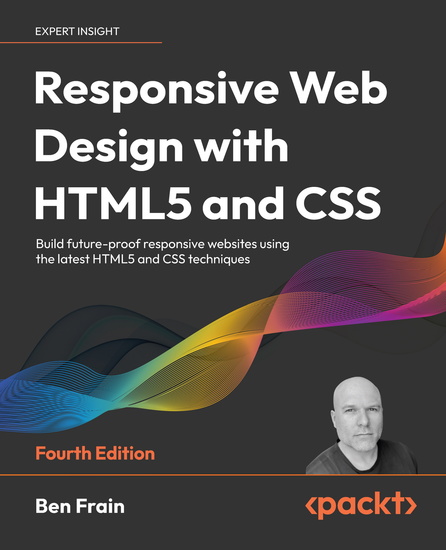
Responsive Web Design with HTML5 and CSS - Build future-proof responsive websites using the latest HTML5 and CSS techniques - cover
LER

Responsive Web Design with HTML5 and CSS - Build future-proof responsive websites using the latest HTML5 and CSS techniques

Ben Frain

Editora: Packt Publishing

  • 0
  • 0
  • 0

Sinopse

Responsive Web Design with HTML5 and CSS, Fourth Edition, is a fully revamped and extended version of one of the most comprehensive and bestselling books on the latest HTML5 and CSS techniques for responsive web design. It emphasizes pragmatic application, teaching you the approaches needed to build most real-life websites, with downloadable examples in every chapter.

Written in the author's friendly and easy-to-follow style, this edition covers all the newest developments and improvements in responsive web design, including approaches for better accessibility, variable fonts and font loading, and the latest color manipulation tools making their way to browsers. You can enjoy coverage of bleeding-edge features such as CSS layers, container queries, nesting, and subgrid.

The book concludes by exploring some exclusive tips and approaches for front-end development from the author.

By the end of the book, you will not only have a comprehensive understanding of responsive web design and what is possible with the latest HTML5 and CSS, but also the knowledge of how to best implement each technique. Read through as a complete guide or dip in as a reference for each topic-focused chapter.
Disponível desde: 19/09/2022.
Comprimento de impressão: 504 páginas.

Outros livros que poderiam interessá-lo

  • Against Technoableism - Rethinking Who Needs Improvement - cover

    Against Technoableism -...

    Ashley Shew

    • 0
    • 0
    • 0
    When Ashley Shew became a self-described "hard-of-hearing chemobrained amputee with Crohn's disease and tinnitus," there was no returning to "normal." Suddenly well-meaning people called her an "inspiration" while grocery shopping or viewed her as a needy recipient of technological wizardry. Most disabled people don't want what the abled assume they want—nor are they generally asked. 


    In vibrant prose, Shew shows how we can create better narratives and more accessible futures by drawing from the insights of the cross-disability community. To forge a more equitable world, Shew argues that we must eliminate "technoableism"—the harmful belief that technology is a "solution" for disability; that the disabled simply await being "fixed" by technological wizardry; that making society more accessible and equitable is somehow a lesser priority. 


    This badly needed introduction to disability expertise considers mobility devices, medical infrastructure, neurodivergence, and the relationship between disability and race. The future, Shew points out, is surely disabled—whether through changing climate, new diseases, or even through space travel. It's time we looked closely at how we all think about disability technologies and learn to envision disabilities not as liabilities, but as skill sets enabling all of us to navigate a challenging world.
    Ver livro
  • Ultramarine 2023 - Stories from the oceanic frontline - cover

    Ultramarine 2023 - Stories from...

    Drew Rooke, Ellen Phiddian,...

    • 0
    • 0
    • 0
    Welcome to Ultramarine, which takes a deep dive into the science seeking to understand and protect our precious aquatic world. As anyone who’s rolled out of a boat in diving or snorkelling gear into deep water knows, there’s nothing as thrilling as entering the ocean and peering inside it. 
    Whether in warm tropical waters or the shiver- inducing briny of temperate and lower marine environments, Earth’s oceans and seas brim with life, wonder and mystery. As 2023 ticks to a close, we wanted to showcase some of the stories that have appeared this year under the Ultramarine banner, and an e-yearbook seemed the perfect vehicle. We have published some 120 stories with a marine focus over the past 9 months; a small selection of those appears in this yearbook.
    Ver livro
  • The Fourth Coming - How God Mathematics Can Put the World to Rights - cover

    The Fourth Coming - How God...

    Francis Keith Robins

    • 0
    • 0
    • 0
    In a time of dire need, as climate change, conflict, and economic upheaval imperil our existence and our mental well-being deteriorates from not utilising our minds as God intended, Francis Keith Robins introduces a groundbreaking approach to saving humanity – reshaping our thought processes through mathematics.
     
    In his book, The Fourth Coming, Robins provides a detailed, step-by-step guide to unlocking our inherent mathematical potential. His vision is to create a society that is inclusive, equal, and peaceful – one that aligns with God’s desire for us. He advocates for a paradigm shift where shared mathematical models and systematic thinking supplant the ineffective classes of governments and institutions currently jeopardizing our planet. This revolutionary approach aims to alter the trajectory of human history in a manner that aligns with divine intentions. 
     
    Robins’ theories, described as a work of mathematical brilliance, offer a refreshingly simple yet profound solution to consciousness – which, as noted by ‘New Scientist’, remains one of the most elusive and significant mysteries in science and philosophy. Furthermore, he concludes that the introduction of religion by God was a response to 
    humanity’s failure to use their brains as He intended.
    Ver livro
  • The Year in Tech 2021 - The Insights You Need from Harvard Business Review - cover

    The Year in Tech 2021 - The...

    Harvard Business Review

    • 0
    • 0
    • 0
    From the latest applications of AI to blockchain-enabled business models to 5G networks, the most important technological innovations of the past year are reshaping the present and future of business. What should you and your company be doing now to take advantage of the new opportunities they are creating? The Year in Tech, 2021: The Insights You Need from Harvard Business Review will help you understand today's most essential thinking on these topics, what the latest tech innovations mean for your organization, and how you can use them to compete and win in the new landscape of business. 


    Business is changing. Will you adapt or be left behind? Get up to speed and deepen your understanding of the topics that are shaping your company's future with the Insights You Need from Harvard Business Review series. Featuring HBR's smartest thinking on fast-moving issues—blockchain, cybersecurity, AI, and more—each book provides the foundational introduction and practical case studies your organization needs to compete today and collects the best research, interviews, and analysis to get it ready for tomorrow. 


    You can't afford to ignore how these issues will transform the landscape of business and society. The Insights You Need series will help you grasp these critical ideas—and prepare you and your company for the future.
    Ver livro
  • The Shocking Truth about Technology's Impact on Society - cover

    The Shocking Truth about...

    Zoey Fraisers

    • 0
    • 0
    • 0
    Technology has transformed every aspect of modern life, reshaping the way people communicate, work, learn, and even think. The rapid evolution of digital tools, artificial intelligence, and automation has created new opportunities for innovation and progress. At the same time, it has introduced complex challenges, raising questions about privacy, security, and the ethical implications of technological advancement. While some argue that technology is a force for good, improving efficiency and convenience, others warn of its unintended consequences, such as addiction, misinformation, and social disconnection.  
      
    The digital revolution has promised to connect the world like never before, making information more accessible and enabling instant communication across continents. However, the same tools that foster global connectivity also contribute to a decline in real-world interactions. Social media platforms, for example, offer a space for people to share ideas, but they have also been linked to mental health issues, cyberbullying, and the spread of false information. Additionally, concerns about surveillance and data privacy have grown, as companies and governments collect vast amounts of personal information, often without users' full awareness or consent.  
      
    Another major area of technological impact is the workforce. Automation and artificial intelligence are changing the job market, replacing certain human roles while creating new ones. While these advancements increase efficiency and reduce costs, they also raise concerns about job displacement and economic inequality. Many industries, from manufacturing to customer service, have seen a shift toward AI-driven processes, leaving workers struggling to adapt. At the same time, some experts believe that technology can enhance human capabilities rather than replace them, leading to a future where humans and machines collaborate rather than compete. 
    Ver livro
  • Ancient Egyptian Astronomy - The Stars and Their Influence - cover

    Ancient Egyptian Astronomy - The...

    Omar Khalil

    • 0
    • 0
    • 0
    Ancient Egyptian astronomy was deeply intertwined with the culture’s religious beliefs, daily life, and architectural marvels. Long before modern telescopes and advanced instruments, the Egyptians observed the night sky with precision, using it to navigate their world, mark the passing of time, and guide their spiritual practices. Astronomy was not merely a scientific endeavor but a fundamental aspect of their understanding of the cosmos and its connection to the gods. 
    The Egyptians viewed the stars, planets, and other celestial bodies as manifestations of divine power. Central to their astronomical system was the Sun, which they associated with the god Ra. Ra's journey across the sky each day symbolized the cycle of life, death, and rebirth. The Sun’s movement was used to structure the day and marked important moments in the agricultural calendar, such as the flooding of the Nile. The Egyptians also closely tracked the movements of the Moon and stars, which helped them define the months and seasons. 
    The study of the stars held profound religious significance for the ancient Egyptians. They believed that the stars were the eyes of the gods, observing and guiding humanity. Certain constellations, such as Orion, were particularly important, representing Osiris, the god of the afterlife. The Egyptians’ knowledge of the stars was so advanced that it influenced the alignment of their monumental architecture. The Great Pyramid of Giza, for instance, is aligned with remarkable precision to the stars, showcasing their ability to map the heavens and incorporate that knowledge into their constructions.
    Ver livro
