Junte-se a nós em uma viagem ao mundo dos livros!
Adicionar este livro à prateleira
Grey
Deixe um novo comentário Default profile 50px
Grey
Assine para ler o livro completo ou leia as primeiras páginas de graça!
All characters reduced
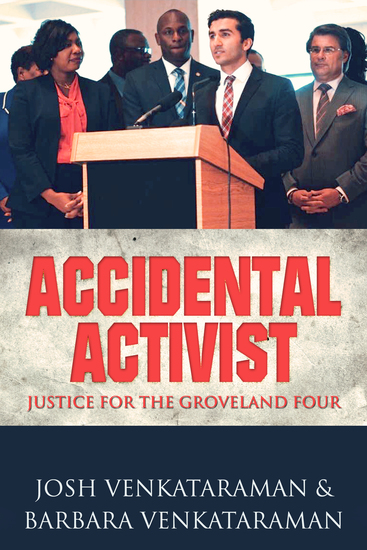
Accidental Activist - Justice for the Groveland Four - cover
LER

Accidental Activist - Justice for the Groveland Four

Barbara Venkataraman, Josh Venkataraman

Editora: Next Chapter

  • 0
  • 0
  • 0

Sinopse

Discover the incredible four-year quest for justice for The Groveland Four, and learn how to pursue your own causes, whatever they may be.
 
Accidental Activist is a primer for positive action, and a journey through Florida's past as well as its future. Some of the things you will learn by reading this book:
 
Everything takes more time than you think
 
Nothing ever goes according to plan
 
Help can come from unexpected places
 
Time is on your side
 
Everyone is connected
 
You can reach your tipping point for success and not even realize it
 
Your goals can change along the way
 
Flexibility is key
 
Let's get started, shall we?
Disponível desde: 07/02/2022.

Outros livros que poderiam interessá-lo

  • Anarchism: What It Really Stands For - cover

    Anarchism: What It Really Stands...

    Emma Goldman

    • 0
    • 0
    • 0
    Emma Goldman (1869 – 1940) was an anarchist political activist and writer. She played a pivotal role in the development of anarchist political philosophy in North America and Europe in the first half of the 20th century. 
    In this essay, (1910) Goldman sets forth her interpretation of the ideology of anarchism. Like most anarchists, she was highly idealistic; believing that human nature was inherently good, she was convinced that a state of absolute freedom would maximize human happiness and productivity. Here she enumerates the many constraints — including religion, property, law and government — that she sees as limiting the individual's liberty. She claims that anarchism stands for a social order based on the free grouping of individuals for the purpose of producing real social wealth, an order that will guarantee to every human being free access to the earth and full enjoyment of the necessities of life.
    Ver livro
  • Children's Rights - A Global Call for Justice and Protection of the Most Vulnerable - cover

    Children's Rights - A Global...

    Marcus Kline

    • 0
    • 0
    • 0
    Children represent the future of our societies, yet they remain among the most vulnerable and marginalized populations worldwide. The protection of children's rights has become one of the most critical global issues in the 21st century, demanding urgent attention and action. While significant progress has been made in raising awareness of children's rights, millions of children still suffer from abuse, neglect, exploitation, and deprivation. This complex and multifaceted issue requires an in-depth understanding of the challenges children face, as well as the actions needed to safeguard their well-being. 
      
    At the core of children's rights is the belief that every child, regardless of nationality, ethnicity, or economic background, deserves to grow up in an environment where they can thrive. The Universal Declaration of Human Rights, adopted in 1948, set the stage for international human rights legislation, but it was the United Nations Convention on the Rights of the Child (CRC), adopted in 1989, that provided a comprehensive framework for child protection. This treaty, ratified by nearly every nation, outlines civil, political, economic, social, and cultural rights for children, recognizing their right to life, education, protection from violence, and participation in the decisions that affect their lives. 
      
    However, despite these legal frameworks, violations of children's rights continue at an alarming rate. Poverty, armed conflict, lack of access to education, child labor, and human trafficking are among the many issues that continue to affect children around the world. These issues often intersect and exacerbate one another, creating a cycle of vulnerability that is difficult to break. It is essential that global efforts to protect children are strengthened, and that all sectors of society—from governments to NGOs to the private sector—work together to ensure the full realization of children's rights.
    Ver livro
  • Imperialism - cover

    Imperialism

    Vladimir Lenin

    • 0
    • 0
    • 0
    Written in 1916 against the backdrop of the First World War, Imperialism: The Highest Stage of Capitalism explains the flaws and power of capitalism, which inevitably lead to monopolies, imperialism and colonialism. Lenin develops Marx’s theories of political economy, which had been put forward 50 years earlier in Das Kapital. He goes on to argue that imperialism is the most advanced state of capitalism, characterised by the domination of monopolies on an international scale, with the export of capital leading to the big imperialist powers carving up the world.More than a century later, Imperialism remains highly relevant in understanding the historical background to the strategies of many of today’s major nations.
    Ver livro
  • Agrippa I: Loyal Roman or Planning a Rebellion? - A Forensic and Political Investigation of Agrippa I: Loyal Roman Rebel King or Something in Between? - cover

    Agrippa I: Loyal Roman or...

    Elizabeth Legge

    • 0
    • 0
    • 0
    Agrippa I: Loyal Roman or Planning a Rebellion? — A Forensic and Political Investigation of Agrippa I: Loyal Roman, Rebel King, or Something in Between 
    This presents the complete script of the author's thesis defence, originally delivered at the conclusion of Master's degree in Classical Archaeology at the University of Pisa. The thesis was awarded the distinction of cum laude and reflects an interdisciplinary exploration of historical, political, archaeological, and medical perspectives. 
    Based on the author's original 750-page dissertation, this defence examines the complex figure of Agrippa I—grandson of Herod the Great and client king of Judea under Roman rule. Was Agrippa a loyal Roman statesman, a potential rebel, or a cunning political survivor? 
    Using a critical approach to ancient literary sources, archaeological evidence, and modern historiography, the work explores:The material and political landscape of Agrippa's reignHis diplomatic positioning between Roman and Judean authoritiesThe recorded symptoms and political consequences of his sudden deathThe forensic plausibility of poisoning as a causeCompeting narratives of loyalty, betrayal, and legacy in the first century CE 
    Both accessible and intellectually grounded, the content is ideal for readers interested in Roman history, ancient politics, and the enduring questions of allegiance and power in antiquity.
    Ver livro
  • Reagan-Carter Debate - cover

    Reagan-Carter Debate

    Ronald Reagan, Jimmy Carter

    • 0
    • 0
    • 0
    The only debate between Ronald Reagan and Jimmy Carter was held in Cleveland, Ohio on October 28, 1980, just days before the election on November 4, 1980. The debate, broadcast live on radio and television, was one of the most-watched presidential debates. 
    Questions by four journalists focused on the following topics: U.S. armed forces, the nation’s economy, urban policies, international terrorism, strategic arms limitation, energy, social security, each candidate’ s assessment of his opponent, and closing statements. 
    Search online for “Ronald Reagan major speeches” to see both a text version and a video version of this debate. 
    Audio recording courtesy of the Ronald Reagan Presidential Library. 
    AspenLeafMedia.com
    Ver livro
  • Capitalist Punishment - How Wall Street Is Using Your Money to Create a Country You Didn't Vote For - cover

    Capitalist Punishment - How Wall...

    Vivek Ramaswamy

    • 0
    • 0
    • 0
    A Wall Street cartel has quietly seized control of the American economy, and they are forcing governments and businesses to bow down to their political agenda—using your money to do it. 
    Three Wall Street firms have quietly amassed more money than Jeff Bezos, Elon Musk, Andrew Carnegie, and John Rockefeller combined. But the money isn’t even theirs. These asset managers have accumulated all their power through “passive funds,” as most investors no longer believe anyone can reliably pick stocks. Yet the Big Three have decided that they can reliably pick the right social policies instead. 
    As entrepreneur Vivek Ramaswamy reveals, the results are all bad—and working their way into every corner of the economy. They force US companies to adopt “racial equity audits” and “emissions caps” while supporting human rights atrocities in China. They coerce Western companies to produce less oil while shifting production to dirtier places like Russia. They allow companies like FTX to take victory laps on good management while collapsing like a house of cards. They charge high fees to mom-and-pop investors for so-called sustainable funds that are effectively identical to lower-fee index funds. 
    Worst of all, they’re celebrated as heroes—at least so far. Capitalist Punishment lifts the veil on the largest fiduciary breaches, antitrust abuses, and First Amendment violations of the twenty-first century, misdeeds that are hiding in plain sight.  
    This isn’t just a threat to capitalism. It’s a threat to democratic self-governance itself. Capitalist Punishment is an easy-to-follow educational tour de force for every participant in financial markets—which, to the surprise of most Americans, includes nearly every single one of them.
    Ver livro