Unisciti a noi in un viaggio nel mondo dei libri!
Aggiungi questo libro allo scaffale
Grey
Scrivi un nuovo commento Default profile 50px
Grey
Iscriviti per leggere l'intero libro o leggi le prime pagine gratuitamente!
All characters reduced
Ferragus Chief of the Dévorants - cover

Ferragus Chief of the Dévorants

Balzac Honoré de

Traduttore Katharine Prescott Wormeley

Casa editrice: DigiCat

  • 0
  • 0
  • 0

Sinossi

In "Ferragus, Chief of the Dévorants," Honoré de Balzac intricately weaves a tale that delves into the darker recesses of human ambition and societal influence. As part of his monumental series "La Comédie Humaine," this novel combines psychological insight with a vivid portrayal of 19th-century Parisian life. Balzac's rich prose and meticulous attention to detail are evident as he explores themes of secret societies, hidden identities, and the moral ambiguities of power, all rendered in a style that balances grim realism with romanticism, making it a hallmark of French literary tradition. Balzac, often regarded as a precursor to modern realism, drew upon his own experiences in a rapidly changing society, which often mirrored the tensions present in his narratives. His profound understanding of social dynamics and personal relationships, cultivated through his extensive observations of Parisian life, informs this compelling tale. "Ferragus" reflects Balzac's interest in the intricate web of human relationships and underscores his fascination with the struggles between personal desires and societal expectations. I highly recommend "Ferragus, Chief of the Dévorants" to readers interested in the complexities of human nature and societal constructs. Balzac's adept storytelling, combined with his profound insights into the human condition, makes this novel not only an engaging read but also a critical commentary on the era, offering timeless lessons that resonate deeply in today's world.
Disponibile da: 16/09/2022.
Lunghezza di stampa: 112 pagine.

Altri libri che potrebbero interessarti

  • The Time Machine The Lost Manuscript - cover

    The Time Machine The Lost...

    H. G. Wells

    • 0
    • 0
    • 0
    Herbert George Wells was an English writer. Prolific in many genres, he wrote dozens of novels, short stories, and works of social commentary, history, satire, biography, and autobiography. His work also included two books on recreational war games. Wells is now best remembered for his science fiction novels and is often called the "father of science fiction", along with Jules Verne.During his own lifetime, however, he was most prominent as a forward-looking, even prophetic social critic who devoted his literary talents to the development of a progressive vision on a global scale. A futurist, he wrote a number of utopian works and foresaw the advent of aircraft, tanks, space travel, nuclear weapons, satellite television, and something resembling the World Wide Web. His science fiction imagined time travel, alien invasion, invisibility, and biological engineering. Wells's earliest specialized training was in biology, and his thinking on ethical matters took place in a specifically and fundamentally Darwinian context. He was also an outspoken Socialist from a young age, often (but not always, as at the beginning of the First World War) sympathizing with pacifist views. His later works became increasingly political and didactic, and he wrote little science fiction, while he sometimes indicated on official documents that his profession was that of a journalist. Novels such as Kipps and The History of Mr. Polly, which describe lower-middle-class life, led to the suggestion that he was a worthy successor to Charles Dickens, but Wells described a range of social strata and even attempted a diagnosis of English society as a whole.
    Mostra libro
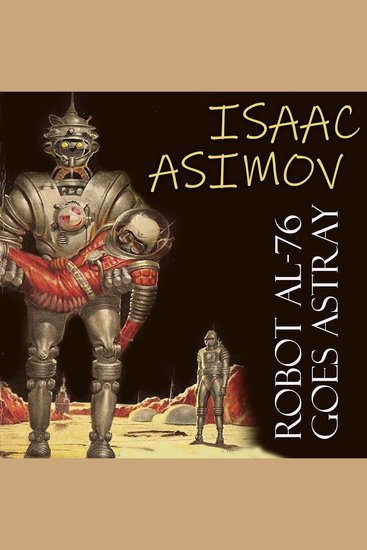
  • Robot AL-76 Goes Astray - cover

    Robot AL-76 Goes Astray

    Isaac Asimov

    • 0
    • 0
    • 0
    "Robot AL-76 Goes Astray" is a humorous science fiction short story by Isaac Asimov, originally published in the February 1942 issue of Amazing Stories and included in the collections The Rest of the Robots (1964) and The Complete Robot (1982). Asimov selected the story for inclusion in the 1949 anthology My Best Science Fiction Story.
    Mostra libro
  • August Heat - From their pens to your ears genius in every story - cover

    August Heat - From their pens to...

    W F Harvey

    • 0
    • 0
    • 0
    William Fryer Harvey AM was born on 14th April 1885 into a wealthy Quaker family in Leeds, West Yorkshire. 
    He was educated at the Quaker Bootham School in Yorkshire and Leighton Park School in Reading before university at Balliol College, Oxford.  
    His health was fragile and he poured his energies into writing short stories and in 1910 published his first collection ‘Midnight House’. 
    In the Great War he was with the Friends' Ambulance Unit and then served as a surgeon-lieutenant in the Royal Navy.  There he received the Albert Medal for Lifesaving but lung damage received at that time troubled him for the rest of his life. 
    He continued to write short stories, and even a memoir, but by 1925 ill health had forced his retirement to any outside work.  Three years later he published his second collection which contained his macabre classic ‘The Beast with Five fingers’, only one more collection would come from his pen in his lifetime. 
    For many years of his life he now lived in Switzerland with his wife but a yearning to be home saw them come back to England in 1935. 
    W F Harvey died in Letchworth on the 4th June 1937. He was 52.
    Mostra libro
  • The Turn of the Screw - cover

    The Turn of the Screw

    Henry James

    • 0
    • 0
    • 0
    "The Turn of the Screw" by Henry James is a gothic novella written in the late 19th century. The story centers around a young governess who is assigned to care for two orphaned children at a remote English estate called Bly, where strange and unsettling events occur, raising questions about both the environment and the children themselves. 
    At the beginning of the novella, a group of friends gathers around a fire on Christmas Eve. During their conversation, they discuss ghostly experiences. One of the members, Douglas, hints at a chilling tale involving two children and a dreadful apparition that appeared to them. This sets the stage for the governess's recounting of her experiences at Bly. 
    Upon her arrival at the estate, she is captivated by the beauty of the children, Miles and Flora. However, beneath this charm lies an unsettling tension, particularly related to the previous governess, who died under mysterious circumstances. The opening sequence effectively builds an atmosphere of suspense, promising a haunting exploration of innocence, corrupted motives, and the supernatural.
    Mostra libro
  • Afterward - cover

    Afterward

    Edith Wharton

    • 0
    • 0
    • 0
    "Afterward" is a short story by American writer Edith Wharton. It was first published in the 1910 edition of The Century Magazine and later reprinted in her books The Collected Short Stories of Edith Wharton and Tales of Men and Ghosts. This intriguing tale weaves an ironic ghost story around themes of greed and retribution.
    Mostra libro
  • Persuasion - Jane Austen’s Masterpiece of Regret Resolve and Romance - cover

    Persuasion - Jane Austen’s...

    Jane Austen

    • 0
    • 0
    • 0
    "Persuasion" by Jane Austen is a novel set in the early 19th century. The story centers around Anne Elliot, the quiet yet perceptive daughter of Sir Walter Elliot, a vain baronet struggling with financial difficulties and the threat to his social status. The novel delves into themes of love, regret, and societal pressures, particularly through Anne's past romance with Captain Frederick Wentworth, a man without fortune or title whom her family disapproved of. 
    At the beginning of the book, we meet Sir Walter Elliot, who is completely absorbed in his vanity and status as a baronet, while ignoring the significant financial problems threatening their estate, Kellynch Hall. The narrative unfolds the dynamics within the Elliot family, especially highlighting Anne's delicate position, which is overshadowed by her more socially ambitious sisters and overlooked by her father.  
    The opening establishes Anne's sense of duty as well as her longing for a life that truly recognizes her character and feelings, setting the stage for the complex emotional struggles she faces as the story progresses and explores her potential reconnection with Wentworth, who is now a successful naval captain. This sets the foundation for Anne's journey of self-discovery amid the entanglements of family, friendship, and social standings.
    Mostra libro