Unisciti a noi in un viaggio nel mondo dei libri!
Aggiungi questo libro allo scaffale
Grey
Scrivi un nuovo commento Default profile 50px
Grey
Iscriviti per leggere l'intero libro o leggi le prime pagine gratuitamente!
All characters reduced
A Greater Britain - Rethinking the UK's Global Strategy - cover

A Greater Britain - Rethinking the UK's Global Strategy

Azeem Ibrahim

Casa editrice: Biteback Publishing

  • 0
  • 0
  • 0

Sinossi

Britain is no longer the great power it once was. Caught between an unmoored America and a fractured Europe, it confronts rising authoritarian challenges from China and Russia, while its domestic debates drift into abstract moralising. Lacking a coherent vision for the future, the country risks sliding further into managed decline, its global relevance steadily eroding.
Yet such a trajectory is not inevitable. In this clear-eyed assessment of Britain's economic, ideological and strategic vulnerabilities, Azeem Ibrahim identifies the essential building blocks of renewal. He outlines a programme of reforms that will allow a genuinely independent Britain to capitalise on its core strengths. After all, as a lean and specialised nuclear power with one of the world's most sophisticated intelligence networks, as well as world-class universities and a cultural reach second only to the US, the UK can still shape global affairs.
A Greater Britain argues that a clear strategic anchor and bold leadership are needed if the UK is to convert its advantages into real influence. By formulating a pioneering Knowledge Power Doctrine, the book offers a global strategy for a once powerful nation, providing nothing short of a roadmap back to British greatness.
Disponibile da: 20/01/2026.
Lunghezza di stampa: 384 pagine.


Altri libri che potrebbero interessarti

  • The Southernization of America - A Story of Democracy in the Balance - cover

    The Southernization of America -...

    Frye Gaillard, Cynthia Tucker

    • 0
    • 0
    • 0
    Pulitzer Prize-winner Cynthia Tucker and award-winning author Frye Gaillard reflect on the role of the South in America's long descent into Trumpism. In 1974, Southern author John Egerton published his seminal work, The Americanization of Dixie, reflecting on the double-edged reality of the South becoming more like the rest of the country and vice versa. Tucker and Gaillard dive deeper into that reality from the time that Egerton published his book until the present. They explore the "birtherism" of Donald Trump and the roots of the racial backlash against President Obama; the specter of family separation on our southern border, with its echoes of similar separations in the era of slavery; as well as the rise of the Christian right, demonstrations in Charlottesville, the death of George Floyd, and the attack on the capital—all of which, they argue, have roots that trace their way to the South. But Tucker and Gaillard see another side too, a legacy rooted in the civil rights years that has given us political leaders like John Lewis, Jimmy Carter, Raphael Warnock, and Stacy Abrams. The authors raise the ironic possibility that the South might lead the way on the path to redemption. They bring a multi-racial perspective and years of political reporting to bear on a critical moment in American history, a time of racial reckoning and of democracy under siege.
    Mostra libro
  • How America Worksand Why It Doesn't - A Brief Guide to the US Political System - cover

    How America Worksand Why It...

    William Cooper

    • 0
    • 0
    • 0
    Twenty-first-century America isn’t working the way it’s supposed to. 
    This book explains why. 
    Americans in the twenty-first century are becoming increasingly untethered from both reality and the essential principles and traditions that have shaped the nation’s historic success. A big part of why America isn’t working is because far too many Americans neither know nor care how it’s supposed to work. 
    “William Cooper presents an insightful, sensitive, and accessible account of the trials that face American democracy in the twenty-first century. This fair- and broad-minded volume makes compelling reading for those who are looking to build a better democracy.” Alexander Yen, Department of Politics and International Relations, University of Oxford 
    “Partisanship fuels personal convictions more than ever in our society, and convictions fuel mysided thinking and other cognitive biases. At no time have we needed this discussion of bias and partisan thinking more than now.” Keith E. Stanovich, author of The Bias That Divides Us 
    “William Cooper logically and authoritatively takes you step by step through all the reasons a President Trump couldn’t imprison his enemies, pardon his friends, overrule judges, weaponize the Department of Justice, prosecute Joe Biden, or order the military to enforce his unconstitutional actions” Cleveland Plain Dealer 
    “William Cooper is an insightful and thought-provoking writer about US politics. He deserves to be widely read.” Thomas Plate, former Editorial Page Editor, Los Angeles Times 
    "In How America Works . . . and Why It Doesn’t, William Cooper gives a thoughtful, readable guide to what ails American democracy. Required reading for any student of political science.” Uri Kaufman, author of Eighteen Days in October 
    "A must-read. His well-written and brief book covers a lot of important ground in a learned but accessible manner. Probably most noteworthy, though, is his astute and fair judgment―the book is not a polemic for the left or the right, but rather a fair appraisal of the strengths and weaknesses of both. I highly recommend reading it―it is an enjoyable tour of key aspects of history (as well as current events), ethics, political philosophy, constitutional law, environmental science, and cognitive psychology―all told in a lucid, efficient way." William O'Donohue, PhD, Professor, University of Nevada, Reno
    Mostra libro
  • EU Law Unlocked: Mastering Security Defense and Citizens' Rights in the European Union - cover

    EU Law Unlocked: Mastering...

    Linda Maureen Loewer

    • 0
    • 0
    • 0
    Unlock the complexities of European Union law in EU Law Unlocked: Mastering Security, Defense, and Citizens' Rights in the European Union. This comprehensive audiobook provides an accessible guide to understanding the EU’s legal framework, focusing on EU security, defense law, and fundamental citizens' rights. 
    Whether you're a student, legal professional, or EU enthusiast, this audiobook breaks down crucial topics, including:EU Security & Defense Law: Learn how the EU addresses global challenges such as defense cooperation, cybersecurity, and counterterrorism.Citizens' Rights: Discover the rights and protections available to EU citizens, from freedom of movement to non-discrimination and digital rights.EU Legal Framework: Understand the treaties, regulations, and landmark cases shaping the Union's policies. 
    With easy-to-understand explanations and real-life examples, EU Law Unlocked offers deep insights into how EU law impacts the lives of over 500 million citizens, international relations, and global trade. 
    Ideal for EU law students, policy makers, legal professionals, and anyone interested in how the European Union navigates security, human rights, and economic integration. 
    Gain the knowledge you need to master the complexities of EU law and understand the future of European governance, defense, and the rights of citizens in an interconnected world.
    Mostra libro
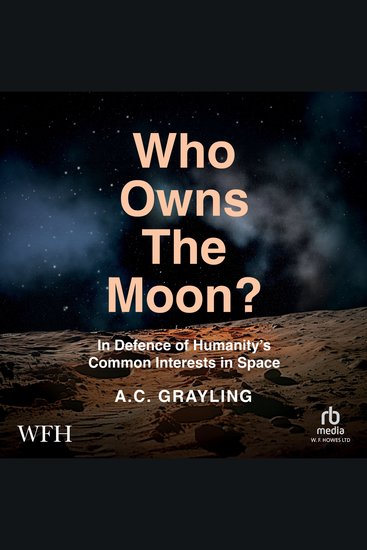
  • Who Owns The Moon? - In Defence of Humanity's Common Interests in Space - cover

    Who Owns The Moon? - In Defence...

    A. C. Grayling

    • 0
    • 0
    • 0
    Silicon for microchips; manganese for batteries; titanium for missiles. 
     
    The moon contains a wealth of natural resources. So, as the Earth’s supplies have begun to dwindle, it is no surprise that the world’s superpowers and wealthiest corporations have turned their eyes to the stars. As this new Space Race begins, A.C. Grayling asks: who, if anyone, owns the moon? Or Mars? Or other bodies in near space? And what do those superpowers and corporations owe to Planet Earth and its inhabitants as a whole? 
     
    From feudal common land, through the rules of the sea, to the vast, nationless expanse of Antarctica, Grayling explores the history of the places which no one, and therefore everyone, owns. Examining the many ways this so-called terra nullius has fallen victim to ‘the tragedy of the commons’ – the tendency for communal resources to be exploited by a few individuals for personal gain at the expense of everyone else – Who Owns the Moon? puts forward a compelling argument for a bold new global consensus, one which recognises and defends the rights of everyone who lives on this planet.
    Mostra libro
  • The Shocking Truth about International Aid - cover

    The Shocking Truth about...

    Zoey Fraisers

    • 0
    • 0
    • 0
    International aid has long been heralded as a solution to the world’s most pressing problems, from poverty and hunger to disease and disaster recovery. It is a system built on the idea that wealthier nations and organizations have the responsibility to assist those in need, providing the necessary resources to help vulnerable populations rise above their circumstances. With trillions of dollars allocated to aid efforts across the globe, it would seem that international aid is fulfilling its mission to promote global well-being. However, a closer examination reveals a far more complex, and often disheartening, reality. 
      
    While aid is essential in times of crisis, its long-term effects are often overlooked. Far too frequently, the aid process is tainted by inefficiencies, corruption, and political agendas, which hinder its effectiveness and frequently exacerbate the problems it seeks to solve. Donor countries may provide aid with specific political or economic interests in mind, making the assistance less about altruism and more about advancing a nation's own objectives. Likewise, organizations tasked with distributing aid can become bogged down by bureaucratic red tape, mismanagement, and a lack of accountability, leading to resources being squandered or diverted from the people who need them most. 
      
    The impact of international aid is not always as straightforward as it appears. While some projects undoubtedly achieve their goals, many others fail to deliver lasting results, leaving behind a trail of dependency rather than empowerment. Aid can often unintentionally disrupt local economies and social structures, creating reliance on external support rather than fostering self-sufficiency. In some cases, aid even perpetuates cycles of poverty by undermining local industries or creating a mindset of dependency that stifles innovation and growth.
    Mostra libro
  • From Odessa With Love - Political And Literary Essays from Post-Soviet Ukraine - cover

    From Odessa With Love -...

    Vladislav Davidzon

    • 0
    • 0
    • 0
    The Tashkent-born Russian-American literary critic, editor, essayist, and journalist Vladislav Davidzon has been covering post-Soviet Ukraine for the past ten years, a tumultuous time for that country and the surrounding world. The 2014 "Revolution of Dignity" heralded a tremendous transformation of Ukrainian politics and society that has continued to ripple and reverberate throughout the world. 


    In late 2015, a year and a half after the 2014 Revolution swept away the presidency of the Moscow-leaning kleptocratic President Viktor Yanukovich, Davidzon and his wife founded a literary journal, The Odessa Review, focusing on newly emergent trends in film, literature, painting, design, and fashion. The journal became an East European cultural institution, publishing outstanding writers in the region and beyond. From his vantage point as a journalist and editor, Davidzon came to observe events and know many of the leading figures in Ukrainian politics and culture, and to write about them for a Western audience. Davidzon later found himself in the center of world events as he became a United States government witness in the Ukraine scandal that shook the presidency of Donald Trump. This eagerly anticipated debut tells the real story of what happened in Ukraine from the keen and resilient perspective of an observer at its center.
    Mostra libro