Unisciti a noi in un viaggio nel mondo dei libri!
Aggiungi questo libro allo scaffale
Grey
Scrivi un nuovo commento Default profile 50px
Grey
Iscriviti per leggere l'intero libro o leggi le prime pagine gratuitamente!
All characters reduced
Family Strength in Nations - cover

Family Strength in Nations

Ava Wilson

Traduttore A AI

Casa editrice: Publifye

  • 0
  • 0
  • 0

Sinossi

What if a nation's true strength lies not just in its economy or military, but in the strength of its families? "Family Strength in Nations" explores this idea, examining the critical link between family dynamics and national well-being. The book posits that supportive, stable family units are foundational for societal health, impacting everything from economic stability to civic engagement. Did you know that nations prioritizing family strength may cultivate healthier and more productive societies? The book challenges conventional metrics of national success, emphasizing the often-overlooked role of family structures.

 
The book begins by defining "family strength" through sociology, psychology, and economics. It then examines how family structure impacts key metrics like education, crime, and public health. Specific chapters delve into parenting styles, communication, and conflict resolution. The book uses statistical analyses, cross-cultural comparisons, and social science research to support its arguments.

 
Ultimately, it offers policy recommendations and strategies nations can adopt to foster stronger families and improve national prosperity.
Disponibile da: 22/02/2025.
Lunghezza di stampa: 83 pagine.

Altri libri che potrebbero interessarti

  • Home Away Elsewhere - cover

    Home Away Elsewhere

    Vaughan Rapatahana

    • 0
    • 0
    • 0
    A poetry collection in three parts. Home is events, situations, descriptions, and attitudes about Hong Kong, which is now Vaughan's home. Away contains poems about events, situations, descriptions, and attitudes about Aotearoa (New Zealand), in particular from a Maori (marginalised) perspective and also about all the other places where Vaughan has lived – The Republic of Nauru, Brunei Darussalam, The People's Republic of China, Australia, The United Arab Emirates (UAE), The Philippines. Elsewhere is emotions (the entire gamut), relationships (marriages, family, friends), deaths (parents, children), reflections – some wry, etcetera – not specifically tied to physical locations. Vaughan does not write to any set forms/formats but attempts to utilise type-face/shape/what a poem looks like on a page to reflect what he attempts to say. He writes to stay sane. "These poems express what I am, and what I also think people I see are, within. They are not mere academic or literary exercises. They are lived experiences, I guess." 
     Poems with attitude. … passionate, uncompromising and sardonic. …there is darkness here … also wit in abundance and a playfulness in language and thought … at times laugh-out-loud funny…. a compelling voice and Vaughan uses it skillfully to tell us his stories, make his often pungent points, and take us places few of us have seen. — James Norcliffe, Robert Burns Fellow (2000), Aotearoa-New Zealand. 
     These poems are pieces of an intricately interlinked multi-cultural and multi-lingual world, in which the poet must learn to live. In fact the poet relishes this confusing richness. His verses celebrate the graphic possibility of words, their visual appearance and sounds. So one must come to them with big eyes, big ears and a limitless imagination. — Muhammad Haji Salleh, National Laureate, Malaysia.
    Mostra libro
  • Can Thought Stop? - Amsterdam 1967 - Public Talk 4 - cover

    Can Thought Stop? - Amsterdam...

    Jiddu Krishnamurti

    • 0
    • 0
    • 0
    "Can thought stop? - 28 May 1967  
    • When there is a process of recognition it is the projection of the past. The mind 
    is always functioning within the field of time, which is of memory. Can the 
    mind go beyond that? 
    • What is pleasure and what is desire? 
    • How is it possible, without control, subjugation or denying, for thought not to 
    allow itself to interfere? 
    • When all authority of every kind is put aside, denied, then you can find out for 
    yourself. 
    • When you are completely attentive, you see. It is only love that sees - not 
    thought, the mind or the intellect. One has to learn how to look, how to hear. 
    • Q: Could you distinguish between what you mean by the word ‘recognizing’ 
    and ‘being aware’? 
    • Q: How is one to break off a concept that one has carefully built?"
    Mostra libro
  • The Occupied City - How Israel Shapes Palestinian Life - cover

    The Occupied City - How Israel...

    Davis Truman

    • 0
    • 0
    • 0
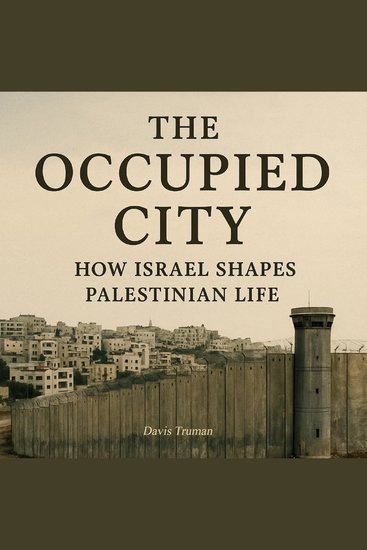
    East Jerusalem is more than a city; it is a battleground of maps, walls, and blueprints. In The Occupied City: How Israel Shapes Palestinian Life, readers are taken inside one of the world’s most contested urban landscapes, where every building permit, zoning law, and planning decision becomes a tool of power. 
    Drawing on years of research and first-hand interviews with Palestinian residents, urban planners, and human rights experts, this book exposes how Israeli urban planning policies restrict Palestinian access to housing, fracture communities, and rewrite the very geography of Jerusalem. It reveals how control is exercised not only through military presence but through bureaucratic procedures, economic pressures, and cultural erasure—quiet mechanisms that determine who gets to build, who is forced to leave, and whose story is allowed to endure. 
    At once rigorous and deeply human, The Occupied City gives voice to those living under the daily weight of planning systems designed to dispossess them. It uncovers the hidden architecture of occupation while also spotlighting acts of resilience, resistance, and visions for a more just future. 
    Essential reading for anyone seeking to understand the Israeli–Palestinian conflict beyond headlines, this book demonstrates how urban planning—often regarded as technical or neutral—is, in fact, one of the most powerful weapons in the struggle over land, rights, and survival.
    Mostra libro
  • Mr Vic’s X-Rated Television: “Miss Fisher Mysteries!” “Lesbian Loving For Miss Fisher and Dot!” Book two - cover

    Mr Vic’s X-Rated Television:...

    VIC VITALE

    • 0
    • 0
    • 0
    “A Lesbian Cums-A-Calling!” 
    “Under a Doctor’s Care and Body!”“ 
    “Alone Time For Phryne and Dot!” 
    "Hi! I'm Kitty Forman! I know I shouldn't be here, but I just have to see you." 
    Mac pauses before letting the woman who raped her inside her home. She is having mixed feelings, but truth be told, she's very glad to see this Kitty Forman. "I don't know? You forced yourself on me. Why should I want to see you?" 
     
    Mostra libro
  • Decentralization and Multilevel Elections in Ukraine - Reform Dynamics and Party Politics in 2010–2021 - cover

    Decentralization and Multilevel...

    Valentyna Romanova

    • 0
    • 0
    • 0
    Methodologically, the book illustrates the added value of investigating elections from a multilevel perspective.
    Mostra libro
  • The Policing Machine - Enforcement Endorsements and the Illusion of Public Input - cover

    The Policing Machine -...

    Tony Cheng

    • 0
    • 0
    • 0
    A revelatory look at how the NYPD has resisted change through strategic and selective community engagement. 
      
    The past few years have seen Americans express passionate demands for police transformation. But even as discussion of no-knock warrants, chokeholds, and body cameras has exploded, any changes to police procedures have only led to the same outcomes. Despite calls for increased accountability, police departments have successfully stonewalled change.  
      
    In The Policing Machine, Tony Cheng reveals the stages of that resistance, offering a close look at the deep engagement strategies that NYPD precincts have developed with only subsets of the community in order to counter any truly meaningful, democratic oversight. Cheng spent nearly two years in an unprecedented effort to understand the who and how of police-community relationship building in New York City, documenting the many ways the police strategically distributed power and privilege within the community to increase their own public legitimacy without sacrificing their organizational independence. By setting up community councils that are conveniently run by police allies, handing out favors to local churches that will promote the police to their parishioners, and offering additional support to institutions friendly to the police, the NYPD, like police departments all over the country, cultivates political capital through a strategic politics that involves distributing public resources, offering regulatory leniency, and deploying coercive force. The fundamental challenge with police-community relationships, Cheng shows, is not to build them. It is that they already exist and are motivated by a machinery designed to stymie reform.
    Mostra libro