Begleiten Sie uns auf eine literarische Weltreise!
Buch zum Bücherregal hinzufügen
Grey
Einen neuen Kommentar schreiben Default profile 50px
Grey
Jetzt das ganze Buch im Abo oder die ersten Seiten gratis lesen!
All characters reduced
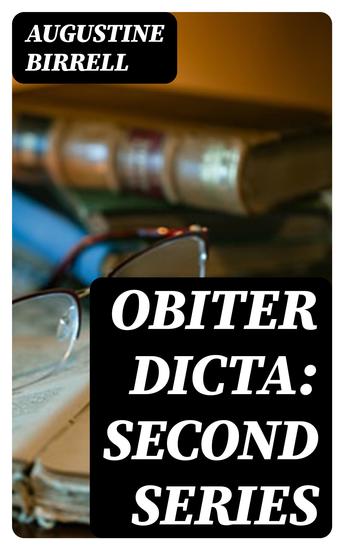
Obiter Dicta: Second Series - cover

Obiter Dicta: Second Series

Augustine Birrell

Verlag: DigiCat

  • 0
  • 0
  • 0

Beschreibung

In "Obiter Dicta: Second Series," Augustine Birrell presents a captivating collection of essays that seamlessly blend personal reflection with astute social commentary. Written in a lyrical, yet accessible style, the book reflects Birrell's characteristic wit and erudition, engaging readers with his thoughtful observations on a range of subjects, from literature and politics to everyday life. This series serves as a continuation of his exploration of the human condition, embedding itself in the literary context of early 20th-century England, where issues of identity and modernity loomed large in public discourse. Augustine Birrell was not only a prominent writer but also a notable figure in British politics, serving as a Liberal Member of Parliament and as Attorney General. His diverse experiences, including his tenure in academia and his legal background, imbue "Obiter Dicta" with a rich perspective on societal intricacies. The influence of contemporaries like Samuel Butler and John Morley is evident in his reflective style, further enriching the intellectual tapestry of his work. Readers seeking a blend of humor, wisdom, and incisive critiques will find "Obiter Dicta: Second Series" a rewarding endeavor. Birrell's essays invite contemplation and spark discussion, making this collection an essential read for those interested in the interplay of literature and life.
Verfügbar seit: 16.09.2022.
Drucklänge: 136 Seiten.

Weitere Bücher, die Sie mögen werden

  • The Seven Storey Mountain - cover

    The Seven Storey Mountain

    Thomas Merton

    • 0
    • 0
    • 0
    From one of the 20th century's best-loved Christian writers comes this extraordinary spiritual testament. Thomas Merton was a man who experienced life to its fullest in the world before entering a Trappist monastery. In this memoir, he recounts his spiritual quest, one that led to his conversion to Catholicism.
    Zum Buch
  • A Middle-Sized Artist - From their pens to your ears genius in every story - cover

    A Middle-Sized Artist - From...

    Charlotte Perkins Gilman

    • 0
    • 0
    • 0
    Charlotte Perkins Gilman was born on 3rd July 1860 in Hartford, Connecticut, to an unaffectionate mother and a father who abandoned her and her older brother to a life of poverty. 
    Inevitably her schooling was limited and by 15 she had attended seven different schools but received only four years education.  However Charlotte was resourceful and did spend time with her father’s aunts – the suffragist Isabella Beecher Hooker and the ‘Uncle Tom Cabin’s’ author, Harriet Beecher Stowe as well as many hours at the public library studying ancient civilisations. 
    In 1878, she enrolled in classes at the Rhode Island School of Design where she met Martha Luther and they developed a close relationship until Luther married in 1881. Charlotte was devastated and detested romance and love until she met and married the artist Charles Walter Stetson.  
    Their only child, Katharine Beecher Stetson, was born in 1885 but left Charlotte with post-natal depression, then often dismissed as a case of hysteria or nerves.  Unsuited to domestic life she ruptured her life and moved to California with Katherine.  She divorced in 1894 and then sent Katharine east to live with her father and his second wife confirming that his paternal rights be acknowledged and that Katherine establish a relationship with her father. 
    After her mother died in 1893, Charlotte moved back east and became involved with her first cousin, Wall Street attorney, Houghton Gilman who she married in 1900. After his death she moved back to California, where Katherine now lived.   
    Her most popular story is ‘The Yellow Wallpaper’ which touched on her own post-partum depression and underlined the need for women to be responsible for their mental and physical well-being, as the narrator is ordered by her husband/doctor to take compete rest in her room where she is isolated and becomes obsessed with the revolting yellow wallpaper.   
    She wrote other notable short stories the best of which we also include.   
    Charlotte lectured widely for social reform, wrote important non-fiction works that questioned our patriarchal system and left a legacy as a leading and positive spokesperson for feminism.  
    She was diagnosed with incurable breast cancer in 1932 and, as she wrote in her suicide note and autobiography, she ‘chose chloroform over cancer’    
    Charlotte Perkins Gilman took her own life on 17th August 1935, aged 75, in Pasadena, California.
    Zum Buch
  • A Memorable Life - cover

    A Memorable Life

    Lesley-Anne Mould

    • 0
    • 0
    • 0
    The inspiration for this novel came to Lesley-Anne when she realised at her Father's funeral that although she'd known him her whole life, she'd never taken the time to ask him more about his life before she was born. She resolved not to let the same thing happen to her children, and that she would therefore tell the story of how she was born in Brazil and grew up in Nigeria, Switzerland, boarding school, Kenya, nursing, up to her marriage in 1979 and the birth of her two children. The thread that weaves through and holds together the story is Lesley's volatile relationship with her mother, which stands in contrast to her close relationship with her grandmother with which many people can identify. This memoir serves as an example for others to follow to leave as part of their legacy and share their lives with their children and descendents before they've passed away and taken their memories with them.
    Zum Buch
  • The Wife Who Didn't Eat - cover

    The Wife Who Didn't Eat

    Thersa Matsuura

    • 0
    • 0
    • 0
    A farmer in old Japan prays to the gods for a wife, someone who is kind, beautiful, and hardworking. What would be even better is if she didn’t eat at all, saving him both money and food. Imagine his surprise when just such a woman shows up at his house one night. But all is not perfect. The gods have quite the sense of humor, and the farmer soon learns what kind of monster he is living with. But is it too late?“The Wife Who Didn’t Eat” is author Thersa Matsuura’s retelling of a classic horror-tinged Japanese folktale, “Kwazu Nyobo”. Here she reads her version of the story followed by a short commentary with some of her research notes and thoughts on the tale. Both the short story and commentary come in at just under one hour. Thersa Matsuura is a published author of two short story collections, one nominated for a Bram Stoker Award. You can also find her on her podcast, Uncanny Japan, where she talks more about the more obscure parts of Japanese culture. Reviews: “Very soothing, educational and entertaining. Love this deep dive into Japanese culture. Not to mention just the right amount of Spooky.”            By Spooks76“High production value and haunting storytelling helps shed light onto Japanese folklore. Teresa is clear, concise and highlights stories that might otherwise never be heard by Western ears. Highly recommend!”         By Jameswhojamesyu
    Zum Buch
  • John Murray - Evangelical Hero - cover

    John Murray - Evangelical Hero

    Joel R. Beeke, Douglas Bond

    • 0
    • 0
    • 0
    What do George Whitefield, Elisabeth Elliot, and J. Gresham Machen have in common? They were all Evangelical Heroes. In the Evangelical Heroes series, Joel Beeke and Douglas Bond present thirty biographical sketches of faithful evangelical leaders from the eighteenth, nineteenth, and twentieth centuries. From George Whitfield to Charles Spurgeon to R.C. Sproul, these men and women held firm to the authority of Scripture and the reality of Christ's death and resurrection in the face of rising liberalism in the Church. These inspiring volumes introduce us to faithful Christians from the past and encourage us to stand firm today!
    Zum Buch
  • Leaning on Gates - cover

    Leaning on Gates

    Seamus O'Rourke

    • 0
    • 0
    • 0
    In the sequel to award-winning playwright Seamus O'Rourke's popular first memoir, Standing in Gaps, this innocent Leitrim lad finally flees the nest, briefly sampling life in New York, Dublin and London, before inevitably returning to his beloved, duller-than-dishwater home, to a life which now includes alcohol, Dr. Hook and some low-budget romance.
    But man does not live on romance alone and Seamus needs to get to the bottom of his general uselessness, spurred on as always by his ever-the-realist father, who prophesied his mediocrity from an early age. Seamus continues to underachieve whilst struggling to interpret his Auld Lad's advice and watered down compliments – 'You weren't as bad as I often saw ya', 'They must be badly stuck, if they asked you' and the classic 'What kind of an eejit are ya?' – in a memoir that captures the innocence and the absurdity of rural life in 1980s and 1990s Ireland.
    Zum Buch