Unisciti a noi in un viaggio nel mondo dei libri!
Aggiungi questo libro allo scaffale
Grey
Scrivi un nuovo commento Default profile 50px
Grey
Iscriviti per leggere l'intero libro o leggi le prime pagine gratuitamente!
All characters reduced
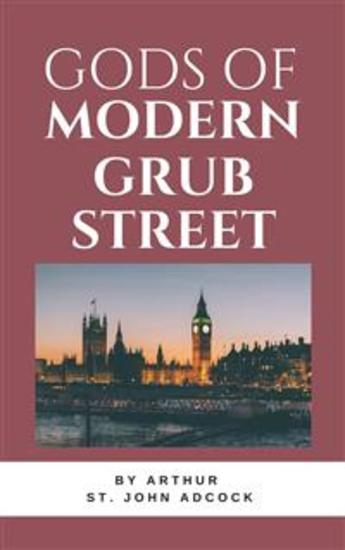
Gods of Modern Grub Street - Impressions of Contemporary Authors - cover

Gods of Modern Grub Street - Impressions of Contemporary Authors

Arthur St. John Adcock

Casa editrice: Full Well Ventures

  • 0
  • 0
  • 0

Sinossi

The book, “Gods of Modern Grub Street,” published in 1923, is a collection of 32 biographical articles featuring a variety of literary figures of early 20th century England, including photographs of each, compiled by Arthur St. John Adcock (1864-1930), an English novelist and poet. He was a Fleet Street journalist for half a century and also built a literary career. As an editor of The Bookman magazine since 1908, he became an influential critic in literary circles. Historically, in the 19th century, Grub Street was a street in an impoverished area of London, famous for its concentration of struggling “hack writers,” aspiring poets, and low-end publishers and booksellers. The street name no longer exists.
Disponibile da: 07/06/2022.
Altri libri che potrebbero interessarti

  • Building a Winning Career - A complete guide to securing and thriving in your ideal senior role - cover

    Building a Winning Career - A...

    William Cowan

    • 0
    • 0
    • 0
    Observers tell us that we will have many jobs and possibly several careers during our lifetimes.  But there is very little practical help available for professionals on how to move between jobs and careers. 
    This audiobook takes the listener through a comprehensive process that will help them to prepare for job search, identify job opportunities, and then maximize their chance of success. 
    The author has worked with over 1,000 senior executives as a career coach.  So, his advice is practical and it is supported by real stories of successes and setbacks. 
    Most people are not aware of the life skills required to manage successful transitions between jobs.  They tend work on their cv and then to make up their own approach to moving forward.   
    They often aim too low.  They do not understand how to prepare properly.  It is not uncommon for them to fail to reach their potential.   When their approach does not work out they blame themselves.    
    It does not need to be this way.  This audiobook increases the possibility of success in your transition process and then in your subsequent career. 
    The original book was written for mid-career professionals.   But the process it describes is relevant for individuals at any stage on their career, from graduation to retirement. 
    This audiobook has four parts: 
    1.    Understanding the basics 
    2.    Building on your strengths 
    3.    Growing the power of your network 
    4.    Finding the right job.
    Mostra libro
  • Rifles - Six Years with Wellington's Legendary Sharpshooters - cover

    Rifles - Six Years with...

    Mark Urban

    • 0
    • 0
    • 0
    The 95th Rifles - Wellington's sharpshooters - first into battle and last out.Acclaimed military writer Mark Urban explores the extraordinary story of these military pioneers; the toughest and deadliest infantrymen in Wellington's Army.Immortalised in Bernard Cornwell's Sharpe novels, the 95th Rifles were skirmishers tasked with acting as Wellington's advanced guard. It was new technology for the warfare of the time: they travelled light, moved rapidly, armed with the accurate rifles that would allow them to take shots from distance. The 95th Rifles were the prototype of the modern infantryman.Mark Urban's fascinating history of the 95th is a must-listen for anyone interested in military history.From the author of Task Force Black, Big Boys' Rules and The Tank War.'If you like Sharpe, then this book is a must, your Christmas present solved.' Bernard Cornwell, Daily Mail
    Mostra libro
  • The Good Mother Myth - Unlearning Our Bad Ideas About How to Be a Good Mom - cover

    The Good Mother Myth -...

    Nancy Reddy

    • 0
    • 0
    • 0
    Timely and thought-provoking, Nancy Reddy unpacks and debunks the bad ideas that have for too long defined what it means to be a "good" mom.When Nancy Reddy had her first child, she found herself suddenly confronted with the ideal of a perfect mother—a woman who was constantly available, endlessly patient, and immediately invested in her child to the exclusion of all else. Reddy had been raised by a single working mother, considered herself a feminist, and was well on her way to a PhD. Why did doing motherhood "right" feel so wrong?For answers, Reddy turned to the mid-20th century social scientists and psychologists whose work still forms the basis of so much of what we believe about parenting. It seems ludicrous to imagine modern moms taking advice from midcentury researchers. Yet, their bad ideas about so-called “good” motherhood have seeped so pervasively into our cultural norms. In The Good Mother Myth, Reddy debunks the flawed lab studies, sloppy research, and straightforward misogyny of researchers from Harry Harlow, who claimed to have discovered love by observing monkeys in his lab, to the famous Dr. Spock, whose bestselling parenting guide included just one (1!) illustration of a father interacting with his child.This timely and thought-provoking audiobook will make you laugh, cry, and want to scream (sometimes all at once).  Blending history of science, cultural criticism, and memoir, The Good Mother Myth pulls back the curtain on the flawed social science behind our contemporary understanding of what makes a good mom.A Macmillan Audio production from St. Martin’s Press.
    Mostra libro
  • The Indonesian Famine of 1945-1946 - A Study in Post-War Disruption - cover

    The Indonesian Famine of...

    Sarah Willards

    • 0
    • 0
    • 0
    The conclusion of World War II marked a pivotal turning point in Indonesia’s history. As the Japanese forces surrendered in August 1945, the vacuum left behind in their wake exposed the fragility of colonial and wartime institutions. Indonesia, long under Dutch colonial rule and occupied by Japan since 1942, was suddenly thrust into a state of political and administrative chaos. The power void that followed the Japanese capitulation was quickly filled by nationalist fervor, culminating in the proclamation of Indonesian independence on August 17, 1945. However, the declaration did not result in immediate recognition or control. Instead, the country found itself caught between competing powers and clashing agendas. 
    The collapse of Japanese administrative structures left the newly proclaimed Republic of Indonesia struggling to assert its legitimacy. Republican leaders, including Sukarno and Mohammad Hatta, faced the monumental task of organizing a new government while also managing the fallout of war. Meanwhile, Dutch authorities, with Allied support, sought to re-establish their colonial presence. This led to violent confrontations and widespread instability, as various factions—including local militias, former Japanese-trained troops, and returning colonial forces—vied for control over towns, supply routes, and administrative posts. 
    The disintegration of centralized governance had far-reaching consequences. Essential services, including food distribution and public health, were severely disrupted. The chaos was further compounded by a breakdown in communication lines and transportation infrastructure, much of which had been damaged during the war or repurposed by occupying forces. With no clear authority in many regions, local leaders and grassroots organizations were left to manage crises as best they could, often with limited resources and no coordination.
    Mostra libro
  • Emotion Hacks - 50 Ways to Feel Better Fast - cover

    Emotion Hacks - 50 Ways to Feel...

    Ryan Martin

    • 0
    • 0
    • 0
    The Anger Professor Dr. Ryan Martin shares easy research-driven hacks to help you manage your emotions and improve your day-to-day life. His goal is to show that small changes to lifestyle, diet, sleep, and ways of thinking will create real and beneficial changes in the way you experience fear, sadness, anger, happiness, and the other emotions. 
     
    This step-by-step guide to great emotional management will enable you to: understand the science of emotions—to enable you to hack them; interpret emotions as signals that guide behavior and decision-making; learn how emotions develop in stages—1. the stimulus; 2. your pre-existing mood; 3. your appraisal; 4. feelings; 5. actions—so you can intervene; manage other people's emotions; deploy fifty easy and effective emotion hacks that will enable you to deal with any challenging situation, e.g. identify your patterns, avoid catastrophizing, pay attention to self-directed "shoulds", refocus positively—and many more! 
     
    Rooted in psychological research and everyday experience, How to Feel Better Fast will enable you to work with the science of happiness. It's all about establishing healthy emotional habits: small changes that will lead to seismic changes in your state of mind.
    Mostra libro
  • Egyptian Dynasties - The Pharaonic Lineages and Their Impact - cover

    Egyptian Dynasties - The...

    Omar Khalil

    • 0
    • 0
    • 0
    The Early Dynastic Period marks the beginning of ancient Egyptian civilization, a time when the foundations of one of history’s most remarkable cultures were laid. Spanning approximately from 3100 to 2686 BCE, this period is characterized by the unification of Upper and Lower Egypt under a single ruler, leading to the establishment of the first dynasties and the concept of pharaonic rule. 
    The unification of Upper and Lower Egypt is often attributed to King Narmer, a powerful ruler who is believed to have brought the two regions together. The famous Narmer Palette, an ancient ceremonial artifact, depicts Narmer wearing the crowns of both Upper and Lower Egypt, symbolizing his authority over the unified land. This pivotal moment not only marked the creation of a centralized state but also set the stage for the development of a dynastic tradition that would persist for millennia. The consolidation of power allowed the pharaohs to wield significant control over the land, fostering political stability and cultural coherence. 
    The role of Narmer and the early pharaohs was instrumental in shaping the governance and societal structure of ancient Egypt. As divine rulers, these early kings were seen as earthly embodiments of the gods, responsible for maintaining ma'at, the concept of cosmic order and balance. This religious authority legitimized their political power and reinforced their role as mediators between the divine and mortal worlds. During this period, the pharaohs established court systems, oversaw the construction of monumental architecture, and promoted the development of writing, which became crucial for record-keeping and administration.
    Mostra libro