Junte-se a nós em uma viagem ao mundo dos livros!
Adicionar este livro à prateleira
Grey
Deixe um novo comentário Default profile 50px
Grey
Assine para ler o livro completo ou leia as primeiras páginas de graça!
All characters reduced
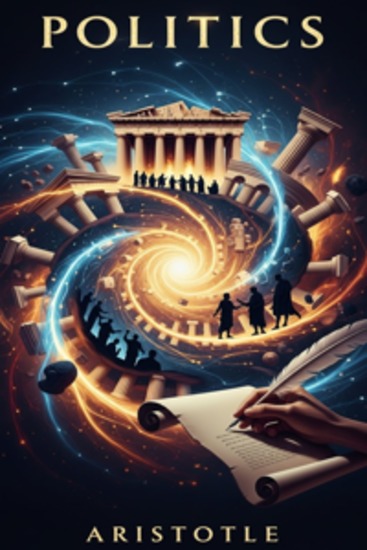
Politics - cover
LER

Politics

Aristotle

Editora: Bu Classics Books

  • 0
  • 0
  • 0

Sinopse

The city-state is examined as the highest form of community, aimed at achieving the common good and enabling citizens to live virtuously. Aristotle compares various constitutions and forms of government, classifying them based on whether they serve the public interest or the rulers' selfish desires. He discusses the role of the citizen, the nature of justice, and the importance of education in maintaining the stability of the state. This political treatise argues that man is by nature a political animal, destined to live in a structured society.
Disponível desde: 29/01/2026.
Comprimento de impressão: 352 páginas.

Outros livros que poderiam interessá-lo

  • Library of Alexandria and the Library of Pergamon The: The History of the Most Important Libraries in Antiquity - cover

    Library of Alexandria and the...

    Editors Charles River

    • 0
    • 0
    • 0
    In the Middle Ages, the lack of libraries in the West helped contribute to the popular imagination of the ancient Library at Alexandria, and all the myths and legends that have come to be associated with it, but the Library of Alexandria deserves its reputation. Before medieval times, Greek scholars carefully collected and inventoried books and other written materials in the Library of Alexandria, which truly made it a sort of precursor to all modern libraries. In fact, the Library of Alexandria proved to be one of the greatest institutions created in the ancient world because it influenced the minds of countless people in profound ways for centuries. The Library not only inspired the imaginations of artists but gave birth to new research methods, which proved to provide the basis for many considered common-place today. The Library of Alexandria was one of the few libraries in the ancient Greek world, which helped ensure that mathematicians, scientists and other scholars from across the Mediterranean traveled to Egypt to study there, and it was so impressive in its size and influence that it left an indelible mark on the world that still reverberates today.  
    	The Library of Pergamon was established slightly later than the Library of Alexandria, during the reign of king Eumenes II, but Eumenes embarked on a program to stock the Library of Pergamon with some of the greatest works of Greek literature in order to rival the Library of Alexandria. For example, a complete set of Demosthenes’ works was among the classics that graced the shelves in the Pergamon collection. This competition seems to have been the basis for the papyrus ban, as the Ptolemies intended to halt academic work in Pergamon, such as editing new editions of the classics. While the Ptolemaic ban on papyrus may have slowed operations at the Library of Pergamon, the introduction of parchment as a medium of writing helped re-stock Pergamon’s Library.
    Ver livro
  • Our Universe - But An incoming outgoing wave - cover

    Our Universe - But An incoming...

    Mike Blake

    • 0
    • 0
    • 0
    Our Universe - But. An incoming/outgoing wave:Poem rediscovering the theories of the creation of the Universe.Some think of string theory, others, that waves are involved etc.My poem postulates a possible cosmic wave outward from the Big Bang, in the order of present Scientific theory.
    Ver livro
  • Battle of the Boyne The: The History of the Battle that Ended James II’s Attempt to Reclaim the Throne of England - cover

    Battle of the Boyne The: The...

    Editors Charles River

    • 0
    • 0
    • 0
    The striking saga of the Glorious Revolution is one that continues to fascinate historians around the world today. Some chroniclers have referred to these events as the “Bloodless Revolution,” but other historians say otherwise. The ruthless game of politics that William of Orange and England’s King James II played may have been somewhat bloodless in comparison to history's greatest rebellions, but the rebels, soldiers, and other pawns who lost their lives along the way must not be forgotten. The revolution would also pave the path for a series of bloody wars between England and Scotland, the result of which has left quite a legacy of its own.  
    Furthermore, it’s important to remember that James did try to return to England, and there would be two more years of war before James II gave up the quest to regain the throne. On July 1, 1690, the famous Battle of the Boyne was fought near the town of Drogheda, about five miles west of Baltray. The combatants were the supporters of King James II and King William III, both claiming to be the lawful sovereigns of England, Scotland, and Ireland. The conflict was part of a broader struggle for the destiny of the British Isles, and though it was not the decisive battle of the war, it is the most famous, the commemoration of which still fans tensions between Protestants and Catholics in Northern Ireland and the Republic of Ireland. In its aftermath, James II would again leave the British Isles, this time for good. 
    Ver livro
  • The Age of the Great Whore-Reformation - cover

    The Age of the Great...

    A.A. Castor

    • 0
    • 0
    • 0
    "The Age of the Great Whore-Reformation" is not a book for the faint of heart—it's a fearless cultural autopsy. Through biting truth, unapologetic critique, and disturbingly honest analysis, this book explores the modern woman's journey from sexual liberation to spiritual monetization. From Instagram repentance to OnlyFans conversions, from porn star to prophetess, we are witnessing the rise of women who trade lingerie for long skirts—only to wear faith like a brand. 
    This is the brutal tale of performative repentance, where religious imagery replaces erotic content, and "modesty" is sold with the same thirst as sin once was. But more than that, it's a lament for the forgotten faithful—the pure, the disciplined, the unseen women who are ignored while the reformed are rewarded. This book investigates how masculinity must be earned, while femininity is merely reclaimed, repackaged, and sold again. 
    Part social critique, part psychological profile, part spiritual warning—this book dives into:The cultural commodification of redemptionThe new market of religious influencersThe silence of true repentance versus the noise of rebrandingWhy real love, trust, and femininity are disintegratingWhat happens when shame becomes strategy 
    If you've ever asked why the world celebrates the fallen who rise with followers, but never honors the ones who never fell—this is your book. 
    Darkly humorous, dead serious, and disturbingly true—"The Age of the Great Whore-Reformation" holds up a mirror. Whether you see repentance, rebranding, or both is up to you.
    Ver livro
  • Swapped in the Pen 2 - Gender Swap - cover

    Swapped in the Pen 2 - Gender Swap

    Kinky Press

    • 0
    • 0
    • 0
    Being in the pen isn’t that bad as long as you stayed on top of the band of skin heads. 
      
    If you’re big enough, the female guards may even let you bang them – and Michael is good at banging. 
      
    But, there’s a new game in town. Glendyle Corp has a solution to the female sterility plaguing their world, and they want to turn the prisoners into voluptuous baby making bimbos. 
      
    Can a big, bad dude like Michael grow melons and a she-thing if he’s promised a free ticket out of jail? Yes. Yes, he can. 
      
    Michael has a fantastic time exploring his, or rather her, new body before being taken into the lab where a machine relentlessly pumps him full of baby making goodness. 
      
    PSA: This story contains a man forced into an undesirable situation. There will be pistons shoved into places – and he never knew how good a woman has it. He’ll do some exploration with a big, black bull and be satisfied by a fertilization machine. Next, he will find out what it’s like to be fertile and expecting.
    Ver livro
  • Byzantines and Ottomans The: The History of the Medieval Middle East’s Most Influential Empires - cover

    Byzantines and Ottomans The: The...

    Editors Charles River

    • 0
    • 0
    • 0
    In terms of geopolitics, perhaps the most seminal event of the Middle Ages was the successful Ottoman siege of Constantinople in 1453. The city had been an imperial capital as far back as the 4th century, when Constantine the Great shifted the power center of the Roman Empire there, effectively establishing two almost equally powerful halves of antiquity’s greatest empire. Constantinople would continue to serve as the capital of the Byzantine Empire even after the Western half of the Roman Empire collapsed in the late 5th century. Naturally, the Ottoman Empire would also use Constantinople as the capital of its empire after their conquest effectively ended the Byzantine Empire, and thanks to its strategic location, it has been a trading center for years and remains one today under the Turkish name of Istanbul. 
    The end of the Byzantine Empire had a profound effect not only on the Middle East but Europe as well. Constantinople had played a crucial part in the Crusades, and the fall of the Byzantines meant that the Ottomans now shared a border with Europe. The Islamic empire was viewed as a threat by the predominantly Christian continent to their west, and it took little time for different European nations to start clashing with the powerful Turks. In fact, the Ottomans would clash with Russians, Austrians, Venetians, Polish, and more before collapsing as a result of World War I, when they were part of the Central Powers. 
    The Ottoman conquest of Constantinople also played a decisive role in fostering the Renaissance in Western Europe. The Byzantine Empire’s influence had helped ensure that it was the custodian of various ancient texts, most notably from the ancient Greeks, and when Constantinople fell, Byzantine refugees flocked west to seek refuge in Europe. Those refugees brought books that helped spark an interest in antiquity that fueled the Italian Renaissance and essentially put an end to the Middle Ages altogether.
    Ver livro