Unisciti a noi in un viaggio nel mondo dei libri!
Aggiungi questo libro allo scaffale
Grey
Scrivi un nuovo commento Default profile 50px
Grey
Iscriviti per leggere l'intero libro o leggi le prime pagine gratuitamente!
All characters reduced
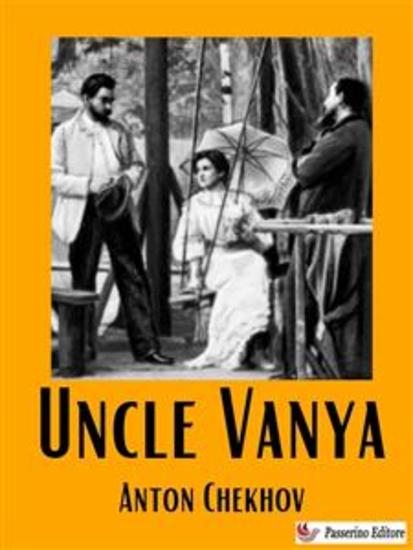
Uncle Vanya - cover

Uncle Vanya

Anton Chekhov

Casa editrice: Passerino

  • 0
  • 0
  • 0

Sinossi

Uncle Vanya is a play by the Russian playwright Anton Chekhov. It was first published in 1897, and first produced in 1899 by the Moscow Art Theatre, directed by Konstantin Stanislavski.

The play portrays the visit of an elderly professor and his glamorous, much younger second wife, Yelena, to the rural estate that supports their urban lifestyle. Two friends—Vanya, brother of the professor's late first wife, who has long managed the estate, and Astrov, the local doctor—both fall under Yelena's spell while bemoaning the ennui of their provincial existence. Sonya, the professor's daughter by his first wife, who has worked with Vanya to keep the estate going, suffers from her unrequited feelings for Astrov. Matters are brought to a crisis when the professor announces his intention to sell the estate, Vanya and Sonya's home, with a view to investing the proceeds to achieve a higher income for himself and his wife.

Anton Pavlovich Chekhov (29 January 1860 – 15 July 1904 was a Russian playwright and short-story writer who is considered to be one of the greatest writers of all time. His career as a playwright produced four classics, and his best short stories are held in high esteem by writers and critics. Along with Henrik Ibsen and August Strindberg, Chekhov is often referred to as one of the three seminal figures in the birth of early modernism in the theatre. Chekhov was a physician by profession. "Medicine is my lawful wife", he once said, "and literature is my mistress."
Disponibile da: 16/10/2023.

Altri libri che potrebbero interessarti

  • There Are Still Woods - cover

    There Are Still Woods

    Hila Ratzabi

    • 0
    • 0
    • 0
    There Are Still Woods is a radiant appraisal of life at the precipice of climate crisis and a haunting elegy for all we stand to lose. Through alternating lenses, from the speculative to the spiritual, from motherhood to science to mythology, Hila Ratzabi looks out at our wounded but vibrant planet and the animal experience of living on it. These poems bear witness to the force and fragility of the natural world and grapple with the complexities of being a human in that landscape: being implicated, vulnerable, humbled, dazzled. These poems are ways of framing and enduring loss, personal and collective and cultural, real and potential and anticipated. They impart a heightened appreciation for the solid and fleeting beauty that surrounds us. Here is an ode to the earth, a vision of its end, a celebration of its endurance, an aching and eloquent plea for intercession on its behalf. Ratzabi’s first collection is a howl, a prayer, a premonition, a reawakening, and an urgent call to action.
    Mostra libro
  • How News Travels - POEMS - cover

    How News Travels - POEMS

    Judy Katz

    • 0
    • 0
    • 0
    This is a debut collection of poetry read by the author. 
    The specific beauties of the poems in Judy Katz’s How News Travels have to do with their accounts of actual human living—among family, among friends, in the real world, with its griefs and losses and growth, its immersions in time, hour by hour, day by day, its immersions in consciousness. The other beauty here, the perpetual beauty, is the illumination—the afterglow, the underglow, the aurora—with which the poet cradles and surrounds her world. A clarifying, eloquent distillation of the truth of our experience, and a wonderful book.  
    — Vijay Seshadri  
    By exploring presence and absence and presence in absence, Judy Katz creates quietly revelatory elegies and odes for the shifting relationships of mid-life: the death of a mother, the independence of grown children, the intimacy of romance and trust between husband and wife. These poems feel both inevitable and surprising, as they invite us into the passage of time. “There is a trail I can follow–– / each of us leaves it, / our light impress…” she writes, and we are transformed by her attention to detail, fresh imagery, and wonder. This is a collection to savor, for “who can sleep / when it keeps arriving / over and over / the world, the world.”  
    — Ellen Bass 
    The voice is so alive, often so playful—and again and again, you will find yourself in a dialogue with the unknowable....How News Travels is a stunning book.  
    — D. Nurkse 
    For more information about Judy Katz's poetry or How News Travels, please visit https://www.judykatzpoetry.com/
    Mostra libro
  • The Night Before - Beautiful poem from a Pulitzer prize winner - cover

    The Night Before - Beautiful...

    Edward Arlington Robinson

    • 0
    • 0
    • 0
    Edwin Arlington Robinson was born on the 22nd December 1869 in Tide in Lincoln County, Maine.  
    His childhood was described by him as ‘stark and unhappy’.  His name was drawn out of a hat from a fellow vacationer from Arlington Massachusetts when fellow holiday makers decided that his parents had waited long enough at 6 months to name him.  It was a name he despised and reflects the station to which his parents had placed him; their great hope at his birth were that he was a girl to complement their two sons. 
    His pessimistic mood carried him to adulthood and a doomed encounter with Emma Loehen Shepherd who constantly encouraged his poetry.  Edwin was thought too young to be her companion and so his elder, middle brother, Herman was assigned to her.  It was a great blow to Edwin and during their marriage on February 12th, 1890, he stayed home and wrote ‘Cortege’ 
    In the fall of 1891 Edwin entered Harvard, taking classes in English, French and Shakespeare.  He felt at ease with the Ivy League and made great efforts to be published in one of the Harvard literary journals.  Indeed, the Harvard Advocate published ‘Ballade of a Ship’ but then his career appeared to stall.  His father died and although he returned to Harvard for a second year it was to be his last but also the start of some life-long friendships. 
    In 1893 he returned to Gardiner Maine as the man of the household.  Herman by this time had become an alcoholic, having suffered business failures, and was now to become estranged from Emma. 
    Edwin began farming whilst he wrote and quickly developed a close relationship with Emma who had now moved back to Gardiner after Herman’s death with her children. 
    Although he proposed twice, he was rejected and in consequence moved to New York to start afresh. 
    But it was a salutary experience. Although surrounded by artists he had little money and life was difficult. 
    In 1896 he published his own book, ‘The Torrent and the Night Before’, paying 100 dollars for 500 copies.  Edwin wanted it to be a surprise for his Mother, but days before its arrival she died of diphtheria. 
    His second volume, ‘The Children of the Night’, had a wider circulation.  At the behest of President Roosevelt, whose son was an avid admirer, he was given a job in 1905 at the New York Customs Office although it appears his real job was “to help American letters”. 
    Either way his success began to widen and his influence proper.  During the 1920s he won the Pulitzer Prize for Poetry on three separate occasions. In 1922 for ‘Collected Poems’ again in 1925 for ‘The Man Who Died Twice’ and finally in 1928 for ‘Tristram’. 
    During the last twenty years of his life he became a regular summer resident at the MacDowell Colony in New Hampshire, where he became the object of fascination by several women.  But he never married. 
    Edwin Arlington Robinson died of cancer on the 6th April 1935 in the New York Hospital in New York. He was 65.
    Mostra libro
  • Churchill in Moscow - cover

    Churchill in Moscow

    Howard Brenton

    • 0
    • 0
    • 0
    'Everything is possible in Moscow at night.'
    The Kremlin, Moscow, 1942. A top-secret meeting between Winston Churchill and Joseph Stalin: one, a wealthy aristocrat from a blue-blooded line of English nobility; the other, a Georgian peasant, hell-bent on destroying capitalism and the class system. Can these two leaders find common ground? As diplomats struggle to control the escalating chaos, two interpreters find themselves caught in the eye of the storm.
    Howard Brenton's gripping play Churchill in Moscow dramatises the historic meeting of two unpredictable titans as history teeters on a knife-edge. It opened in 2025 at London's Orange Tree Theatre, directed by the venue's Artistic Director Tom Littler, starring Roger Allam as Churchill and Peter Forbes as Stalin.
    'Brenton is a masterly storyteller'Financial Times
    Mostra libro
  • A Rhyme A Dozen ― Cats - 12 Poets 12 Poems 1 Topic - cover

    A Rhyme A Dozen ― Cats - 12...

    Edward Lear, W B Yeats, Percy...

    • 0
    • 0
    • 0
    ‘A dime a dozen’ as known in America, is perhaps equal to the English ‘cheap as chips’ but whatever the lingua franca of your choice in this series we hereby submit ‘A Rhyme a Dozen’ as 12 poems on many given subjects that are a well-rounded gathering, maybe even an essential guide, from the knowing pens of classic poets and their beautifully spoken verse to the comfort of your ears. 
    1 - A Rhyme a Dozen - 12 Poets, 12 Poems , 1 Topic.  Cats - An Introduction 
    2 - The Owl and the Pussycat by Edward Lear 
    3 - The Rat-Catcher and Cats by John Gay 
    4 - The Cat and the Old Rat by Jean de la Fontaine 
    5 - Verses on a Cat by Percy Bysshe Shelley 
    6 - The Cat by Charles Baudelaire 
    7 - The Cat and the Moon by W B Yeats 
    8 - Milk For the Cat by Harold Munro 
    9 - The Cats Have Come to Tea by Kate Greenaway 
    10 - The Vain Cat by Ambrose Bierce 
    11 - Mrs Reynold's Cat by John Keats 
    12 - To My Cat by Rosamund Marriott Watson 
    13 - An Oxford Don Curses His Cat by Thomas Master
    Mostra libro
  • The Prophet - cover

    The Prophet

    Kahlil Gibran

    • 0
    • 0
    • 0
    "The Prophet" by Khalil Gibran is a profoundly spiritual and philosophical collection of poetic essays that has captivated readers worldwide with its timeless insights into the human condition. Set against the backdrop of a fictional Middle Eastern village, the narrative unfolds through the character of Almustafa, the titular prophet, who, on the eve of his departure after twelve years of exile, shares his deep reflections on life, love, sorrow, joy, and mortality with the townspeople. Each essay addresses essential aspects of life—from marriage and parenting to work and freedom—offering wisdom that seeks to uplift the spirit and enrich the soul. Gibran's eloquent prose is both lyrical and accessible, making profound philosophical concepts resonate with readers of all backgrounds. The book not only explores the trials and tribulations of individual existence but also delves into the communal and universal truths that bind humanity together, making "The Prophet" a cherished classic in modern literature.
    Mostra libro