Unisciti a noi in un viaggio nel mondo dei libri!
Aggiungi questo libro allo scaffale
Grey
Scrivi un nuovo commento Default profile 50px
Grey
Iscriviti per leggere l'intero libro o leggi le prime pagine gratuitamente!
All characters reduced
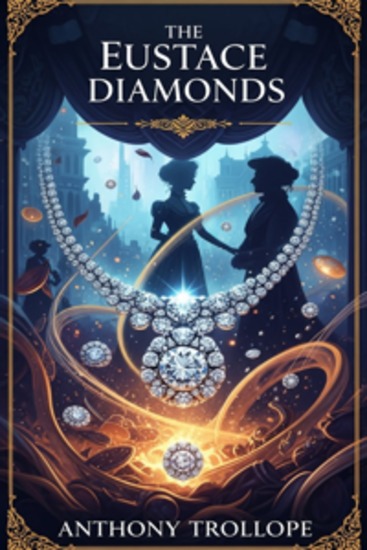
The Eustace Diamonds - cover

The Eustace Diamonds

Anthony Trollope

Casa editrice: Bu Classics Books

  • 0
  • 0
  • 0

Sinossi

Lizzie Eustace, a beautiful and cunning widow, finds herself at the center of a scandalous legal battle over a valuable diamond necklace she claims as a heirloom. Her web of lies and manipulations entraps suitors, lawyers, and family members, exposing the greed and hypocrisy lurking beneath the surface of polite society. The narrative combines elements of a mystery with biting social satire, as the diamonds become a symbol of the hollow values of the upper class. Lizzie’s relentless pursuit of wealth and status creates a chaotic yet mesmerizing spectacle of deception.
Disponibile da: 29/01/2026.
Lunghezza di stampa: 1068 pagine.

Altri libri che potrebbero interessarti

  • The Man Who Would Be King - Classic Tales Edition - cover

    The Man Who Would Be King -...

    Rudyard Kipling

    • 0
    • 0
    • 0
    Through the sands of the scalding deserts of India, two loafing vagabonds follow a half scribbled map, heading for a land they hope to conquer.
    Mostra libro
  • Measure for Measure - cover

    Measure for Measure

    William Shakespeare

    • 0
    • 0
    • 0
    Measure for Measure is one of darkest of Shakespeare’s comedies. Written in about 1603 and first performed in 1604, it immediately preceded the composition of the major tragedies Othello, King Lear, and Macbeth. 
    Duke Vincentino, the ruler of Vienna, fears that under his mild sovereignty, the people may have become lazy and lax. He decides to “go over cover” in the disguise of a monk and appoint his deputy, Angelo, who is a reputed paragon of virtue, as temporary ruler. 
    On assuming power, Angelo inaugurates draconian provisions regarding sexual propriety. One of the first victims of this new regime is young Claudio, who has impregnated his lover Juliet, and is accordingly sentenced to death. 
    Claudio’s sister, Isabella, who is preparing to enter religious life, is encouraged to approach Angelo and plead for her brother’s life. Angelo is immediately smitten with the beautiful Isabella and makes her an offer: her brother will be spared if she yields to Angelo’s sexual advances. Isabella indignantly rejects this proposal, but finds herself unable to reveal Angelo’s hypocrisy publicly, as she fears her accusations will lack credence. 
    Fortunately, the Duke, who has not left Vienna, befriends Isabella in his assumed role of friar, and hatches a plan to both save Claudio and to unmask Angelo. 
    Featuring the voices of Denis Daly, Gary D. MacFadden, David Shears, Graham Scott, Josh Innerst, Kendra Murray, Blaise Doran, Simon Paxton, Roberta Jackson, Alexandra Lee Smith, and Alan Weyman. 
    Audio edited by Denis Daly 
    Tunes for songs provided by Alan Weyman. 
    The text used for this performance was kindly provided by playshakespeare.com.
    Mostra libro
  • The Merry Adventures of Robin Hood - cover

    The Merry Adventures of Robin Hood

    Howard Pyle

    • 0
    • 0
    • 0
    "Pull a long bow and feast on the King's venison in the heart of Sherwood."
    
    Deep within the sun-dappled glades of Sherwood Forest, a band of brothers lives outside the law, but for the sake of justice. The Merry Adventures of Robin Hood follows the legendary archer from his first run-in with the King's foresters to his legendary recruitment of Little John, Will Scarlet, and the jovial Friar Tuck. Howard Pyle's retelling is a joyous celebration of wit, skill, and the defiance of tyranny. Whether outsmarting the bumbling Sheriff of Nottingham or competing for a golden arrow, Robin and his Merry Men embody a spirit of freedom and chivalry that has inspired generations. This version is celebrated not just for its prose, but for its archaic, rhythmic charm that transports readers directly into a "merrie" medieval England.
    
    The "Noble Outlaw" Philosophy: Pyle refined the character of Robin Hood, transforming him from a simple highwayman into a champion of the oppressed. His Robin is a man of honor who strictly follows a code: never harm a woman, a child, or a man in the company of a lady, and always aid those whom the law has failed.
    
    A Masterpiece of Illustration: Howard Pyle was as much an artist as a writer. His original edition featured intricate, woodcut-style illustrations that set the visual standard for the "Golden Age of Illustration." His depiction of the characters—broad-shouldered, hearty, and full of life—remains the blueprint for every film and television adaptation that followed.
    
    Why It Is an Essential Classic: The Merry Adventures of Robin Hood is the rare book that appeals equally to the sense of childhood wonder and the adult appreciation for craft. It is a story of brotherhood and the belief that even in a world of corruption, a few "stout hearts" can make a difference. It remains the most readable and influential version of the Robin Hood mythos ever penned.
    
    Join the band in the greenwood. Purchase "The Merry Adventures of Robin Hood" today.
    Mostra libro
  • Keep the Aspidistra Flying - cover

    Keep the Aspidistra Flying

    George Orwell

    • 0
    • 0
    • 0
    Gordon Comstock is a poor young man who works by day in a grubby London bookstore and spends his evenings shivering in a rented room, trying to write. Gordon has published a slim volume of verse and is determined to keep free of the “money world” of safe, lucrative jobs, marriage, and family responsibilities. This world, to Gordon, spells the end of art and aspidistra, the homely, indestructible house plant that stands in every middle-class British window.Gordon’s sweetheart, Rosemary, understands him: she is patient with his pride and lack of funds. But then, as it happens with all lovers, events overtake them. 
    Orwell’s picture of the “money world,” as Gordon sees it, is in his best satirical vein.
    Mostra libro
  • The Coup de Grace - From their pens to your ears genius in every story - cover

    The Coup de Grace - From their...

    Ambrose Bierce

    • 0
    • 0
    • 0
    Ambrose Gwinnett Bierce was born on 24th June 1842 at Horse Cave Creek in Meigs County, Ohio. His parents were poor but they introduced him to literature at an early age, instilling in him a deep appreciation of books, the written word and the elegance of language.  
    Growing up in Koscuisko County, Indiana poverty and religion were defining features of his childhood, and he would later describe his parents as “unwashed savages” and fanatically religious, showing him little affection but always quick to punish. He came to resent religion, and his introduction to literature appears to be their only positive effect. 
    At age 15 Bierce left home to become a printer’s devil, mixing ink and fetching type at The Northern Indian, a small Ohio paper. Falsely accused of theft he returned to his farm and spent time sending out work in the hopes of being published. 
    His Uncle Lucius advised he be sent to the Kentucky Military Institute. A year later he was commissioned as an Officer.  As the Civil War started Bierce enlisted in the 9th Indiana Infantry Regiment.  
    In April 1862 Bierce fought at the Battle of Shiloh, an experience which, though terrifying, became the source of several short stories. Two years later he sustained a serious head wound and was off duty for several months. He was discharged in early 1865.  
    A later expedition to inspect military outposts across the Great Plains took him all the way to San Francisco. He remained there to become involved with publishing and editing and to marry, Mary Ellen on Christmas Day 1871.  They had a child, Day, the following year.  
    In 1872 the family moved to England for 3 years where he wrote for Fun magazine. His son, Leigh, was born, and first book, ‘The Fiend’s Delight’, was published.  
    They returned to San Francisco and to work for a number of papers where he gained admiration for his crime reporting. In 1887 he began a column at the William Randolph Hearst’s San Francisco Examiner.  
    Bierce’s marriage fell apart when he discovered compromising letters to his wife from a secret admirer. The following year, 1889 his son Day committed suicide, depressed by romantic rejection. 
    In 1891 Bierce wrote and published the collection of 26 short stories which included ‘An Occurrence at Owl Creek Bridge’.  Success and further works including poetry followed.  
    Bierce with Hearst’s resources helped uncover a financial plot by a railroad to turn 130 million dollars of loans into a handout. Confronted by the railroad and asked to name his price Bierce answered “my price is $130 million dollars. If, when you are ready to pay, I happen to be out of town, you may hand it over to my friend, the Treasurer of the United States”.  
    He now began his first foray as a fabulist, publishing ‘Fantastic Fables’ in 1899.  But tragedy again struck two years later when his second son Leigh died of pneumonia relating to his alcoholism.  
    He continued to write short stories and poetry and also published ‘The Devil’s Dictionary’.  
    At the age of 71, in 1913 Bierce departed from Washington, D.C., for a tour of the battlefields where he had fought during the civil war. At the city of Chihuahua he wrote his last known communication, a letter to a friend. It’s closing words were “as to me, I leave here tomorrow for an unknown destination,” Ambrose Bierce then vanished without trace.
    Mostra libro
  • The Picture of Dorian Gray - cover

    The Picture of Dorian Gray

    Oscar Wilde

    • 0
    • 0
    • 0
    "It is your best work, Basil, the best thing you have ever done," said Lord Henry, languidly. "You must certainly send it next year to the Grosvenor. The Academy is too large and too vulgar. The Grosvenor is the only place."    "I don't think I will send it anywhere," he answered, tossing his head back in that odd way that used to make his friends laugh at him at Oxford. "No: I won't send it anywhere."    Lord Henry elevated his eyebrows, and looked at him in amazement through the thin blue wreaths of smoke that curled up in such fanciful whorls from his heavy opium-tainted cigarette. "Not send it anywhere? My dear fellow, why? Have you any reason? What odd chaps you painters are! You do anything in the world to gain a reputation. As soon as you have one, you seem to want to throw it away. It is silly of you, for there is only one thing in the world worse than being talked about, and that is not being talked about. A portrait like this would set you far above all the young men in England, and make the old men quite jealous, if old men are ever capable of any emotion."    "I know you will laugh at me," he replied, "but I really can't exhibit it. I have put too much of myself into it."    Lord Henry stretched his long legs out on the divan and shook with laughter.  "Yes, I knew you would laugh; but it is quite true, all the same."    "Too much of yourself in it! Upon my word, Basil, I didn't know you were so vain; and I really can't see any resemblance between you, with your rugged strong face and your coal-black hair, and this young Adonis, who looks as if he was made of ivory and rose-leaves. Why, my dear Basil, he is a Narcissus, and you--well, of course you have an intellectual expression, and all that.    But beauty, real beauty, ends where an intellectual expression begins. Intellect is in itself an exaggeration, and destroys the harmony of any face. The moment one sits down to think, one becomes all nose, or all forehead, or something horrid. Look at the successful men in any of the learned professions. How perfectly hideous they are! Except, of course, in the Church. But then in the Church they don't think. A bishop keeps on saying at the age of eighty what he was told to say when he was a boy of eighteen, and consequently he always looks absolutely delightful. Your mysterious young friend, whose name you have never told me, but whose picture really fascinates me, never thinks. I feel quite sure of that. He is a brainless, beautiful thing, who should be always here in winter when we have no flowers to look at, and always here in summer when we want something to chill our intelligence. Don't flatter yourself, Basil: you are not in the least like him."
    Mostra libro