Unisciti a noi in un viaggio nel mondo dei libri!
Aggiungi questo libro allo scaffale
Grey
Scrivi un nuovo commento Default profile 50px
Grey
Iscriviti per leggere l'intero libro o leggi le prime pagine gratuitamente!
All characters reduced
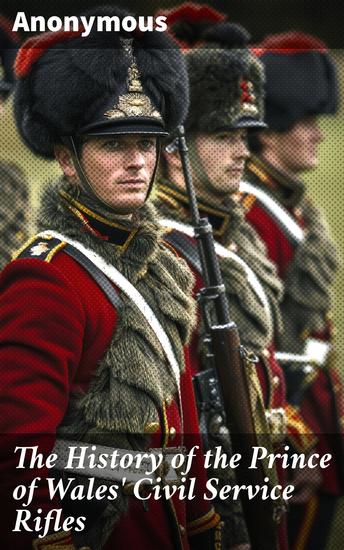
The History of the Prince of Wales' Civil Service Rifles - Uncovering the Legacy of a Rifle Regiment: Insights into British Military History - cover

The History of the Prince of Wales' Civil Service Rifles - Uncovering the Legacy of a Rifle Regiment: Insights into British Military History

Anonimo

Casa editrice: Good Press

  • 0
  • 0
  • 0

Sinossi

The History of the Prince of Wales' Civil Service Rifles offers a meticulous chronicle of one of the most distinguished British volunteer regiments, detailing its inception, operational engagements, and the societal context in which it thrived. Written in a clear yet evocative style, the book draws upon an array of primary documents, including regimental accounts, letters, and photographs, thereby immersing readers in the lives of the soldiers and the evolution of military service during the age of imperial expansion. This historical narrative not only captures the valor and camaraderie of the Rifles but also situates them within the broader tapestry of British military and social history, emphasizing themes of duty, patriotism, and community resilience. The author, an anonymous chronicler, likely had intimate knowledge of the regiment's history, possibly as a participant or a dedicated enthusiast of military heritage. This connection to the Rifles lends authenticity and passion to the narrative, offering a uniquely personal perspective that enriches the storytelling. The anonymity further invites readers to focus on the collective memory of the regiment rather than the individual author, thereby reinforcing the communal spirit that the organization represents. This book serves as an essential resource for historians, military enthusiasts, and anyone interested in understanding the complex interplay between civilian life and military service in Britain. With its robust research and engaging prose, it captivates both academic readers and casual history buffs alike, making it a worthwhile addition to any library.
Disponibile da: 27/10/2023.
Lunghezza di stampa: 514 pagine.

Altri libri che potrebbero interessarti

  • Sit in the Sun - And Other Lessons in the Spiritual Wisdom of Cats - cover

    Sit in the Sun - And Other...

    Jon M. Sweeney

    • 0
    • 0
    • 0
    As a spiritual pilgrim for more than half a century, Jon Sweeney has practiced with teachers of many religious traditions. He's gone looking for wisdom, beauty, and truth wherever it can be found. But recently he's found himself learning closer to home—from the teacher-cats he lives with. 


    What he discovered is that our greatest spiritual teachers are at our feet. Literally. They are the cats we love and treasure. Nearly 60 million cats live in US households today. These feline teachers have much to offer us about living in the present, loving unconditionally, approaching life with a sense of playfulness, and trusting others, all the while being independent spirits. 


    Jon Sweeney, beloved scholar and author of The Pope's Cat and numerous books about Saint Francis, offers a playful, gentle, informed meditation on the many spiritual truths and practices our feline companions provide if we but pause and pay attention.
    Mostra libro
  • The American Imperative - Reclaiming Global Leadership through Soft Power - cover

    The American Imperative -...

    Daniel F. Runde

    • 0
    • 0
    • 0
    It's time for America to get back in the international leadership game. 


    What should our global strategy look like in an age of renewed great power competition? And what must America offer to a newly empowered developing world when we're no longer the only major player? 


    In The American Imperative, international development expert Daniel Runde makes the case for building a new global consensus through vigorous internationalism and the judicious use of soft power. Runde maps out many of the steps that we need to take—primarily in the non-military sphere—to ensure an alliance of stable and secure, like-minded, self-reliant partner nations in order to prevent rising authoritarian powers such as China from running the world.
    Mostra libro
  • Unleashing the Sigma Male in You - Unlocking the Biblical Code Evolution Unleashing Sigma Potentials Genetic Traits of a Sigma Develop and Enhance Sigma Traits What Sigma Knows that You Don't - cover

    Unleashing the Sigma Male in You...

    Charles Remington

    • 0
    • 0
    • 0
    A Sigma male is not born but made! 
    By developing certain personality traits, a person can become a Sigma male. But to develop these skills and personality traits, one must be open to change and accept it. 
    Without an open mindset, it can become impossible for a person to learn new personality traits. 
    Learn the importance of having a growth mindset 
    The psychology of attraction 
    How to make yourself appear more attractive to others 
    Build charisma and charm 
    Learn the laws of attractiveness. 
    How to flirt, dating techniques 
    Self-Discipline 
    Building up Mental Toughness 
    Mindset 
    Positivity 
    Strength 
    Nobody is born a natural leader. Leadership qualities are learned. Similarly, nobody is born as a Sigma male. These qualities have to be learned as one goes through life. While some people put in efforts to develop their personalities, most people don't. 
    Those who go the extra mile to develop their personality, end up being identified as a Sigma male, while the rest fall into the beta category. 
    Buy my book now!
    Mostra libro
  • American Civil War in 1864 The: The History and Legacy of the War’s Penultimate Year - cover

    American Civil War in 1864 The:...

    Editors Charles River

    • 0
    • 0
    • 0
    Americans have long been fascinated by the Civil War, marveling at the size of the battles, the leadership of the generals, and the courage of the soldiers. Since the war's start over 150 years ago, the battles have been subjected to endless debate among historians and the generals themselves. The Civil War was the deadliest conflict in American history, and had the two sides realized it would take 4 years and inflict over a million casualties, it might not have been fought. Since it did, however, historians and history buffs alike have been studying and analyzing the biggest battles ever since.  
    	By the close of 1864, Abraham Lincoln had been reelected, the Union army had taken Nashville from General Hood, and Sherman had concluded his total war, “slash-and-burn” march of destruction to Savannah, Georgia, offering it as a Christmas present to Lincoln. Nevertheless, with everything seemingly falling to pieces, the South still held out hope of some sort of miracle, and Davis even attempted to send a peace delegation to meet with Lincoln in the early months of 1865. On January 28, 1865 as Union General Ulysses S. Grant was continuing to lay siege to Lee’s army at Petersburg, Virginia, Davis sent three commissioners headed by Vice-President Stephens to initiate informal peace talks with Lincoln. By February 3, however, the talks, known as the Hampton Roads Conference, came to a stalemate as Lincoln would accept nothing less than total union, while Davis would only accept Southern independence.  
    	Even at that point, the South was clearly on its last legs. General George H. Thomas destroyed John Bell Hood’s Confederate army at the battles of Nashville and Franklin, leaving only two large Confederate armies still in the field. Lee's army was weakened by desertion, lack of supplies and casualties, and Joseph E. Johnston’s army could barely resist against Sherman’s army as it was advancing north toward Virginia.
    Mostra libro
  • The Hundred Years' War - England Vs France - cover

    The Hundred Years' War - England...

    Harris Ropes

    • 0
    • 0
    • 0
    The Hundred Years' War, a conflict that lasted from 1337 to 1453, was shaped by a variety of complex political, social, and dynastic factors. It was not a war that emerged overnight but rather a culmination of long-standing tensions between England and France. At the heart of the conflict were competing territorial claims, royal succession disputes, and issues of sovereignty that had been simmering for centuries. 
    One of the most significant catalysts for the war was the feudal system that governed both England and France. In the medieval period, rulers held vast territories that often extended beyond their borders, which led to intricate relationships between monarchs and their vassals. The English monarchy, under King Edward III, had long-held claims to the French throne due to the inheritance of the Duchy of Guyenne, which was located in the southwest of France. This land, granted to the English king by the French crown centuries earlier, became a point of contention when King Philip VI of France attempted to assert control over it. The French monarchy's desire to regain full sovereignty over its territory clashed with the English king’s interests, setting the stage for the war. 
    Additionally, the death of the French king Charles IV in 1328 sparked a succession crisis. The French throne was left without a direct male heir, leading to a dispute over the rightful successor. The French crown passed to Philip VI, but Edward III, the King of England, claimed that his mother, Isabella, was the sister of Charles IV and thus, he had a stronger claim to the throne. This dynastic dispute became the primary reason for the conflict, as Edward III demanded recognition of his claim.
    Mostra libro
  • The Era of Liberation - 1862-1894 - cover

    The Era of Liberation - 1862-1894

    Louis Kossuth, Abraham Lincoln,...

    • 0
    • 0
    • 0
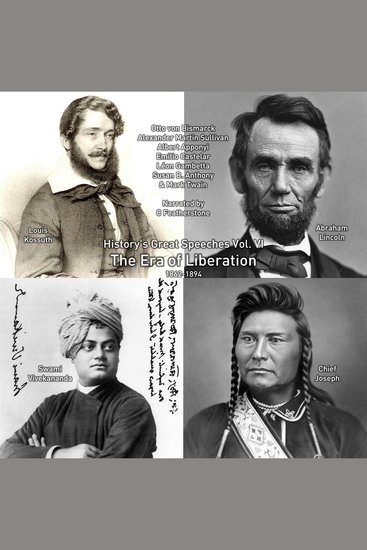
    The late 19th Century was a time of liberation. After the collapse of empires, people of all creeds demanded their equality.We begin with two speeches that represent the old order, by Bismarck. Between the two speeches he went from being Prussia’s last Minister President to being the Germany’s first Chancellor. A statesman in the oldest mold, he argues for nationalist dominance against forces temporal and religious.The counter is given by Sullivan, who excoriates the British government for the Zulu war, asking why the country supported wars of aggression in foreign lands.From there, we move to the liberation of nations and peoples. Louis Kossuth embodied Hungary’s struggle against imperial oppression, Castelar argues for a Spanish republic, and Gambetta for the education of the peasantry in France. Across Europe, a tide rose demanding the government serve the people rather than use them.In America, Lincoln defined the struggle between the Union and Confederacy as the start of universal emancipation and freedom for all men. In contrast, Chief Joseph’s speech drips with pathos, as he lays down his spear forever, desperate to find what is left of his massacred and desolate peoples in the wilderness. After the Civil War ends, Susan Anthony’s speech demands that women should have the vote, as guaranteed in the constitution for all citizens.A series of speeches by Swami Vivekananda follow, given at the first World’s Parliament of Religions. These speeches brought Buddhism and Hinduism into the Anglosphere, and began a trend of searching for spiritual liberation alongside the more material demands of the time.We finish on a lighter tone, as Mark Twain bemoans the decay of the art of lying. In an age of such seriousness, the tall tale fell out of fashion, and the simple joy of telling a fisherman’s tale was lost.
    Mostra libro