Unisciti a noi in un viaggio nel mondo dei libri!
Aggiungi questo libro allo scaffale
Grey
Scrivi un nuovo commento Default profile 50px
Grey
Iscriviti per leggere l'intero libro o leggi le prime pagine gratuitamente!
All characters reduced
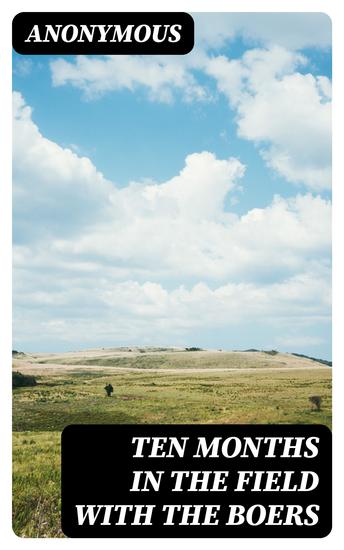
Ten Months in the Field with the Boers - cover

Ten Months in the Field with the Boers

Anonimo

Casa editrice: DigiCat

  • 0
  • 0
  • 0

Sinossi

In "Ten Months in the Field with the Boers," the anonymous author provides a gripping first-hand account of the Second Boer War (1899-1902), exploring the complexities of guerrilla warfare through a lens of vivid personal experience. The narrative combines elements of memoir and reportage, employing a straightforward yet evocative prose style that immerses readers in the harsh realities faced by soldiers on both sides of the conflict. Rich with detail, the book illustrates the landscape and human cost of war, revealing the moral ambiguities inherent in imperialistic endeavors while maintaining a reflective tone steeped in the literary traditions of war literature. The identity of the author remains anonymous, perhaps reflecting the intimate nature of the account and the desire to prioritize the experiences over individual recognition. Yet, it is evident that they possess deep insights into military strategy, the psychology of combat, and the socio-political implications of the war. Having witnessed the brutalities of the battlefield, this individual captures the complexities of South African identities and foreshadows the conflicts that would follow in the region. "Ten Months in the Field with the Boers" stands as a vital contribution to the canon of war literature, providing readers with an unfiltered perspective on a pivotal historical moment. It is highly recommended for historians, students of military strategy, and general readers alike who seek to understand the human dimensions of conflict amidst the backdrop of a tumultuous era.
Disponibile da: 15/09/2022.
Lunghezza di stampa: 107 pagine.

Altri libri che potrebbero interessarti

  • Media and Society - How Mass Communication Influences Our Social World - cover

    Media and Society - How Mass...

    Fred Grandsen

    • 0
    • 0
    • 0
    Media plays a central role in shaping how individuals perceive and interact with the world. From newspapers and television to digital platforms and social media, mass communication influences nearly every aspect of modern life. Media serves as a bridge between individuals and society, providing information, entertainment, and a platform for discourse. As technology evolves, the ways in which people consume and engage with media continue to transform, creating both opportunities and challenges. 
    Throughout history, media has been a powerful force in shaping cultural norms, political ideologies, and social movements. The early days of print media allowed for the dissemination of knowledge and ideas, while the emergence of radio and television expanded the reach of information and entertainment. Today, digital media and social networking platforms have revolutionized the speed and accessibility of communication. The constant flow of information enables individuals to stay informed about global events, yet it also raises concerns about misinformation, media bias, and the impact of media consumption on mental health. 
    The role of media in shaping public opinion is significant. News outlets and entertainment industries influence how issues are framed, which stories receive attention, and how people interpret social and political events. Media has the power to amplify voices, create awareness about critical issues, and inspire social change. However, it can also reinforce stereotypes, promote sensationalism, and contribute to the spread of misinformation. Understanding how media functions, who controls its narratives, and how it affects society is crucial in navigating today’s media landscape.
    Mostra libro
  • Life's Short Talk Fast - Fifteen Writers on Why We Can't Stop Watching Gilmore Girls (An Unauthorized Edition) - cover

    Life's Short Talk Fast - Fifteen...

    Ann Hood

    • 0
    • 0
    • 0
    Fifteen leading writers explore what Gilmore Girls means to them in this delightful celebration of a contemporary TV classic. 


    Fast-talking, warm-hearted, and endlessly rewatchable, Gilmore Girls has bonded real-life mothers and daughters since 2000, when its iconic pilot introduced us to Lorelai, Rory, and their idyllic Connecticut town of Stars Hollow. More than twenty years later, it has become one of the most-streamed TV shows, ever. 


    In an anthology as intimate and quick-witted as Gilmore Girls itself, bestselling author Ann Hood invites fifteen writers to investigate their personal relationships to the show. ("It's a show? It's a lifestyle. It's a religion.") Joanna Rakoff considers how Emily Gilmore helped her understand her own mother; Sanjena Sathian sees herself—and Asian American defiance—in Lane Kim; Freya North connects with her son through the show; Francesco Sedita discovers an antidote to pandemic loneliness; Nina de Gramont offers a comic ode to the unreality of Stars Hollow. For anyone who identifies as Team Logan, Team Jess, or even Team Dean, Life's Short, Talk Fast reveals what Gilmore Girls tells us about ourselves—and why it matters.
    Mostra libro
  • Cryptography and the World Wars: The History of Codemaking and Codebreaking during Both Global Conflicts - cover

    Cryptography and the World Wars:...

    Editors Charles River

    • 0
    • 0
    • 0
    World War I was the first major conflict in which new electronic means of transmitting and receiving messages became a major factor in political and military operations. The electric telegraph was developed in the first half of the 19th century, and by 1850, there were several telegraph companies around the world providing a service that allowed virtually instantaneous communication over long distances. This was a major breakthrough, but the telegraph depended on the availability of wires to transmit messages between stations, meaning that if these wires were broken or damaged, communications were cut off. 
    	Of course, this came with a fundamental problem: radio, telephone, and telegraph messages could be intercepted by the enemy, potentially giving them notice of impending operations. To protect these electronic messages from being read by the enemy, armies began to use codes and ciphers to disguise the meaning of messages. Teams were created to devise effective codes and ciphers, and these were quickly followed by other teams whose role was to attempt to break the codes and ciphers used by the other side. As a result, a secret war began, almost completely hidden from public view, as the belligerents devised complex ways of hiding the real meaning of their own messages while simultaneously attempting to understand those of the enemy.  
    	During the Second World War, cryptography suddenly became a significant factor in warfare because of mid-20th century advances in communications technology. With radios small and common enough to be fitted into most individual vehicles and readily carried in a man-portable form, information and orders flowed from supreme headquarters to individual squad leaders, tanks, and soldiers at the front and back again.  
    Despite the power of the new technology and its metamorphic effects on warfare, cryptography's story during World War II remained a very human one. 
    Mostra libro
  • The Habsburg Empire - Central Europe's Dynastic Rule - cover

    The Habsburg Empire - Central...

    Nova Ashford

    • 0
    • 0
    • 0
    The Habsburg Dynasty, one of the most influential and enduring families in European history, laid the foundation for an empire that would dominate much of Central Europe for over six centuries. The family’s rise to power was not a result of military conquest or economic dominance, but rather strategic marriages, political alliances, and a series of calculated moves that allowed them to amass territories and influence across Europe. At the heart of the Habsburg's success was their ability to use dynastic marriages to expand their reach, securing land, titles, and influence through the marriages of their children to powerful European houses. 
    The origins of the Habsburgs can be traced to the 11th century, with the rise of the family’s first significant member, Radbot, a nobleman from what is now Switzerland. However, it was not until the 13th century that the Habsburgs began their ascent to prominence under the leadership of Rudolf I. In 1273, Rudolf was elected King of Germany, marking the beginning of the Habsburgs' long reign in Central Europe. This election not only established their position within the Holy Roman Empire but also set the stage for their future expansion. 
    The key to their continued rise lay in the Habsburgs’ unparalleled ability to form advantageous marriages. Rather than relying on military might, the family expanded its territorial holdings through strategic unions with other royal and noble families. One of the most significant of these marriages was that of Maximilian I in 1477 to Mary of Burgundy, which brought the Habsburgs the rich territories of the Burgundian Netherlands. This marriage effectively linked the Habsburgs with the wealth and influence of the Low Countries, establishing them as key players in European politics.
    Mostra libro
  • The Dress Diary - Secrets from a Victorian Woman's Wardrobe - cover

    The Dress Diary - Secrets from a...

    Kate Strasdin

    • 0
    • 0
    • 0
    In 1838, a young woman was given a diary on her wedding day. Collecting snippets of fabric from a range of garments—some her own, others donated by family and friends—she carefully annotated each one, creating a unique record of their lives. Her name was Mrs. Anne Sykes. 


    Nearly two hundred years later, the diary fell into the hands of Kate Strasdin, a fashion historian and museum curator. Using her expertise, Strasdin spent the next six years unraveling the secrets contained within the album's pages, and the lives of the people within. Her findings are remarkable. Piece by piece, she charts Anne's journey from the mills of Lancashire to the port of Singapore before tracing her return to England in later years. Fragments of cloth become windows into Victorian life: pirates in Borneo, the complicated etiquette of mourning, poisonous dyes, the British Empire in full swing, rioting over working conditions, and the terrible human cost of Britain's cotton industry. This is life writing that celebrates ordinary people: not the grandees of traditional written histories, but the hidden figures, the participants in everyday life. Through the evidence of waistcoats, ball gowns, and mourning outfits, Strasdin lays bare the whole of human experience in the most intimate of mediums: the clothes we choose to wear.
    Mostra libro
  • Hot Spot - A Doctor's Diary From the Pandemic - cover

    Hot Spot - A Doctor's Diary From...

    Dr. Alex Jahangir, Katie...

    • 0
    • 0
    • 0
    When Nashville identified its first case of coronavirus in March 2020, the city was between Public Health Department directors and as unprepared as the rest of the world for what was to come. Dr. Alex Jahangir, a trauma surgeon acting at that time as chair of the Metro Nashville Board of Health, unexpectedly found himself head of the city's COVID-19 Task Force and responsible for leading it through uncharted waters. 


    What followed was a year of unprecedented challenge and scrutiny. Jahangir, who immigrated to the United States from Iran at age six, grew up in Nashville. He thought he knew the city well. But the pandemic laid bare ethnic, racial, and cultural tensions that daily threatened to derail what should have been a collective effort to keep residents healthy and safe. 


    Hot Spot is Jahangir's narrative of the first year of COVID, derived from his op notes (the journal-like entries surgeons often keep following operations) and expanded to include his personal reflections and a glimpse into the inner sanctums of city and state governance in crisis.
    Mostra libro