Unisciti a noi in un viaggio nel mondo dei libri!
Aggiungi questo libro allo scaffale
Grey
Scrivi un nuovo commento Default profile 50px
Grey
Iscriviti per leggere l'intero libro o leggi le prime pagine gratuitamente!
All characters reduced
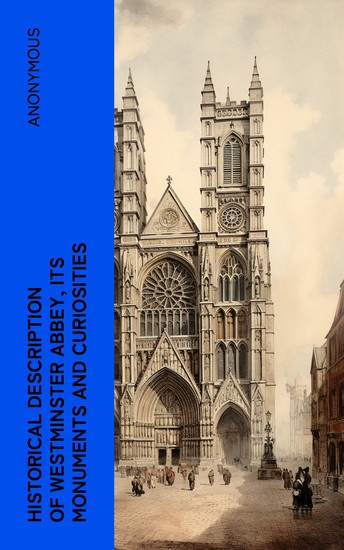
Historical Description of Westminster Abbey Its Monuments and Curiosities - cover

Historical Description of Westminster Abbey Its Monuments and Curiosities

Anonimo

Casa editrice: e-artnow

  • 0
  • 0
  • 0

Sinossi

"Historical Description of Westminster Abbey, Its Monuments and Curiosities" by Anonymous. Published by e-artnow. e-artnow publishes a wide range of titles that encompasses every genre. From well-known classics & literary fiction and non-fiction to forgotten−or yet undiscovered gems−of world literature, we issue the books that need to be read. Each e-artnow edition has been meticulously edited and formatted to boost readability for all e-readers and devices. Our goal is to produce eBooks that are user-friendly and accessible to everyone in a high-quality digital format.
Disponibile da: 02/12/2023.
Lunghezza di stampa: 935 pagine.

Altri libri che potrebbero interessarti

  • Master and Margarita by Mikhail Bulgakov The (Book Analysis) - Detailed Summary Analysis and Reading Guide - cover

    Master and Margarita by Mikhail...

    Bright Summaries

    • 0
    • 0
    • 0
    Unlock the more straightforward side of The Master and Margarita with this concise and insightful summary and analysis!This engaging summary presents an analysis of The Master and Margarita by Mikhail Bulgakov, which is widely considered to the author's masterpiece and one of the finest novels of the 20th century. Through three interwoven narrative strands, namely Pontius Pilate's persecution of the man who would later be known as Jesus Christ, a love story set in Moscow in the 1930s and the Devil's visit to that city, the novel delivers biting satire and explores weighty themes such as the interplay between good and evil and the importance of spiritual and intellectual freedom. Due to pervasive censorship in the Soviet Union, the novel was not published until almost 30 years after its author's death, and is now the work on which his reputation rests. Indeed, although Bulgakov died in poverty and obscurity, his writing now enjoys popular and critical acclaim around the world.Find out everything you need to know about The Master and Margarita in a fraction of the time!This in-depth and informative reading guide brings you:• A complete plot summary• Character studies• Key themes and symbols• Questions for further reflectionWhy choose BrightSummaries.com?Available in print and digital format, our publications are designed to accompany you on your reading journey. The clear and concise style makes for easy understanding, providing the perfect opportunity to improve your literary knowledge in no time.See the very best of literature in a whole new light with BrightSummaries.com!
    Mostra libro
  • The Mandela Effect - Exploring the Phenomenon of False Collective Memories - cover

    The Mandela Effect - Exploring...

    John Harpoon

    • 0
    • 0
    • 0
    The Mandela Effect is a psychological phenomenon in which large groups of people remember an event, fact, or detail differently from documented reality. The term originates from a widespread belief that Nelson Mandela died in prison during the 1980s, despite historical records confirming his release in 1990 and later presidency of South Africa. Since then, the Mandela Effect has come to describe various collective false memories, ranging from misremembered movie quotes to altered brand logos and even significant historical events. While some view it as mere confusion or misinformation, others see it as evidence of alternate realities or shifts in consciousness.  
    The phenomenon gained widespread recognition through the internet, where individuals began sharing their experiences of remembering things differently than historical records suggest. Social media platforms, online forums, and viral discussions have amplified these false memories, making them more widespread and reinforcing the belief that something unusual is occurring. Many people report feeling unsettled upon discovering that their memories do not align with reality, further fueling speculation about the cause. Some theories suggest that quantum physics, parallel universes, or glitches in reality could be responsible. Others argue that the Mandela Effect is a result of how human memory works, shaped by cognitive biases and external influences.  
    Memory is not a perfect recording of past events; rather, it is a reconstructive process that can be influenced by suggestion, misinformation, and group reinforcement. Psychological research has shown that memories can be distorted over time, leading to the formation of collective false memories.
    Mostra libro
  • Wealth Supremacy - How the Extractive Economy and the Biased Rules of Capitalism Drive Today’s Crises - cover

    Wealth Supremacy - How the...

    Marjorie Kelly, Edgar Villanueva

    • 0
    • 0
    • 0
    This powerful analysis explains how the bias toward wealth that is woven into the very fabric of American capitalism is damaging people, the economy, and the planet and explores what the foundations of a new economy could be. 
     
    This bold manifesto exposes seven myths underlying wealth supremacy-the bias that institutionalizes infinite extraction of wealth by and for the wealthy and is the hidden force behind economic injustice, the climate crisis, and so many other problems of our day: 
     
    -	The Myth of Maximizing-No amount of wealth is ever enough. 
    -	The Myth of Fiduciary Duty-Corporate managers' most sacred duty is to expand capital. 
    -	The Myth of Corporate Governance-Corporate membership must be reserved for capital alone. 
    -	The Myth of the Income Statement-Income to capital must always be increased, while income to labor must always be decreased. 
    -	The Myth of Materiality-Profit-that is, material gain-alone is real, while social and environmental damages are not. 
    -	The Myth of Takings-The first duty of government must be the protection of private property. 
    -	The Myth of the Free Market-There should be no limits on the sphere of influence of corporations and capital. 
     
    Kelly argues instead for the democratization of ownership: public ownership of vital services, worker-owned businesses, and more. And she sketches the outlines of a nonextractive capitalism that would be subordinate to the public interest. This is an ambitious reimagining of the very foundations of our economy and society.
    Mostra libro
  • Food - Second Edition - cover

    Food - Second Edition

    John Coveney

    • 0
    • 0
    • 0
    In Food, John Coveney examines "food as . . . " identity, politics, industry, regulation, the environment, justice, and gastronomy. He explores how food helps us understand what it means to be human. 


    The centrality of food in life, and the importance of food as life, is undeniable. As a source of biological substrates, personal pleasure, and political power, food is and has been an enduring requirement of human biological, social, and cultural existence. Interest in food has increased across the academic, public, and popular spheres, fueled by popular media's constant play on the role of food and body size, and food and cooking, as a mass spectacle for TV audiences. Through food, we construct our social identities, our families and communities. However, Coveney also highlights the tensions between the industrialization of food, the environment, and the iniquitous distribution of food. He also considers how the food industries, on which most of us must rely, have also had direct effects on our bodies through diet, and the development of illness and diseases. 


    This accessible primer is for students and general listeners alike, indeed, for anyone with an interest in food. It questions the idea that food is merely something inert on the plate. Instead, it shows how influential, symbolic, powerful, and transformative food has come to be.
    Mostra libro
  • Oil - Power Politics and Pipelines: The Story of Black Gold - cover

    Oil - Power Politics and...

    Ian Fitzgerald

    • 0
    • 0
    • 0
    A fascinating overview of the substance that has shaped the modern world. 
     
    In this compelling account, Ian Fitzgerald tells the complete story of oil, from its formation over millions of years to its first discovery and use by humankind to its role as a crucial energy source and the conflicts that have since revolved around it. 
     
    Along the way, he covers such themes as technological innovation, cartels and collusions, oil's ever-depleting stocks and the rise of environmentalism, and its staggering influence on politics and business. Taking us from the days of oil barons like John D. Rockefeller and the first refineries of Standard Oil through to the formation of OPEC in the mid-20th century and the rise of fracking in the 21st, A History of Oil explores everything from the creation of plastics to the causes of the Gulf Wars.
    Mostra libro
  • Romantic Things - A Tree A Rock A Cloud - cover

    Romantic Things - A Tree A Rock...

    Mary Jacobus

    • 1
    • 1
    • 0
    Our thoughts are shaped as much by what things make of us as by what we make of them. Lyric poetry is especially concerned with things and their relationship to thought, sense, and understanding. In Romantic Things, Mary Jacobus explores the world of objects and phenomena in nature as expressed in Romantic poetry alongside the theme of sentience and sensory deprivation in literature and art. Jacobus discusses objects and attributes that test our perceptions and preoccupy both Romantic poetry and modern philosophy. John Clare, John Constable, Rainer Maria Rilke, W. G. Sebald, and Gerhard Richter make appearances around the central figure of William Wordsworth as Jacobus explores trees, rocks, clouds, breath, sleep, deafness, and blindness in their work. While she thinks through these things, she is assisted by the writings of Maurice Merleau-Ponty, Jacques Derrida, and Jean-Luc Nancy. Helping us think more deeply about things that are at once visible and invisible, seen and unseen, felt and unfeeling, Romantic Things opens our eyes to what has been previously overlooked in lyric and Romantic poetry.
    Mostra libro