Join us on a literary world trip!
Add this book to bookshelf
Grey
Write a new comment Default profile 50px
Grey
Subscribe to read the full book or read the first pages for free!
All characters reduced
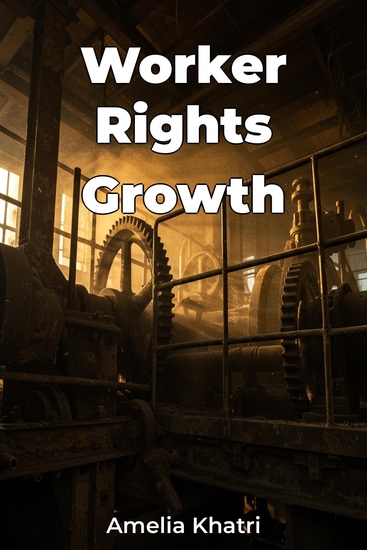
Worker Rights Growth - cover

Worker Rights Growth

Amelia Khatri

Translator A AI

Publisher: Publifye

  • 0
  • 0
  • 0

Summary

Worker Rights Growth explores the extensive history of employee protections, from early labor movements to today's complex employment law. It examines how landmark legal decisions and persistent advocacy shaped workplace policies, highlighting the ongoing journey toward fair labor practices and social justice. Readers will discover how industrialization and the rise of labor movements laid the foundation for current employment rights and the legal frameworks designed to protect them.

 
The book uniquely emphasizes the interplay between legal frameworks and social realities, analyzing how laws are implemented and their actual impact. For instance, the National Labor Relations Act significantly altered worker rights, impacting employer responsibilities and promoting unionization.

 
The narrative progresses chronologically, starting with initial legislative attempts to regulate working conditions, then explores key labor laws, and concludes with modern workplace policies. This comprehensive guide provides a clear and coherent narrative, supported by historical documents, case studies, and statistical data.

 
It offers practical insights into navigating workplace regulations, empowering readers to understand and advocate for their rights. By integrating perspectives from economics, sociology, and political science, Worker Rights Growth offers a holistic understanding of labor history and its continued relevance.
Available since: 02/18/2025.
Print length: 74 pages.

Other books that might interest you

  • The 7 Wonders of Me - A Journey of Healing Through Self Reflection - cover

    The 7 Wonders of Me - A Journey...

    Darnell L. Davis

    • 0
    • 0
    • 0
    At just 13 years old, Darnell Davis took the stand as the key witness in a murder trial that would send his father to prison for life. That moment didn’t just break his family—it fractured his sense of self, setting off years of pain, anger, and isolation. The 7 Wonders of Me is Darnell’s raw and revelatory memoir of what came after: the slow, spiritual excavation of his soul—and the courageous rebuilding of a life once lost to trauma. 
    More than a memoir, this book is a healing companion. Structured around the seven chakras, The 7 Wonders of Me charts Darnell’s path from survival to self-realization—beginning with the root chakra’s call for safety and trust, and culminating in the crown chakra’s invitation to live with purpose and divine connection. Each chapter offers not just gripping personal stories, but also the insights, practices, and breakthroughs that helped him rise. 
    Whether you are walking through your own fire or seeking a deeper connection to who you are, The 7 Wonders of Me is a soul-deep guide back to your light. With equal parts spiritual wisdom and hard-won truth, this is a book for anyone ready to turn their pain into power. 
    Perfect for readers of self-help, memoir, and spiritual growth, The 7 Wonders of Me is a testament to resilience, radical honesty, and the liberating power of self-love.
    Show book
  • Heavyweight - Black Boxers and the Fight for Representation - cover

    Heavyweight - Black Boxers and...

    Jordana Moore Saggese

    • 0
    • 0
    • 0
    In Heavyweight, Jordana Moore Saggese examines images of Black heavyweight boxers to map the visual terrain of racist ideology in the United States, paying particular attention to the intersecting discourses of Blackness, masculinity, and sport. Looking closely at the "shadow archive" of portrayals across fine art, vernacular imagery, and public media at the turn of the twentieth century, she demonstrates how the images of boxers reveal the racist stereotypes implicit in them, many of which continue to structure ideas of Black men today. With a focus on both anonymous fighters and notorious champions, including Jack Johnson, Saggese contends that popular images of these men provided white spectators a way to render themselves experts on Blackness and Black masculinity. These images became the blueprint for white conceptions of the Black male body—existing between fear and fantasy, simultaneously an object of desire and an instrument of violence. Reframing boxing as yet another way whiteness establishes the violent mythology of its supremacy, Saggese highlights the role of imagery in normalizing a culture of anti-Blackness.
    Show book
  • The Holodomor - The Brutal Terror-Famine Inflicted on Millions of Ukrainians by the Soviet Union - cover

    The Holodomor - The Brutal...

    Kelly Mass

    • 0
    • 0
    • 0
    The Holodomor, also known as the Terror-Famine (meaning 'to kill through starving' in Ukrainian) or The Great Famine, was a devastating man-made disaster that struck Soviet Ukraine between 1932 and 1933. It resulted in the deaths of millions of Ukrainians, with the word "Holodomor" specifically highlighting the purposeful nature of the famine. The term reflects the severity of the event, suggesting not only a catastrophic food shortage but also a deliberate attempt to destroy the Ukrainian population through starvation. Various factors contributed to the famine's man-made characteristics, including the refusal of Soviet authorities to allow outside aid, the forced confiscation of family food supplies, and the imposition of severe restrictions on population movement. 
    The Holodomor was part of a larger Soviet famine that affected other grain-producing regions of the USSR in the same period, but Ukraine, as one of the Soviet Union's most important agricultural producers, bore the brunt of the crisis. The famine was not a result of natural disasters but of Stalinist policies, such as forced collectivization, that wreaked havoc on Ukraine's agricultural systems. The Ukrainian people, most of whom were ethnic Ukrainians, faced the unimaginable toll of starvation in what remains one of the most catastrophic peacetime events in Ukrainian history. 
    Ukraine, along with 15 other countries, officially recognized the Holodomor as a genocide perpetrated by the Soviet regime against the Ukrainian people, a stance that has been supported since 2006. The question of how many people perished remains a subject of debate. A joint declaration made to the United Nations in 2003 suggested that between 7 and 10 million Ukrainians died during the famine. However, current estimates by scholars tend to range from 3.5 to 5 million deaths.
    Show book
  • Pumpkinflowers - A Soldier's Story of a Forgotten War - cover

    Pumpkinflowers - A Soldier's...

    Matti Friedman

    • 0
    • 0
    • 0
    “A book about young men transformed by war, written by a veteran whose dazzling literary gifts gripped my attention from the first page to the last.” —The Wall Street Journal “Friedman’s sober and striking new memoir . . . [is] on a par with Tim O’Brien’s The Things They Carried -- its Israeli analog.” —The New York Times Book Review It was just one small hilltop in a small, unnamed war in the late 1990s, but it would send out ripples that are still felt worldwide today. The hill, in Lebanon, was called the Pumpkin; flowers was the military code word for “casualties.” Award-winning writer Matti Friedman re-creates the harrowing experience of a band of young Israeli soldiers charged with holding this remote outpost, a task that would change them forever, wound the country in ways large and small, and foreshadow the unwinnable conflicts the United States would soon confront in Afghanistan, Iraq, and elsewhere.Pumpkinflowers is a reckoning by one of those young soldiers now grown into a remarkable writer. Part memoir, part reportage, part history, Friedman’s powerful narrative captures the birth of today’s chaotic Middle East and the rise of a twenty-first-century type of war in which there is never a clear victor and media images can be as important as the battle itself. Raw and beautifully rendered, Pumpkinflowers will take its place among classic war narratives by George Orwell, Philip Caputo, and Tim O’Brien. It is an unflinching look at the way we conduct war today.
    Show book
  • Vision Changing Charity - cover

    Vision Changing Charity

    Ian Bruce

    • 0
    • 0
    • 0
    The late twentieth century saw charities grow from timid service deliverers into major providers with campaigning teeth. What caused this? How did they gain confidence and strength? In this fascinating history, examined through the eyes of RNIB from 1970 to 2010, Ian Bruce examines the internal drivers and the external socio-political environment that allowed and encouraged this explosion. Bruce’s experience of leading a charity at the forefront of this change, and his participation in the wider charity sector for fifty years as both activist and academic, gives him an unsurpassed understanding of what happened and why. His first-hand knowledge will speak to charity workers as well as academics, covering themes such as the rise of beneficiary power against patronising providers; the change from welfare to rights; the shift from the medical to the social model of disability; and the adoption of social welfare and business professionalisms such as Strategic Planning and Charity Marketing. Today’s charities have much to learn from the successes and mistakes of this dynamic period.
    Show book
  • How We Can Win - Race History and Changing the Money Game That's Rigged - cover

    How We Can Win - Race History...

    Kimberly Jones

    • 0
    • 0
    • 0
    A breakdown of the economic and social injustices facing Black people and other marginalized citizens inspired by political activist Kimberly Jones' viral video, “How Can We Win.”“So if I played four hundred rounds of Monopoly with you and I had to play and give you every dime that I made, and then for fifty years, every time that I played, if you didn't like what I did, you got to burn it like they did in Tulsa and like they did in Rosewood, how can you win? How can you win?"When Kimberly Jones declared these words amid the protests spurred by the murder of George Floyd, she gave a history lesson that in just over six minutes captured the economic struggles of Black people in America. Within days the video had been viewed by millions of people around the world, riveted by Jones’s damning—and stunningly succinct—analysis of the enduring disparities Black Americans face.In How We Can Win, Jones delves into the impacts of systemic racism and reveals how her formative years in Chicago gave birth to a lifelong devotion to justice. Here, in a vital expansion of her declaration, she calls for Reconstruction 2.0, a multilayered plan to reclaim economic and social restitutions—those restitutions promised with emancipation but blocked, again and again, for more than 150 years. And, most of all, Jones delivers strategies for how we can effect change as citizens and allies while nurturing ourselves—the most valuable asset we have—in the fight against a system that is still rigged.A Macmillan Audio production from Henry Holt and Company
    Show book