Unisciti a noi in un viaggio nel mondo dei libri!
Aggiungi questo libro allo scaffale
Grey
Scrivi un nuovo commento Default profile 50px
Grey
Iscriviti per leggere l'intero libro o leggi le prime pagine gratuitamente!
All characters reduced
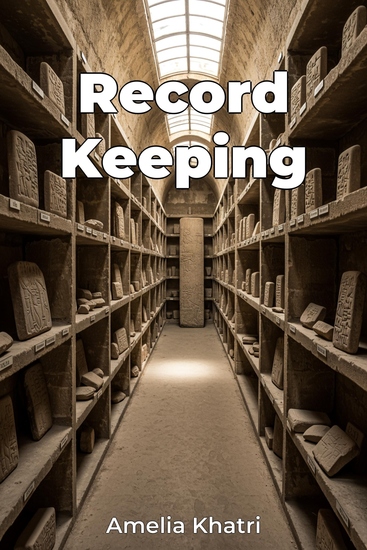
Record Keeping - cover

Record Keeping

Amelia Khatri

Traduttore A AI

Casa editrice: Publifye

  • 0
  • 0
  • 0

Sinossi

Record Keeping explores the captivating history of how societies have documented and preserved information, highlighting the crucial role of historical records in shaping civilizations. From ancient markings on stone to today's digital databases, the book traces the evolution of information management and its profound societal impact. Discover how early cultures, such as those in Mesopotamia and ancient Egypt, developed unique methods for preserving their histories, laws, and knowledge using cuneiform tablets and hieroglyphic records. The book uniquely links advances in record-keeping technologies to the progress of human civilization, demonstrating how these advancements have facilitated more sophisticated governance, commerce, and intellectual exchange.

 
The book progresses by examining the technologies of record-keeping, the impact on societal structures, and the ethical considerations surrounding information management. It delves into the societal impact of record-keeping practices, illustrating how accurate and accessible records are essential for legal frameworks and governmental accountability. The rise of digital records introduces new challenges, particularly in data privacy and security, which the book addresses through insights from archival science and information ethics.

 
Ultimately, Record Keeping provides essential insights into the importance of preserving knowledge in our increasingly digital world, drawing on archaeological findings, historical documents, and archival records.
Disponibile da: 29/03/2025.
Lunghezza di stampa: 75 pagine.

Altri libri che potrebbero interessarti

  • Celtic Gods and Goddesses - Exploring the Divine in Ancient Celtic Lore - cover

    Celtic Gods and Goddesses -...

    Odessa Nightshade

    • 0
    • 0
    • 0
    The mythology of the Celts is a vast and complex tapestry woven with gods, goddesses, spirits, and mystical forces that shaped their understanding of the universe. Unlike the structured pantheons of Greek or Roman mythology, Celtic deities were deeply intertwined with nature, the cycles of life, and the mysterious Otherworld. Their gods and goddesses were not merely distant figures residing in the heavens but active participants in the world of mortals, influencing the landscape, the seasons, and even the fate of individuals.  
      
    At the heart of Celtic belief was an intimate connection with the land. The Celts saw sacredness in rivers, mountains, forests, and the sky, often linking divine beings to specific places. Many gods and goddesses had direct associations with natural elements—Brigid with sacred wells and fire, Manannán mac Lir with the sea, and Cernunnos with the wild and untamed forests. This reverence for nature shaped their spiritual practices, with offerings made at holy sites and rituals performed to honor the divine forces that governed their world.  
      
    Another key aspect of Celtic spirituality was the concept of the Otherworld. This was not a place of punishment or reward but a mystical realm existing parallel to the human world. It was the dwelling place of powerful deities, spirits, and the souls of the departed. The Otherworld was often accessible through sacred sites, burial mounds, or moments of deep ritual significance. Many myths tell of heroes or mortals who ventured into this hidden realm, encountering gods, gaining wisdom, or even securing supernatural gifts. 
    Mostra libro
  • The Art of War - cover

    The Art of War

    Sun Tzu

    • 0
    • 0
    • 0
    "The Art of War" is an ancient Chinese military treatise attributed to Sun Tzu, a military strategist and philosopher. Though it is most commonly known as a manual for warfare, its principles have been applied to various aspects of life including business, politics, and personal development. The text is organized into 13 chapters, each dedicated to an aspect of warfare, and it emphasizes the importance of strategy, flexibility, and psychological warfare, among other things
    Mostra libro
  • Waiting for Mister Rogers - Teaching with Attachment Attunement and Intention - cover

    Waiting for Mister Rogers -...

    Wysteria Edwards

    • 0
    • 0
    • 0
    Every day children enter classrooms crying out for love and relief. Waiting for Mister Rogers reveals a Kindergarten teacher's journey to find answers for the broken children entering her classroom—and the wounds in her own heart—through the personal notes, speeches, and writings of Fred Rogers.  Many moments of adversity, violence, and suffering can be traced back to broken attachments in childhood. These early attachment wounds follow children into adulthood, often damaging their interpersonal relationships.  Where the world offers shallow and complex solutions, the gentle work of Mister Rogers models simple and deep ways to heal insecure attachment. Waiting for Mister Rogers, answers questions of personal development and connection for anyone seeking support, such as:  What do children need to be securely attached?  How can teachers heal their wounds to be fully present, intentional, and effective with their students?  Could student be triggering a teacher's childhood trauma?  Can teachers go deeper while doing less?  It's time to remember childhood, return to the Neighborhood and teach with attachment, attunement, and intention. Mister Rogers was right all along!
    Mostra libro
  • Uncle Tom's Cabin: The Icon Black Lives Matter Series - cover

    Uncle Tom's Cabin: The Icon...

    Harriet Beecher Stowe

    • 0
    • 0
    • 0
    Uncle Tom's Cabin is an antislavery novel by American author Harriet Beecher Stowe. Published in two volumes in 1852, the novel had a profound effect on attitudes toward African Americans and slavery in the U.S., and is said to have "helped lay the groundwork for the [American] Civil War". 
      
    Stowe, a Connecticutborn woman of English descent, was part of the religious Beecher family and an active abolitionist. She wrote the sentimental novel to depict the reality of slavery while also asserting that Christian love could overcome slavery. The novel focuses on the character of Uncle Tom, a longsuffering black slave around whom the stories of the other characters revolve. 
      
    Uncle Tom's Cabin was the bestselling novel and the second bestselling book of the 19th century, following the Bible, and is credited with helping fuel the abolitionist cause in the 1850s. The impact attributed to the book was so great that a likely apocryphal story arose of Abraham Lincoln meeting Stowe at the start of the Civil War and declaring, "So this is the little lady who started this great war." 
      
    The book and the plays it inspired helped popularize a number of negative stereotypes about black people including that of the namesake character "Uncle Tom", with the term now used to describe an excessively subservient person. These associations with Uncle Tom's Cabin have, to an extent, overshadowed the historical impact of the book as a "vital antislavery tool". However, the novel stands as a "landmark" in protest literature with later books such as The Jungle by Upton Sinclair and Silent Spring by Rachel Carson owing a large debt to it A oneofakind audio encounter for lovers of history, literature, spiritual texts, and inspirational writing. 
      
     
    Mostra libro
  • Sipahi The: The History and Legacy of the Ottoman Empire’s Elite Cavalry - cover

    Sipahi The: The History and...

    Editors Charles River

    • 0
    • 0
    • 0
    Among those who were responsible for the projection of Ottoman power, few deserve as much credit as the Sipahi. Civilizations across the steppes and the Middle East relied heavily on cavalry, and the Sipahi were elite cavalry units during medieval times for a couple of powers. That said, they were a massive contributor to the success of Ottoman warfare, and during good times for the empire, the Sipahi were rewarded, to the extent that they became their own social class, much like the Janissaries. In fact, much the way the Janissaries became less effective over time as being one denoted social status, the Sipahi and Janissaries had class resentments among each other, one of the various cracks in the Ottoman Empire that would help bring about its decline.  
    	As a result, the Sipahi’s private lives in the Ottoman Empire were varied and complex, depending on their social status, wealth, education, and religion. Their homes were often luxuriously decorated, and they were usually portrayed as highly-educated and sophisticated people. The Sipahi frequently had several wives and concubines, and their houses were equipped to accommodate their many guests. They had harems, where they kept their concubines and slaves, and the maintenance of their harems was important for each Sipahi's reputation and status. Their wives and concubines were often confined to the harem, and they did not have much freedom, but in some cases, especially in wealthier families, the women were educated and had an active social life. Furthermore, the Sipahi were often involved in art, music, and writing poetry. They had castles and villas they used for parties and social events, and they were also known for organizing hunts and other sporting activities. Many of them were also highly educated and engaged in the sciences, such as mathematics, astronomy, and philosophy.
    Mostra libro
  • Is There in the Brain Anything Untouched By Culture? - Brockwood Park and Gstaad 1975 - Dialogue 9 - cover

    Is There in the Brain Anything...

    Jiddu Krishnamurti

    • 0
    • 0
    • 0
    Is there in the brain anything untouched by culture?" - 6 August 1975Can there be a total perception which completely heals the brain?What benefit has culture?Does speech come before thought?Is it possible to say something without the operation of thought?Is there in the brain anything untouched by culture?Is attention a conscious process?Is love the factor of profound change?You explain all this, and you say that whatever the damaged brain – which is the result of thought and tradition and all the rest of it – whatever it does will produce further damage. So, because you point it out, I realise that. That is the first necessity – I realise it. Then, after I’ve realised it, you talk to me at a depth which thought has not touched. You planted a seed.
    Mostra libro