

Unisciti a noi in un viaggio nel mondo dei libri!
Aggiungi questo libro allo scaffale
Grey
Scrivi un nuovo commento Default profile 50px
Grey
Iscriviti per leggere l'intero libro o leggi le prime pagine gratuitamente!
All characters reduced
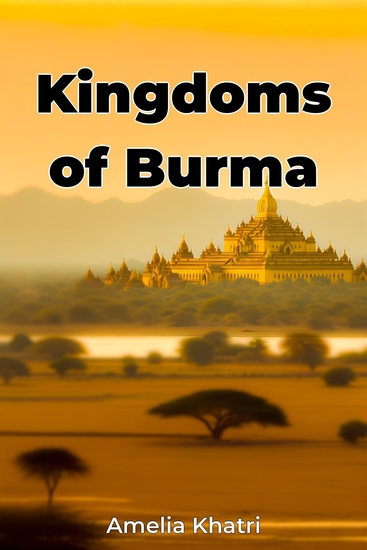
Kingdoms of Burma - cover

Kingdoms of Burma

Amelia Khatri

Traduttore A AI

Casa editrice: Publifye

  • 0
  • 0
  • 0

Sinossi

"Kingdoms of Burma" delves into the captivating history of early Burmese kingdoms and their profound influence on Southeast Asia. It explores how small settlements evolved into influential powers, shaping the region's political and cultural development. The book reveals that these kingdoms actively participated in a network of political and cultural exchange, impacting Southeast Asia's identity, and emphasizes the importance of Burmese history in understanding modern Myanmar. The book chronologically examines key periods, from the Pyu city-states to the Bagan Empire, and the Ava, Taungoo, and Konbaung dynasties. It analyzes these kingdoms' social, economic, and religious underpinnings, relationships with neighbors, and lasting cultural legacies. For example, the rise of Theravada Buddhism during the Bagan Empire significantly impacted the region. By synthesizing scholarship and original research, the book provides a balanced account of Burma's pre-colonial history, emphasizing the agency of the Burmese people. The book progresses through the pre-Bagan era, the rise and fall of the Bagan Empire, the emergence of Ava and Taungoo, and the Konbaung dynasty's expansionist policies. By examining archaeological evidence, inscriptions, chronicles, and scholarly works, the book reconstructs the political, social, and economic dynamics of these kingdoms. This approach offers readers a comprehensive understanding of Burmese history and its place in the broader world.
Disponibile da: 12/02/2025.
Lunghezza di stampa: 64 pagine.

Altri libri che potrebbero interessarti

  • Welcome to Dragon Talk - Inspiring Conversations about Dungeons & Dragons and the People Who Love to Play It - cover

    Welcome to Dragon Talk -...

    Greg Tito, Shelly Mazzanoble

    • 0
    • 0
    • 0
    If it seems like everyone you know is playing Dungeons & Dragons, it's because they are! After nearly five decades, the iconic roleplaying game is more popular than ever. Famous Hollywood actors and directors, therapists, educators, politicians, kids, parents, and grandparents all count themselves as fans. In Welcome to Dragon Talk, hosts of the official D&D podcast Shelly Mazzanoble and Greg Tito and their surprising guests show how this beloved pastime has amassed a diverse, tight-knit following of players who defy stereotypes. 


    Shelly and Greg recount some of their most inspiring interviews and illuminate how their guests use the core tenets of the game in everyday life. An A-list actor defends D&D by baring his soul (and his muscles) on social media. A teacher in a disadvantaged district in Houston creates a D&D club that motivates students to want to read and think analytically. A writer and live-streamer demonstrates how D&D–inspired communication breaks barriers and empowers people of color. Listeners will see why Dungeons & Dragons has remained such a pop culture phenomenon and how it has given this disparate and growing community the inspiration to flourish and spread some in-game magic into the real world.
    Mostra libro
  • What's Real about Race? - Untangling Science Genetics and Society - cover

    What's Real about Race? -...

    Rina Bliss

    • 0
    • 0
    • 0
    In What's Real About Race?, sociologist Rina Bliss illuminates the truth about one of the most misunderstood, controversial concepts in our society and reveals why we cannot confuse race with genetic difference. Blending energizing prose with the latest in genetics research, this paradigm-shifting tour unmasks what's truly real about race: namely, racism's impact on our bodies and lives. 


    Bliss traces the history of race, revealing how unscientific categories of identity—White, Black, Asian/Pacific Islander, and American Indian/Alaska Native—became the standard, and illuminates how the myth of biological races endures in science and society, warping our understanding of complex topics like intelligence, disease susceptibility, and behavior. Along the way, What's Real About Race? busts enduring myths about IQ, ancestry tests, behavioral racism, and more. In fascinating explorations of gene research, medicine, and social justice, Bliss argues for a new way forward. To create equity in science and society, we must disentangle our understanding of genetics from identity and see race for what it really is: a purely social category. At a time when misinformation about our bodies and identities is dangerously prevalent, What's Real About Race? is an indispensable resource and a powerful reminder that, biologically, our similarities vastly outweigh our differences.
    Mostra libro
  • The ANC Billionaires - Big Capital's Gambit and the Rise of the Few - cover

    The ANC Billionaires - Big...

    Pieter Du Toit

    • 0
    • 0
    • 0
    ‘We were talking about the rise of Japan, about Ronald Reagan’s Star Wars … globalisation, technology. And they were still banging on about the Freedom Charter.’ – Anglo American’s Michael Spicer on the ANC in the mid-1980s 
      
    In 1985, a group of white South African business leaders, led by Gavin Relly, the executive chairperson of Anglo American, travelled to a game lodge in Zambia to meet with the exiled ANC leadership under Oliver Tambo and Thabo Mbeki. This visit set in motion a coordinated and well-resourced plan by big business to influence and direct political change in South Africa. 
      
    In The ANC Billionaires, top-selling author Pieter du Toit draws on first-hand accounts by major roleplayers about the contentious relationship between capital and the ANC before, during and after the country’s transition to democracy, and shows how the liberation organisation was completely unprepared to navigate the intersection between business and politics. 
      
    He also ties the rise of the new elite – including Cyril Ramaphosa, Patrice Motsepe and Saki Macozoma – to the ANC, a party of government and patronage.
    Mostra libro
  • Codependency - Why do you attract unhealthy people? No more falling into toxic relationships Break the suffering cycle and learn how to love again - cover

    Codependency - Why do you...

    David Lawson PhD

    • 0
    • 0
    • 0
    Are you having trouble fostering healthy relationships? 
    Are you stressed, feeling drained and exhausted from giving too much in your relationships? 
    Do you know who you are? What you need? What you like? Or do you feel that you need to be validated and approved by a partner (or any other person) to feel good about yourself? 
    Codependency is notoriously difficult to combat because there is no precise definition of the disorder. The signs and symptoms also differ for everyone. It is often mistaken for narcissism or other personality disorders that do not reflect the true situation. 
    People who suffer from this disorder tend to mask what they really feel. At other times, they are not even aware of what they are doing. This only serves to cloud the overall picture by delaying positive interventions, which, sometimes will never come. 
    I RECOMMEND THAT YOU READ THIS BOOK IF: 
    • You are not aware of how you truly feel. 
    • You have difficulty identifying your feelings. 
    • You have difficulty expressing your feelings. 
    • You tend to minimize, modify or even deny the reality of what you feel. 
    • You tend to worry and/or fear how others may respond to how you feel. 
    • You give power over your feelings to others. 
    Act now before it's too late 
    If a codependent denies his destructive behavior, he can pass it on to his children. If the child does not realise the behavioural model of the parents, and its negative impact, it will generate the same patterns as an adult. An endless cycle can be established. 
    Commit to breaking this cycle and regain control of your life.
    Mostra libro
  • Ur - The History of the City-State in Ancient Mesopotamia - cover

    Ur - The History of the...

    Kelly Mass

    • 0
    • 0
    • 0
    Ur was a considerable Sumerian city-state in old Mesopotamia, situated near modern-day "Tell el-Muqayyar" in the Dhi Qar Governorate in southern Iraq. Ur was formerly a seaside city on the Persian Gulf, near the mouth of the Euphrates, but the shoreline has modified, and the city is now well inland, on the south bank of the Euphrates, sixteen kilometers (about 9.9 miles) from Nasiriyah in modern-day Iraq. 
    The city stemmed from the Ubaid period around 3800 BC, and it initially appears in written history as a city-state in the 26th century BC, with Mesannepada as its first noted king. 
    In this guide, you will be able to satisfy your curiosity about this ancient location.
    Mostra libro
  • Satavahana Empire - Buddhism Trade and the Power of the Deccan - cover

    Satavahana Empire - Buddhism...

    Rolf Hedger

    • 0
    • 0
    • 0
    The Satavahana Empire, one of the earliest and most influential dynasties in ancient India, emerged in the Deccan region after the decline of the Mauryan Empire. The origins of the Satavahanas remain a subject of historical debate, but they are believed to have belonged to the Andhra region, gaining prominence as local chieftains before consolidating their rule into a powerful dynasty. Their rise marked a significant transition in Indian history, bridging the gap between the Mauryan administration and later regional powers. 
    The early history of the Satavahanas is primarily reconstructed through inscriptions, numismatic evidence, and references in ancient texts. The Puranas mention them as the Andhra dynasty, while inscriptions such as the Naneghat and Nasik inscriptions provide valuable insights into their rulers and governance. The first known ruler of the dynasty, Simuka, is credited with establishing Satavahana rule by overthrowing remnants of Mauryan authority in the Deccan and expanding his control over parts of present-day Maharashtra, Telangana, and Andhra Pradesh. His successors continued to strengthen the empire, laying the foundation for centuries of Satavahana dominance. 
    Following Simuka, his brother and successor Krishna further expanded the territory, but it was under the reign of Satakarni I that the empire gained considerable power. Satakarni I led successful military campaigns, extending his influence northward to the Narmada region and challenging the Shunga and Kshatrapa rulers. His achievements were commemorated in inscriptions and coins, some of which depict him performing Vedic sacrifices such as the Ashvamedha, indicating his aspirations for imperial legitimacy. This period also saw the Satavahanas emerging as key players in trade, administration, and culture, integrating diverse communities into their governance system.
    Mostra libro
