Begleiten Sie uns auf eine literarische Weltreise!
Buch zum Bücherregal hinzufügen
Grey
Einen neuen Kommentar schreiben Default profile 50px
Grey
Jetzt das ganze Buch im Abo oder die ersten Seiten gratis lesen!
All characters reduced
History of Time - cover

History of Time

Amelia Khatri

Übersetzer A AI

Verlag: Publifye

  • 0
  • 0
  • 0

Beschreibung

"History of Time" explores humanity's long journey to measure and understand time, revealing how this pursuit has profoundly shaped our civilization. The book delves into the evolution of timekeeping, the science behind accurate time measurements, and the impact of standardized time on global society. From ancient sundials to modern atomic clocks, our ability to quantify time has been essential for coordinating activities like agriculture, trade, and scientific research. The book highlights how different cultures developed unique calendrical systems based on astronomical observations and societal needs. It also explores the scientific principles behind pendulum clocks, quartz oscillators, and atomic clocks, including the role of quantum mechanics in atomic timekeeping. The standardization of time, driven by railroads and global communication, transformed the world into a synchronized society. The book unfolds in three parts, starting with the history of timekeeping, then exploring the science behind it, and finally examining the social and cultural ramifications of standardized time. It demonstrates that our methods of measuring and organizing time have shaped social structures, economic systems, and even our individual consciousness. The book adopts a narrative non-fiction style, presenting complex information in an accessible manner, and encourages readers to critically examine the role of time in their lives.
Verfügbar seit: 12.02.2025.
Drucklänge: 57 Seiten.

Weitere Bücher, die Sie mögen werden

  • Violence - A Very Short Introduction - cover

    Violence - A Very Short...

    Philip Dwyer

    • 0
    • 0
    • 0
    Violence is part and parcel of human history and of human nature. It is one of our most distinctive traits, the one thing that all cultures and societies, across time, share in common. It has defined not only the ways in which individuals relate to each other, but also how collective entities and states have interacted with each other over the millennia. All societies are violent and all individuals have the capacity for violence. However, not all societies and not all individuals are equally violent, and nor does violence exist with the same intensity across cultures. 


    This Very Short Introduction examines the more visible, physical acts of violence—interpersonal, gendered, collective, religious, sexual, criminal, and political—in the modern world. It explores how violence in the pre-modern world was different from the modern world, and what is significant about those differences. It also discusses what violence is by examining understandings of the ideas, values, and cultural practices embedded in an act of violence, and considering acts of violence as the outcome of a process dependent on the cultural context in which they take place. Along the way Dwyer considers some core questions, asking whether violence is always 'bad', and if there are any limits to human violence? And, are we becoming more or less violent?
    Zum Buch
  • Muscle - The Gripping Story of Strength and Movement - cover

    Muscle - The Gripping Story of...

    MD Roy A. Meals

    • 0
    • 0
    • 0
    An entertaining deep dive into muscle, from the discovery of human anatomy to the latest science of strength training. 


    Muscle tissue powers every heartbeat, blink, jog, jump, and goosebump. It is the force behind the most critical bodily functions, including digestion and childbirth, as well as extreme feats of athleticism. We can mold our muscles with exercise and observe the results. 


    In this lively, lucid book, orthopedic surgeon Roy A. Meals takes us on a wide-ranging journey through anatomy, biology, history, and health to unlock the mysteries of our muscles. He breaks down the three different types of muscle—smooth, skeletal, and cardiac—and explores major advancements in medicine and fitness, including cutting-edge gene-editing research and the science behind popular muscle conditioning strategies. Along the way, he offers insight into the changing aesthetic and cultural conception of muscle, from Michelangelo's David to present-day bodybuilders, and shares fascinating examples of strange muscular maladies and their treatment. Brimming with fun facts and infectious enthusiasm, Muscle sheds light on the astonishing, essential tissue that moves us through life.
    Zum Buch
  • Attachment in the Age of Ghosting - cover

    Attachment in the Age of Ghosting

    Marcus Reed

    • 0
    • 0
    • 0
    In a world where messages vanish and connections fade without warning, emotional attachment has become both more fragile and more complex. Attachment in the Age of Ghosting explores what happens when modern dating collides with ancient survival instincts — how our nervous systems interpret silence as threat, and why anxious and avoidant patterns now play out in texts, not touch. Through psychology, neuroscience, and real-world reflection, this book guides readers to recognize their attachment style, decode emotional triggers, and learn how to communicate securely even when others disappear. 
    Gentle, grounded, and deeply human, it shows that emotional security isn’t about finding someone who never leaves — it’s about learning to stay connected to yourself when they do.
    Zum Buch
  • A Nation With Two Face - Brave Nation but In The Darkness - cover

    A Nation With Two Face - Brave...

    Dr. Azami

    • 0
    • 0
    • 0
    A Nation with Two Faces: A Brave Nation in the Darkness is a powerful reflection on Afghanistan’s twenty-year war, from the U.S.-led invasion in 2001 to the chaotic withdrawal in 2021. 
     It explores the rise, fall, and resurgence of the Taliban, revealing the deep political and cultural complexities behind their return. Through the voices of civilians, it documents the immense human cost, loss, displacement, and trauma etched into daily life. The book critically examines foreign interventions, questioning motives beyond the fight against terrorism. 
     Women’s rights and media narratives are analyzed in contrast with the lived realities of Afghan women. It confronts war crimes, injustice, and the silence around accountability, urging global awareness and responsibility. 
     Eyewitness memories bring raw emotion and vivid imagery to the chaos, fear, and resilience of Afghan communities. The book remains neutral, prioritizing truth over blame, and focuses on human stories above politics. 
     It highlights the gap between foreign policies and ground realities, emphasizing cultural misunderstanding. 
     Each chapter adds depth to the complex puzzle of Afghanistan’s struggle for peace, identity, and sovereignty. 
     This is not just a story of war, but a call for compassion, justice, and a rethinking of international intervention. 
     A tribute to the resilience of the Afghan people, the book serves as both a historical record and a message for the future.
    Zum Buch
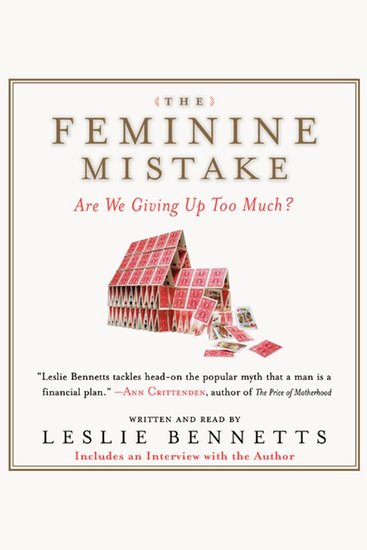
  • The Feminine Mistake - cover

    The Feminine Mistake

    Leslie Bennetts

    • 0
    • 0
    • 0
    Women are constantly being told that it's simply too difficult to balance work and family, so if they don't really ""have to"" work, it's better for their families if they stay home. Not only is this untrue, Leslie Bennetts says, but the arguments in favor of stay-at-home motherhood fail to consider the surprising benefits of work and the unexpected toll of giving it up. It's time, she says, to get the message across—combining work and family really is the best choice for most women, and it's eminently doable. 
    Bennetts raised two children while earning a living, and understands the challenges and the rewards firsthand. She and millions of other working women provide ample proof that there are many different ways to have kids, maintain a challenging career, and have a richly rewarding life as a result. When women sacrifice their financial autonomy by quitting their jobs, they become vulnerable to divorce as well as the potential illness, death, or unemployment of their breadwinner husbands. The truth is that when women gamble on dependency, most eventually end up on the wrong side of the odds. 
    Not since Betty Friedan has anyone offered such an eye-opening and persuasive argument for why women can—and should—embrace the joyously complex lives they deserve.
    Zum Buch
  • The Crusades - cover

    The Crusades

    Abigail Archer

    • 0
    • 0
    • 0
    Looking into the past, the Crusades seem incomprehensible. What combination of religious fervor, hatred of people of different faiths, and gall led Europeans of 1100 AD to make their way thousands of miles to conquer the Holy Land? Why did they continue for 200 years? How did the Crusades change the world? 
    The intriguing story is peppered with colorful characters. Over the centuries, this well-researched and written book argues, crusaders saw—and participated in—the evolution of warfare and the transformation of society from feudal fiefdoms to nations and empires. The story of the Crusades is a reminder, too, of the horrors wrought in the name of religion. The Crusades are seen by many Christians today as an exercise in fanaticism, an episode in which the teachings of Christ were used to justify the horrors perpetrated on innocents. That judgment is accurate, but not the whole story. The whole story is in these pages.
    Zum Buch