Unisciti a noi in un viaggio nel mondo dei libri!
Aggiungi questo libro allo scaffale
Grey
Scrivi un nuovo commento Default profile 50px
Grey
Iscriviti per leggere l'intero libro o leggi le prime pagine gratuitamente!
All characters reduced
Han Dynasty Legacy - cover

Han Dynasty Legacy

Amelia Khatri

Traduttore A AI

Casa editrice: Publifye

  • 0
  • 0
  • 0

Sinossi

"Han Dynasty Legacy" explores one of history's most transformative periods, examining how a dynasty founded by a peasant's son in 206 BCE revolutionized Chinese civilization and shaped East Asian culture for generations to come. The book masterfully weaves together archaeological evidence, historical records, and recent discoveries to paint a comprehensive picture of the Han Dynasty's profound influence on governance, technology, and culture during its four-century rule.

 
At its core, the book highlights three remarkable achievements that defined the Han period: the establishment of a sophisticated bureaucratic system based on merit rather than heredity, groundbreaking technological innovations including papermaking and advanced metallurgy, and lasting cultural developments that standardized written Chinese and elevated Confucianism to state doctrine. The civil service examination system, in particular, created unprecedented social mobility and established education as a pathway to power—a concept that would influence Chinese society for millennia.

 
The narrative progresses chronologically, starting with the dynasty's founding and moving through its technological and cultural achievements, while incorporating recent archaeological findings that offer fresh insights into daily life during the Han period. The book uniquely bridges multiple disciplines, from archaeology to political science, demonstrating how Han innovations continue to resonate in modern times. Through detailed maps, photographs, and primary source translations, readers gain an intimate understanding of how this remarkable dynasty's legacy extends far beyond its historical period, influencing everything from modern bureaucratic systems to cultural practices across East Asia.
Disponibile da: 30/01/2025.
Lunghezza di stampa: 95 pagine.

Altri libri che potrebbero interessarti

  • How to Be Calm - cover

    How to Be Calm

    Olivia Werner

    • 0
    • 0
    • 0
    [How to Be Calm] delves into the subtle art of finding peace in a world that never stops moving. Through intimate prose that reads like a conversation with a close friend, this guide illuminates the spaces between breaths, the moments between thoughts, where true tranquility resides. Unlike conventional self-help books that prescribe rigid routines, this work weaves together practical wisdom with poetic insight, showing how calmness isn't something to achieve but rather a natural state to remember. Drawing from both ancient wisdom and modern neuroscience, it explores how our relationship with silence, solitude, and simplicity shapes our capacity for peace. The book's unique approach lies in its recognition that calmness isn't the absence of chaos but the ability to find stillness within it, teaching readers how to navigate life's complexities with grace and presence. Through chapters that flow like gentle streams of consciousness, readers discover that the path to tranquility isn't about adding more techniques to their lives, but about remembering their innate capacity for peace.
    Mostra libro
  • Bridging Our Political Divide - How Liberals and Conservatives Can Understand Each Other and Find Common Ground - cover

    Bridging Our Political Divide -...

    Kenneth Barish

    • 0
    • 0
    • 0
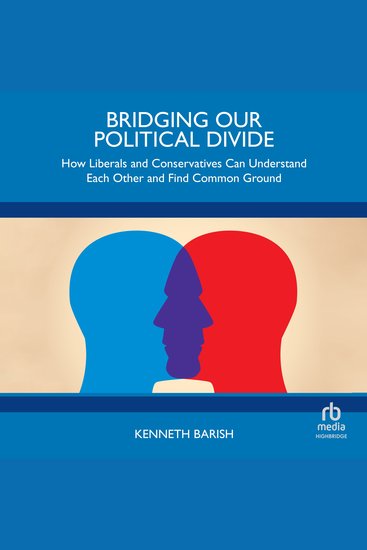
    Bridging Our Political Divide: How Liberals and Conservatives Can Understand Each Other and Find Common Ground is an essential contribution to a better national conversation. 


    Psychologist Kenneth Barish explains the sources and consistency of our political beliefs and why we continue to disagree about fundamental issues in American life. He offers antidotes to the angry, repetitive, and unproductive arguments that now dominate our political culture. Barish teaches us how to listen, think, and speak about our political opinions in a way that allows us to understand each other's concerns, resist false dichotomies and ideological certainty, see new perspectives and possibilities, and find common ground. The concluding chapter shows how we can move beyond partisan divisions toward pragmatic solutions and a better future for America's children. 


    This fundamentally hopeful book is an essential listen for students in all areas of study, for professionals in the fields of conflict resolution, communication, political science, and social psychology, and for anyone seeking to improve the quality of their conversations with people who may disagree with them, in both politics and in their personal relationships.
    Mostra libro
  • Man A Machine - cover

    Man A Machine

    Julien Offray de La Mettrie

    • 0
    • 0
    • 0
    This recording has been digitally produced by DeepZen Limited, using a synthesized version of an audiobook narrator’s voice under license. DeepZen uses Emotive Speech Technology to create digital narrations that offer a similar listening experience to human narration.  
     
    "Man a Machine" by Julien Offray de La Mettrie is a provocative treatise from the Enlightenment period that challenges traditional distinctions between humans and machines. In this work, La Mettrie contends that humans are purely material beings, driven by their physical components, akin to complex machines. He argues that all human thought, emotion, and behavior can be understood in terms of mechanical and physiological principles, dismissing the idea of an immaterial soul. This materialist perspective, revolutionary at the time, stirred controversy as it confronted religious and philosophical views about human nature and the soul.
    Mostra libro
  • The Chinese Great Leap Forward Famine - A Social and Political Catastrophe - cover

    The Chinese Great Leap Forward...

    Sarah Willards

    • 0
    • 0
    • 0
    The origins of the Great Leap Forward are deeply rooted in the political ambition and ideological vision of Mao Zedong, the founding leader of the People’s Republic of China. Following the success of the Communist revolution in 1949, Mao sought not only to rebuild a war-torn nation but to rapidly transform it into a socialist utopia capable of rivaling the industrial powers of the West. By the mid-1950s, China had already launched its First Five-Year Plan, modeled after the Soviet approach to centralized economic planning. Encouraged by early gains in heavy industry, Mao envisioned a second phase of development that would leap over traditional stages of economic growth. 
    At the heart of this vision was a push for mass mobilization. Mao believed that the sheer size of China's population could be harnessed as a revolutionary force capable of achieving miraculous feats. The Great Leap Forward, initiated in 1958, was designed to propel China into a modern communist society by emphasizing agricultural collectivization and rural industrialization simultaneously. Rather than relying on expert knowledge or slow-paced industrial planning, Mao favored decentralized enthusiasm and ideological commitment, trusting that the collective will of the people would overcome any technical limitations. 
    One of the most radical elements of this plan was the establishment of people’s communes, which replaced the traditional family unit and private farming with large-scale collective labor. Households were merged into communes comprising thousands of individuals, who would eat, sleep, and work under strict communal arrangements. The idea was to increase efficiency and free up labor for industrial production, especially in rural areas where backyard furnaces were set up to produce steel. This was accompanied by an aggressive campaign to eliminate what were seen as capitalist tendencies, including private plots and individual incentives.
    Mostra libro
  • Once We Were Slaves - The Extraordinary Journey of a Multiracial Jewish Family - cover

    Once We Were Slaves - The...

    Laura Arnold Leibman

    • 0
    • 0
    • 0
    An obsessive genealogist and descendent of one of the most prominent Jewish families since the American Revolution, Blanche Moses firmly believed her maternal ancestors were Sephardic grandees. Yet she found herself at a dead end when it came to her grandmother's maternal line. Using family heirlooms to unlock the mystery of Moses's ancestors, Once We Were Slaves overturns the reclusive heiress's assumptions about her family history to reveal that her grandmother and great-uncle, Sarah and Isaac Brandon, actually began their lives as poor Christian slaves in Barbados. Tracing the siblings' extraordinary journey throughout the Atlantic World, Leibman examines artifacts they left behind in Barbados, Suriname, London, Philadelphia, and, finally, New York, to show how Sarah and Isaac were able to transform themselves and their lives, becoming free, wealthy, Jewish, and—at times—white. While their affluence made them unusual, their story mirrors that of the largely forgotten population of mixed African and Jewish ancestry that constituted as much as ten percent of the Jewish communities in which the siblings lived, and sheds new light on the fluidity of race—as well as on the role of religion in racial shift—in the first half of the nineteenth century.
    Mostra libro
  • Younger Dryas Period The: The History of the Earth’s Drastic Climate Change at the End of the Pleistocene Era - cover

    Younger Dryas Period The: The...

    Editors Charles River

    • 0
    • 0
    • 0
    From about 12,900 to 11,700 before present (BP), near Ice Age conditions returned to the Northern Hemisphere of the planet. It was a sudden shift from the warm temperatures that had prevailed for nearly 2,000 years. This period is referred to by archaeologists, geologists, and earth scientists as the Greenland Stadial, but it is more commonly known as the Younger Dryas. The Younger Dryas marked the end of the last glacial period, the end of the Pleistocene Era, and the beginning of the Holocene Era, which is the current era. It was a period of great change, when climate change happened quite quickly, directly affecting the flora, fauna, and humans of the Northern Hemisphere in the process. The impact on the human populations was perhaps most important because, in some places, it virtually destroyed emerging cultures, while in other places, it might have propelled humans to develop new survival traits and technologies later used to move humanity into the Neolithic era. Although scholars now know quite a bit about the Younger Dryas, many elements of it are still debated. Other aspects serve as a predictor of what humans can expect in the future. 
    	There is, however, still plenty of information about the Younger Dryas that remains unknown or open to debate. Not all scholars agree on the dates of the Younger Dryas or how long it lasted. Even more controversial are the alternate theories about what caused the Younger Dryas and the effect it had on the Northern Hemisphere’s bio-populations. This book examines the background of the Younger Dryas, its effects on bio-populations, and how it contributed to the emergence of the Neolithic Era. Alternative theories will be examined and compared to more standard ideas currently prevailing in academia.
    Mostra libro