Join us on a literary world trip!
Add this book to bookshelf
Grey
Write a new comment Default profile 50px
Grey
Subscribe to read the full book or read the first pages for free!
All characters reduced
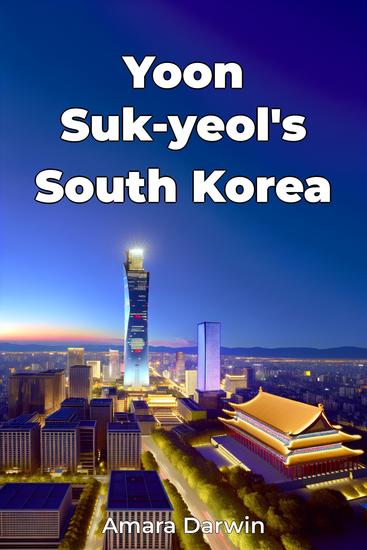
Yoon Suk-yeol's South Korea - cover

Yoon Suk-yeol's South Korea

Amara Darwin

Translator A AI

Publisher: Publifye

  • 0
  • 0
  • 0

Summary

"Yoon Suk-yeol's South Korea" offers a comprehensive analysis of how South Korea's conservative president is reshaping one of Asia's most influential democracies during a pivotal period of global change. The book examines three crucial dimensions of Yoon's presidency: his market liberalization economic reforms, his strategic approach to regional diplomacy, and his commitment to strengthening the US-South Korea alliance.

 
Against the backdrop of South Korea's transition from the Moon Jae-in administration, the book illuminates how Yoon's background as a prosecutor influences his governance style and policy decisions. Through methodically organized sections, the narrative explores Yoon's economic vision for regulatory reform and innovation-driven growth, followed by an examination of his foreign policy doctrine that emphasizes stronger ties with democratic allies and a more assertive stance toward North Korea.

 
The book draws from extensive research, including government documents, economic data, and policymaker interviews, presenting a balanced analysis of both the potential and challenges of Yoon's policy agenda. What distinguishes this work is its multidisciplinary approach, connecting political science, economics, and international relations to demonstrate how South Korea's domestic policies influence regional dynamics and global partnerships.

 
While maintaining scholarly rigor, the book remains accessible to readers interested in Asian politics and economics, offering valuable insights for policymakers, business leaders, and informed citizens seeking to understand South Korea's evolving role in global affairs.
Available since: 01/17/2025.
Print length: 103 pages.

Other books that might interest you

  • Prince The (Fingerprint Classics) - cover

    Prince The (Fingerprint Classics)

    Niccolò Machiavelli

    • 0
    • 0
    • 0
    The Prince by Niccolò Machiavelli is a timeless political treatise that explores the dynamics of power, leadership, and statecraft. Written in the early 16th century, this concise yet provocative work offers pragmatic advice to rulers on how to gain, maintain, and consolidate authority, often advocating for realism over idealism. Machiavelli examines historical examples and human behavior to present strategies that prioritize effectiveness over morality, making the book both influential and controversial. Its insights into political maneuvering and the nature of authority have cemented it as a foundational text in political philosophy and realpolitik.
    Show book
  • Psychological Warfare - Using Psychological Tactics to Undermine or Control - cover

    Psychological Warfare - Using...

    Cito Harder

    • 0
    • 0
    • 0
    Psychological warfare is the deliberate use of tactics designed to influence, manipulate, and control the thoughts, emotions, and behaviors of individuals or groups. It involves the strategic deployment of psychological tactics to achieve specific objectives, often with the goal of weakening the will, confidence, and decision-making abilities of an opponent. Unlike physical warfare, which relies on the use of force and violence, psychological warfare focuses on undermining an adversary’s mental state, creating doubt, confusion, fear, or anxiety. The concept of psychological warfare spans across military, political, social, and personal domains, and its methods are utilized to achieve both large-scale and individual objectives. 
    At its core, psychological warfare operates by exploiting the weaknesses of human perception, beliefs, and emotions. It seeks to manipulate how people think, feel, and act, often in ways that are subtle and hard to detect. Through the strategic use of information, misinformation, fear, and emotional appeals, psychological warfare can alter the course of events and influence outcomes in a way that physical force alone cannot achieve. This manipulation can be direct, as in the use of propaganda, or more covert, as in the use of gaslighting to distort reality and create confusion. 
    Psychological warfare can be seen in many contexts, from international conflict and military operations to corporate competition, political campaigns, and even personal relationships. For example, in warfare, psychological tactics are employed to break the enemy’s morale, instill fear, and create division within their ranks. In the political arena, psychological warfare is often used to manipulate public opinion, spread propaganda, and discredit opponents.
    Show book
  • How Does Change Happen? - Scenes from the Frontlines of Activism - cover

    How Does Change Happen? - Scenes...

    Sam Gonçalves

    • 0
    • 0
    • 0
    Mass protests and direct action have been familiar tactics against the many crises of the 21st century. Though methods vary, there's a collective longing for meaningful and transformative action. Some are deemed too weak, others too disruptive: from Instagram tiles to cans of soup thrown on famous paintings.
    Through conversations with activists and organisers, Sam Gonçalves recounts stories of protest and the fight for change, from a community of landless workers in Southern Brazil, to chefs unionising their workplace in Glasgow, Scotland. These narratives reveal the opportunities and challenges that are part of the difficult work of creating change, a wrestling with the question: how does change happen?
    Having a 'positive impact' in the world is often relegated to the 'personal', an individual endeavour. Gonçalves investigates that assumption and explores ways communities have resisted collectively, and fought against the individualising forces surrounding them.
    Show book
  • I Am the Law - How Judge Dredd Predicted Our Future - cover

    I Am the Law - How Judge Dredd...

    Michael Molcher

    • 0
    • 0
    • 0
    He is the law—and you better believe it! 


    Judge, jury, and executioner, Judge Dredd is the brutal comic book cop policing the chaotic future urban jungle of Mega-City One, created by John Wagner and Carlos Ezquerra and launching in the pages of 2000 AD in 1977. 


    But what began as a sci-fi action comic quickly evolved into a searing satire on hardline, militarized policing and "law and order" politics, its endless inventiveness and ironic humor acting as a prophetic warning about our world today—and with important lessons for our future. 


    Blending comic book history with contemporary radical theories on policing, I Am The Law takes key Dredd stories from the last forty-five years and demonstrates how they provide a unique wake up call about our gradual, and not so gradual, slide towards authoritarian policing. 


    From the politicization of policing to "zero tolerance," from violent suppression of protest to the rise of the surveillance state, I Am The Law examines how a comic book warned us about the chilling endgame of today's "law and order" politics.
    Show book
  • Moderate Conservatism - Reclaiming the Center - cover

    Moderate Conservatism -...

    John Kekes

    • 0
    • 0
    • 0
    Moderate Conservatism: Reclaiming the Center by John Kekes is a response to attacks on the United States' 300-year-old constitutional democracy by extremists on the left and the right. It makes a reasoned case for moderation and the defense of a political system that has endured because it has balanced the often-conflicting claims of justice, liberty, equality, prosperity, and security. That balance is now threatened by extremists who ignore all else but their grievances. They are blind to the destructive consequences of their attacks on the conditions on which the well-being of all Americans, including their own, depends. 


    The aim of Moderate Conservatism is to protect the United States' political system. It is a defense of what Americans have and are in danger of losing. Central to it is the rarely conscious patriotism of many millions of citizens who live private lives, earn a living, raise a family, and rely on the political system to protect the conditions in which they can continue to do so. They sustain life as Americans know it. And that life is now threatened by the destructive attacks of extremists. The United States is in urgent need of the balance and moderation this book describes and defends.
    Show book
  • One Nation Under the Influence - America's Drug Habit and How We Can Overcome It - cover

    One Nation Under the Influence -...

    Kevin A. Sabet

    • 0
    • 0
    • 0
    We are in the midst of the worst drug crisis in American history. What are we going to do about it?Around 100,000 Americans died of a drug overdose last year—nearly double the number who died in Vietnam. More than 1,000,000 have perished since 2000, thanks largely to an explosion of fentanyl and other addictive opioids. But fentanyl, abundant methamphetamine, and other lethal drugs are not the only things that are killing us: our policy is. So far, America has lacked the will to do better. That must change, and this book tells us how.No one is immune, which is why Kevin Sabet has authored this remarkable book. Sabet, dubbed the "the quarterback of the new anti-drug movement" by Salon, has spent most of his life battling the destructive effects of drugs. In One Nation Under the Influence, he asks hard questions and provides clear answers, taking listeners from the streets of San Francisco and New York to the southern border, up to Canada, and across to Europe to show how we can chart a necessary way forward. The solutions are out there, if only we have the will to apply them.
    Show book