Unisciti a noi in un viaggio nel mondo dei libri!
Aggiungi questo libro allo scaffale
Grey
Scrivi un nuovo commento Default profile 50px
Grey
Iscriviti per leggere l'intero libro o leggi le prime pagine gratuitamente!
All characters reduced
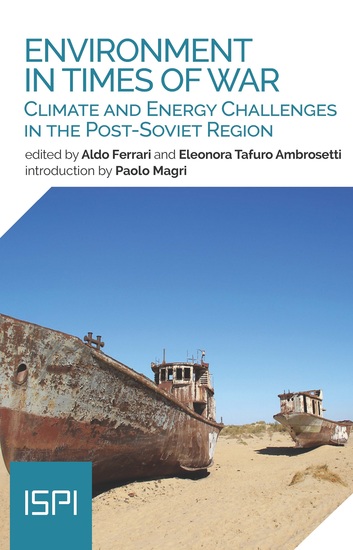
Enviroment in Times of War - Climate and Energy Challenges in the Post-Soviet Region - cover

Enviroment in Times of War - Climate and Energy Challenges in the Post-Soviet Region

Aldo Ferrari, Eleonora Tafuro Ambrosetti

Casa editrice: Ledizioni

  • 0
  • 0
  • 0

Sinossi

The impact of Russia's war against Ukraine has been devastating both politically and environmentally. On top of the environmental damage directly caused by military operations, the invasion has put an abrupt end to the EU-Russia "green cooperation", which had previously raised many hopes. At the same time, it has also shifted international attention away from climate and environmental concerns, which are particularly acute in the post-Soviet region.
This Report analyses some of the main climate change and environmental issues in the post-Soviet space, providing an initial assessment of the invasion's impact. The bulk of the latest scholarly and policy production on these matters focuses on Russia – given the country's geopolitical and energy relevance. However, this analysis finds that environmental disasters such as the desertification of the Aral Sea transcend state borders and require a broader approach both from an analytic and policy standpoint.
Disponibile da: 27/07/2022.
Lunghezza di stampa: 145 pagine.
Altri libri che potrebbero interessarti

  • Spirit of the Laws The: Book Summary & Analysis - cover

    Spirit of the Laws The: Book...

    Briefly Summaries

    • 0
    • 0
    • 0
    This is a concise summary and analysis of The Spirit of the Laws, by Montesquieu.
     
    It is not the original book and is not affiliated with or endorsed by 
    Montesquieu.
     
    Ideal those seeking a quick and insightful overview.
     
    The Spirit of the Laws is a groundbreaking exploration of political theory, law, and governance. It examines the principles that shape governments, emphasizing the balance of power, the importance of justice, and the role of social and cultural factors in shaping legal systems. From dissecting the separation of powers to analyzing the influence of climate and geography on societies, this work remains a cornerstone of modern political thought and a vital resource for understanding the foundations of democracy and human rights.
    Mostra libro
  • Cosmos and Republic - Arendtian Explorations of the Loss and Recovery of Politics - cover

    Cosmos and Republic - Arendtian...

    Wolfgang R. Heuer

    • 0
    • 0
    • 0
    In 20 essays inspired by Hannah Arendt's analysis of crisis-ridden modernity, Wolfgang R. Heuer addresses aspects of depoliticization and the loss of politics, and thus of freedom. The wide-ranging essays are grouped in five sections: When Politics Vanishes, The Call of Responsibility, Images and Emotions, Federations, and From Plurality to Cosmos. They lead to the insight that the crises of our time require a common change of perspective towards ecological and political sustainability, the unity of »Cosmos and Republic«.
    Mostra libro
  • Freedom of Speech - Navigating the Balance Between Expression and Responsibility - cover

    Freedom of Speech - Navigating...

    Marcus Klein

    • 0
    • 0
    • 0
    Freedom of speech is a cornerstone of democratic societies, integral to the exercise of individual autonomy and the pursuit of truth. At its core, it is the right to express ideas, opinions, and beliefs without fear of government reprisal or censorship. This principle is enshrined in numerous legal documents, most notably the First Amendment to the U.S. Constitution, which guarantees "the freedom of speech, or of the press," protecting the individual’s right to speak openly in the public sphere. 
      
    The origins of free speech can be traced back to philosophical and political thinkers of the Enlightenment era, who emphasized the importance of reason, individual rights, and personal liberty. Thinkers such as John Locke, Voltaire, and John Stuart Mill argued that the free exchange of ideas was essential for the flourishing of society, allowing for the progress of knowledge, the correction of errors, and the protection of political freedom. These ideas laid the groundwork for the modern understanding of free expression as a fundamental human right. 
      
    However, the right to free speech is not absolute. Throughout history, the boundaries of this freedom have been tested by a wide range of societal, political, and ethical concerns. From the regulation of speech in times of war or national security threats to the ongoing debates over hate speech, defamation, and misinformation, societies have struggled to find a balance between protecting free expression and safeguarding the common good. This tension continues to shape the debate surrounding free speech, particularly in the context of emerging technologies like social media, which have transformed the landscape of communication.
    Mostra libro
  • Summary of Sam Quinones’s The Least of Us - cover

    Summary of Sam Quinones’s The...

    Falcon Press

    • 0
    • 0
    • 0
    Buy now to get the main key ideas from Sam Quinones’s The Least of Us 
      
    Sam Quinones’s The Least of Us (2021) is an in-depth analysis of drug use and addiction in America, and how it has been exacerbated by Mexican smugglers, drug traffickers, and pharmaceutical companies. Quinones chronicles the American opioid epidemic and explores the far-reaching damage generated by the meth and fentanyl crises. This follow-up to his bestseller Dreamland is a powerful combination of scientific research and new insights into the reality of drug use.  
    From real-life experiences of drug victims and addicts, Quinones tells stories of pain, weakness, and wreckage. He also reveals how food chains and international corporations indirectly use the language of drugs to target consumers and satisfy their cravings. 
     
    Mostra libro
  • What Makes a Terrorist - Economics and the Roots of Terrorism - cover

    What Makes a Terrorist -...

    Alan B. Krueger

    • 0
    • 0
    • 0
    Why we need to think more like economists to successfully combat terrorismIf we are to correctly assess the root causes of terrorism and successfully address the threat, we must think more like economists do. Alan Krueger’s What Makes a Terrorist, explains why our tactics in the fight against terrorism must be based on more than anecdote, intuition, and speculation.Many popular ideas about terrorists  are fueled by falsehoods, misinformation, and fearmongering. Many believe that poverty and lack of education breed terrorism, despite a wealth of evidence showing that most terrorists come from middle-class and often college-educated backgrounds. Krueger closely examines the factors that motivate individuals to participate in terrorism, drawing inferences from terrorists’ own backgrounds and the economic, social, religious, and political environments in the societies from which they come. He describes which countries are the most likely breeding grounds for terrorists, and which ones are most likely to be their targets. Krueger addresses the economic and psychological consequences of terrorism and puts the threat squarely into perspective, revealing how our nation’s sizable economy is diverse and resilient enough to withstand the comparatively limited effects of most terrorist strikes. He also calls on the media to be more responsible in reporting on terrorism.Bringing needed clarity to one of the greatest challenges of our generation, this 10th anniversary edition of What Makes a Terrorist features a new introduction by the author that discusses the lessons learned in the past decade from the rise of ISIS and events like the 2016 Pulse nightclub attack in Orlando, Florida.
    Mostra libro
  • Democracy Rules - cover

    Democracy Rules

    Jan-Werner Müller

    • 0
    • 0
    • 0
    A much-anticipated guide to saving democracy, from one of our most essential political thinkers. 


    Everyone knows that democracy is in trouble, but do we know what democracy actually is? Jan-Werner Müller, author of the widely translated and acclaimed What Is Populism?, takes us back to basics in Democracy Rules. In this short, elegant volume, he explains how democracy is founded not just on liberty and equality, but also on uncertainty. The latter will sound unattractive at a time when the pandemic has created unbearable uncertainty for so many. But it is crucial for ensuring democracy's dynamic and creative character, which remains one of its signal advantages over authoritarian alternatives that seek to render politics (and individual citizens) completely predictable. 


    Müller shows that we need to re-invigorate the intermediary institutions that have been deemed essential for democracy's success ever since the nineteenth century: political parties and free media. Contrary to conventional wisdom, these are not spent forces in a supposed age of post-party populist leadership and post-truth. Müller suggests concretely how democracy's critical infrastructure of intermediary institutions could be renovated, re-empowering citizens while also preserving a place for professionals such as journalists and judges.
    Mostra libro