Unisciti a noi in un viaggio nel mondo dei libri!
Aggiungi questo libro allo scaffale
Grey
Scrivi un nuovo commento Default profile 50px
Grey
Iscriviti per leggere l'intero libro o leggi le prime pagine gratuitamente!
All characters reduced
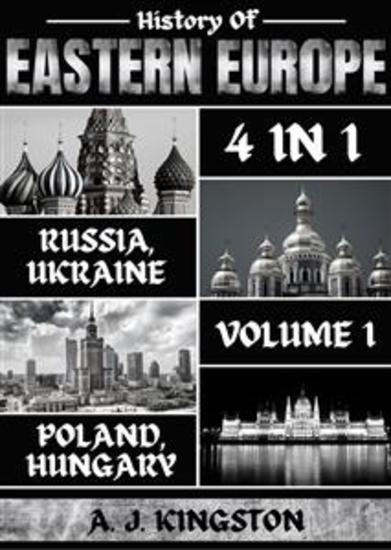
History Of Eastern Europe: 4 In 1 - Russia Ukraine Poland & Hungary - cover

History Of Eastern Europe: 4 In 1 - Russia Ukraine Poland & Hungary

A.J. A.J.Kingston

Casa editrice: A.J.Kingston

  • 0
  • 0
  • 0

Sinossi

Step into the captivating world of Eastern Europe with our book, "History of Eastern Europe: Russia, Ukraine, Poland & Hungary". This comprehensive volume delves deep into the rich history and culture of these four fascinating countries. From the ancient civilizations of the Scythians and the Slavs to the modern-day challenges of populism and migration, this book covers it all.
Learn about the turbulent history of Russia, from the rise of the Kievan Rus to the Soviet era and beyond. Discover the unique culture and traditions of Ukraine, with its colorful folklore and complex political landscape. Explore the complex history of Poland, from its medieval glory days to the struggles of World War II and the Communist period. And delve into the fascinating world of Hungary, with its rich artistic and literary traditions and tumultuous political history.
Whether you're a history buff, a traveler seeking to understand the complexities of these four countries, or simply interested in the diverse cultures and traditions of Eastern Europe, this book is for you. With detailed and engaging storytelling, this book brings to life the people, events, and ideas that have shaped the region over the centuries.
Written by expert historians and scholars, this book is a must-read for anyone interested in understanding the complexities of Eastern Europe. With its in-depth analysis and compelling narrative, "History of Eastern Europe: Russia, Ukraine, Poland & Hungary" is the ultimate guide to this endlessly fascinating region. Don't miss out on this essential addition to your bookshelf.
Disponibile da: 12/03/2023.

Altri libri che potrebbero interessarti

  • Little Women Podcast: The Real-Life Friedrich Bhaer - cover

    Little Women Podcast: The...

    Niina Niskanen

    • 0
    • 0
    • 0
    There was a real-life Friedrich Bhaer. In fact, Louisa May Alcott wanted to marry him and even start a school with him. This man appears in literal disguises in all of her novels. He is Friedrich in Little Women, Mac in Rose in Bloom and David in Work and many more. Henry and Louisa shared a deep friendship, was it more than friendship? In Little Women Jo's and Friedrich's age gap is 16 years. It is the same age difference as between Henry and Louisa. 
    One of the models for Jo and Friedrich might be Louisa's friend Elizabeth and her husband. Her life was surprisingly similar to the book Jo. She wasn't a writer, but there are parallels. Based on what I have found, her marriage with her lawyer husband was a happy one. She was devoted to the educational work and in the same way, as Jo does, she promoted co-education, for both male and female students. She became a dean of the university. Same way as Jo who becomes the matriarch of the Bhaer Academy in "Jo´s Boys".. 
    There is a very compelling case to be made that Henry David Thoreau was the real-life Friedrich Bhaer. Louisa once called her friend Emerson "The God of my idolatry" but it was Henry who merited her lifelong affection. The ties between Henry and the Alcotts are more extensive than one might expect. From the time when the Alcotts moved to Concord in March 1840 until Henry's passing in 1862. He was a frequent guest in the Alcott´s home taking tea or dinner with the family. Bronson who admired the young man's intellect often visited him in his hut at Walden Pond. If the connection between Henry and the Alcotts was strong, the connection between Louisa and Henry was even stronger
    Mostra libro
  • 'Til Death Did We Part - cover

    'Til Death Did We Part

    Justin Erickson

    • 0
    • 0
    • 0
    A love story between two men. This is my personal account of falling in love with a man who struggled with alcohol and drug abuse. I dive into the roots of what unconditional love can lead someone like me and perhaps you! It's a story of surviving abuse and evil while witnessing the physical, mental, emotional and spiritual decay of the man I once knew and fell in love with. It's a testament that you too don't have to be treated any less than how you would want to be treated. The fight is worth fighting and you are not alone in yours!
    Mostra libro
  • Influence - The Science of Persuasion and Its Impact on Decision Making - cover

    Influence - The Science of...

    Wesley Felt

    • 0
    • 0
    • 0
    This book contains two titles. Here are some snippets of what you can find in there: 
    Book 1 - In today’s world, our perception fundamentally shapes our reality. This explains why two people can have entirely different interpretations of the same event. The meaning we assign to events stems from our beliefs and emotions. So, can altering our perception actually change our world? If so, how can this be achieved? And if it's possible, how can we mold our reality to create a better one? 
    What we see defines what we believe, and what we believe dictates what we consider true. Our sense of truth then becomes our reality. Thus, our perception molds our reality. Although we share the same world, we each focus on our own perceived truths. Even though everyone has eyes, each person views the world in a unique way. It’s easy to find what we’re looking for, but harder to notice what we’re not searching for. For example, one person might see a glass as half-full while another sees it as half-empty. 
    Book 2 - Gender does influence persuasion, largely due to the emotional and intellectual differences between men and women. It is often believed that the direct, straightforward approach typically associated with men is more effective in persuasion than the emotionally nuanced methods often attributed to women. 
    One of the key differences between men and women is that men are primarily visually stimulated. This trait, while sometimes criticized as shallow, is rooted in our DNA and evolution. Historically, men were driven to seek healthy partners for reproduction, as visual cues were the primary way to assess health before the advent of modern medicine. In the days of early human society, a woman of child-bearing age who appeared healthy was naturally attractive to men, as it signaled good prospects for offspring.
    Mostra libro
  • Mughal Empire The: The History of the Modern Dynasty that Ruled Much of India Before the British - cover

    Mughal Empire The: The History...

    Editors Charles River

    • 0
    • 0
    • 0
    In the late 15th century, Western Europe entered the Renaissance, which is often credited with the origins of modern, scientific thought. The Age of Exploration also began around that time, and 1517 is when the Reformation began. Meanwhile, the Islamic world was also quickly evolving around the same time, with the Ottoman Empire expanding into Eastern Europe and wiping the Orthodox Christian Byzantine Empire off the face of the map. And while the Ottomans were establishing themselves as the premier Islamic power with the help of early gunpowder weapons, hundreds of miles away in Central Asia, another “gunpowder empire” was forming.  
    	The Mughals, a group with Turkish and Mongolian roots, also used gunpowder weapons to sweep into northern India, topple the existing Islamic dynasty in Delhi, and eventually subject most of India to their rule. The term “gunpowder empire” was originally coined by Russian scholar V. V. Bartold and popularized by American historians William McNeil and Marshall Hodgson in the mid-20th century to describe the Islamic Ottoman, Safavid, and Mughal empires, which they claimed came to power through gunpowder. Although that core thesis has been challenged by historians in recent years, who argue that gunpowder weapons were a feature or result of the rise of these empires, not the cause for them, the term is still used (Streusand 2011, 3).  
    	To be fair, the Mughals rose through a combination of political acumen and battlefield brutality, and they held onto their empire for hundreds of years in much the same way. In the process, the Mughals developed a state that was unique in many ways, adopting elements of Islamic culture and meshing them with native Indian culture and even Western European culture. When the British conquered India in the mid-19th century, they had the benefit of inheriting the Mughal system, which, despite many problems, proved to be a suitable template for rule over a land as vast and diverse as India.
    Mostra libro
  • It's Not Your Fault - cover

    It's Not Your Fault

    Sally Cook

    • 0
    • 0
    • 0
    It's Not Your Fault delves into what can only be described as communication nightmares as a patient of the medical system. This true accounts show how fragile the trust between medical practitioner and patient can be and how it can be psychologically compromised bringing about negative effects. For example the author was already half way through her first pregnancy when a well known and respected obstetrician/gynaecologist began treating her for infertility and the possibility of a dangerously big tumour,  That large lump turned out to be a baby,
    Mostra libro
  • America’s Defeat - A Revolutionary War Won by the British - cover

    America’s Defeat - A...

    Marcus Draysun

    • 0
    • 0
    • 0
    The American colonies in the mid-18th century were a thriving part of the British Empire, but tensions had been brewing for decades. What began as minor grievances over trade and governance escalated into a full-scale rebellion. British policies, aimed at tightening control over the colonies, ignited widespread dissatisfaction, planting the seeds of revolution. 
    One of the earliest sources of discontent was the British system of taxation. The Sugar Act of 1764 and the Stamp Act of 1765 imposed direct levies on the colonies, enraging merchants, publishers, and legal professionals. The colonists, who had no direct representation in the British Parliament, saw these taxes as a blatant overreach. Their rallying cry—“No taxation without representation”—became a defining slogan of the growing resistance. The Stamp Act’s repeal in 1766 provided temporary relief, but the British government soon followed with new policies, including the Townshend Acts, which further strained relations. 
    The presence of British troops in colonial cities only exacerbated tensions. Stationed to enforce British laws and maintain order, soldiers were often viewed as an occupying force. Clashes between civilians and the military became frequent, culminating in the infamous Boston Massacre of 1770, where British troops fired into a crowd of unarmed colonists, killing five. This event, heavily publicized by Patriot leaders, fueled anti-British sentiment and strengthened calls for defiance.
    Mostra libro