Unisciti a noi in un viaggio nel mondo dei libri!
Aggiungi questo libro allo scaffale
Grey
Scrivi un nuovo commento Default profile 50px
Grey
Iscriviti per leggere l'intero libro o leggi le prime pagine gratuitamente!
All characters reduced
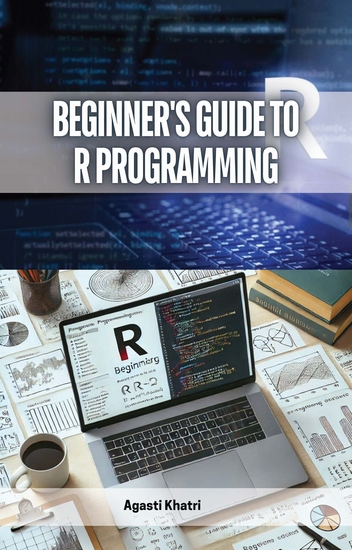
Beginner's Guide to R Programming - cover

Beginner's Guide to R Programming

Agasti Khatri

Casa editrice: Educohack Press

  • 0
  • 0
  • 0

Sinossi

Discover the world of data analysis with "Beginner's Guide to R Programming." This comprehensive resource is crafted to help individuals learn the R programming language and explore its diverse applications. Whether you're a complete beginner or an experienced analyst, our book offers a structured learning path that starts with the basics and progresses to advanced topics like statistical analysis, data visualization, and machine learning.

Each chapter includes practical examples, exercises, and real-world case studies, encouraging hands-on experimentation with R code. You'll delve into data types, functions, data manipulation, statistical analysis, data visualization, and more, building a solid foundation in R programming and data analysis.

Complex concepts are explained in clear, easy-to-understand language, with visual aids, code snippets, and step-by-step tutorials to help you grasp key ideas effectively. The book emphasizes practical applications of R in real-world scenarios, showcasing how you can use R to solve problems, analyze data, make informed decisions, and communicate insights.

With access to supplementary resources, including downloadable datasets, code samples, and additional exercises, you'll further enhance your learning experience and practice your skills.
Disponibile da: 20/02/2025.
Lunghezza di stampa: 252 pagine.


Altri libri che potrebbero interessarti

  • Salton Sea The: The History of America’s Most Unique Lake - cover

    Salton Sea The: The History of...

    Editors Charles River

    • 0
    • 0
    • 0
    In the list of popular American geological oddities and attractions, one sizeable phenomenon remains surprisingly unfamiliar to the average citizen. This may be due in part to its remote desert location, but perception of the Salton Sea in southern California is also laden with environmental concerns and is in a constant state of flux. The extensive body of inland saltwater hides a glorious commercial past and has served as an important wildlife preserve but approaches a seemingly inevitable crisis in the coming decade. 
    	The Salton Sea in not directly “on the way” to anything substantial or iconic, and is situated one hour’s drive from Palm Springs, 30 miles to the south of Indio, California on Highway 111. Its distance from Los Angeles and San Diego is approximately three hours driving time. The most recognizable natural phenomenon of Imperial and Riverside counties, it is surrounded by a rural area comprised of predominantly migrant farm workers and located in the southern Colorado desert area known as the Salton Trough, or Salton Sink. 
    	Despite being a natural occurrence filling and emptying intermittingly throughout history, the current presence of this large inland sea surrounded by sand was created accidentally in the early 20th century. First formed around 700 CE, the original and much larger version of the great inland lake was called Lake Cahuilla, connected to the Sea of Cortez. By the time the first Europeans arrived in the 16th century, the basin was completely dry as Don Juan Bautista led the first party across the basin’s expanse.  
    	The “accidental” creation of the lake’s modern version was a product of the rising Colorado that destroyed a crucial section of the canal system designed to help farmers. Millions of gallons of water were forced into the lowland area. Beyond the one breach, the entire volume of the river flowed into the Salton lowlands for nearly two years before engineers finally stopped it.
    Mostra libro
  • On Assisted Suicide - cover

    On Assisted Suicide

    Stephanie Gray Connors

    • 0
    • 0
    • 0
    Assisted suicide and euthanasia are being legalized or at least debated throughout much of the world today. But should suicide ever be assisted? When someone is suffering and no longer wants to live, and asks another to help him end his life, what is the right response? In this powerful volume in Word on Fire’s Dignity Series, Stephanie Gray Connors engages both the mind and the heart in answering these increasingly urgent questions. Through ten proposed principles to help guide the conversation, On Assisted Suicide will draw readers into the mysteries of joy and suffering, life and death, and the unconditional dignity of the human person.   Why dignity? Because human dignity (dignitas, the worthiness of each person) is the foundation of all human society. Jacques Maritain, the Catholic philosopher who helped draft the United Nations Declaration of Human Rights, affirmed this in saying, “The privilege connected with the dignity of the person is inalienable, and human life involves a sacred right.”  In a time of political polarization, social division, and the ongoing “culture wars,” the Dignity Series aims to refocus our attention on human dignity. The series enters into the great mystery of human life with wonder and reverence, and unflinchingly faces grave threats to human dignity, many of them ignored in the culture today.  Each volume in the series will examine one of those threats, drawing on rational argument, spiritual sources, and above all, personal stories that take readers into the lived experience on the frontier of the issue. This broad mix of ideas and approaches acknowledges that a wide variety of backgrounds and personalities shape how we interact with these questions—and that if a book is to help us grow, it has to stir our hearts as well as activate our minds. The Dignity Series emerges out of and points back to the whole-life ethic of Catholic social teaching, which is grounded in the principle of human dignity. “Social justice,” the Catechism of the Catholic Church teaches, “can be obtained only in respecting the transcendent dignity of man” (CCC 1929). And that dignity, on the Catholic reading, can only finally rest on our status as creatures made in the image and likeness of God (Gen. 1:26). However, these books are for anyone—Catholic or non-Catholic, religious or nonreligious—who wrestles with these issues and longs to see a more informed and considerate approach to them.  To see a full list of titles in the Dignity Series, please visit www.wordonfire.org/dignity.
    Mostra libro
  • Explainable AI - Demystifying AI Decisions A Guide to Transparency and Trust - cover

    Explainable AI - Demystifying AI...

    James Ferry

    • 0
    • 0
    • 0
    In an era where artificial intelligence (AI) shapes critical decisions in healthcare, finance, law, and beyond, understanding how AI arrives at its conclusions is paramount. "Explainable AI: Demystifying AI Decisions" is an essential guide that unveils the inner workings of AI models, making them transparent and understandable to all. 
    Authored by experts at the forefront of AI research and application, this book demystifies the complex algorithms that underpin modern AI systems. It introduces readers to the core principles of Explainable AI (XAI) — transparency, interpretability, accountability, and fairness — and illustrates how these principles ensure AI decisions align with ethical standards and regulatory requirements. 
    Through practical examples and case studies, "Explainable AI" equips readers with the tools to:Understand AI Decisions: Explore how AI models make predictions and recommendations, breaking down the process into comprehensible steps.Detect and Mitigate Bias: Learn techniques for identifying biases within AI systems and strategies to mitigate them, promoting fairness and equity.Enhance Trust and Accountability: Gain insights into how transparency and interpretability foster trust among users, stakeholders, and the broader community.Navigate Ethical Challenges: Address ethical considerations in AI development, including privacy, consent, and the societal impact of AI technologies. 
    "Explainable AI" provides invaluable knowledge and practical guidance. It empowers readers to harness the potential of AI responsibly, ensuring that AI technologies benefit society while upholding ethical standards and transparency. 
     
    Mostra libro
  • R Programming - R Data Analysis and Statistics - cover

    R Programming - R Data Analysis...

    Andy Vickler

    • 0
    • 0
    • 0
    Interested in statistical computing? 
    R Programming: Data Analysis and Statistics is a beginner-friendly book. It is written in an accessible way, and deals with the basics as well as more complex problems. 
    No prior statistical knowledge is required. 
    The following topics are covered :R programming Data ManipulationR Data VisualizationLarge Datasets Data Analysis and StatisticsR Supervised LearningAnd much more 
    This book may also help more advanced programmers expand their skills.
    Mostra libro
  • What Do Bees Think About? - cover

    What Do Bees Think About?

    Mathieu Lihoreau

    • 0
    • 0
    • 0
    Explore the mind of a bee and learn what drives its behavior. 


    Have you ever observed a bee up close and wondered what was going on inside its head? Like ours, insects' brains take up most of the space in their heads, but their brains are smaller than a grain of rice, only 0.0002% as large as ours. But what purpose does the insect brain serve, and how does that drive their creativity, morality, and emotions? 


    Bees in particular exhibit unexpected and fascinating cognitive skills. In What Do Bees Think About? animal cognition researcher Mathieu Lihoreau examines a century of research into insect evolution and behavior. He explains recent scientific discoveries, recounts researchers' anecdotes, and reflects on the cognition of these fascinating creatures. Lihoreau's and other scientists' research on insects reinforces the importance of protecting and preserving insects such as bees: after all, our survival on the planet is deeply dependent on theirs. This book provides an eye-opening window into the world of insect cognition and echoes an important ecological message about bees—they are intelligent creatures sharing the same fragile ecosystem as us.
    Mostra libro
  • Beacon - The Definitive Business Guide to AI Strategy and Transformation - cover

    Beacon - The Definitive Business...

    Raymond A. Bordogna

    • 0
    • 0
    • 0
    Many companies start AI projects, but few scale them successfully. Beacon gives CEOs, CIOs, and enterprise leaders the roadmap to move beyond experimentation and embed AI across the organization.
    Mostra libro