Unisciti a noi in un viaggio nel mondo dei libri!
Aggiungi questo libro allo scaffale
Grey
Scrivi un nuovo commento Default profile 50px
Grey
Iscriviti per leggere l'intero libro o leggi le prime pagine gratuitamente!
All characters reduced
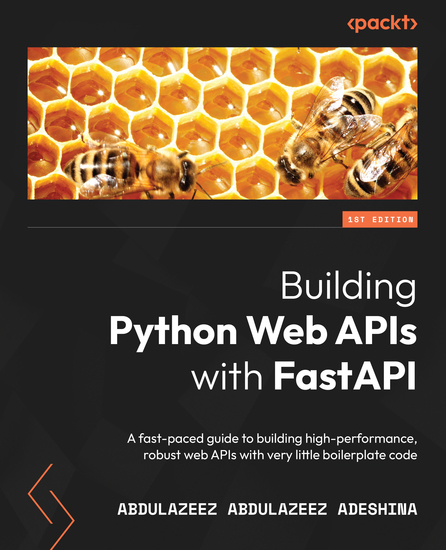
Building Python Web APIs with FastAPI - A fast-paced guide to building high-performance robust web APIs with very little boilerplate code - cover

Building Python Web APIs with FastAPI - A fast-paced guide to building high-performance robust web APIs with very little boilerplate code

Abdulazeez Abdulazeez Adeshina

Casa editrice: Packt Publishing

  • 0
  • 0
  • 0

Sinossi

RESTful web services are commonly used to create APIs for web-based applications owing to their light weight and high scalability. This book will show you how FastAPI, a high-performance web framework for building RESTful APIs in Python, allows you to build robust web APIs that are simple and intuitive and makes it easy to build quickly with very little boilerplate code.
This book will help you set up a FastAPI application in no time and show you how to use FastAPI to build a REST API that receives and responds to user requests. You’ll go on to learn how to handle routing and authentication while working with databases in a FastAPI application. The book walks you through the four key areas: building and using routes for create, read, update, and delete (CRUD) operations; connecting the application to SQL and NoSQL databases; securing the application built; and deploying your application locally or to a cloud environment.
By the end of this book, you’ll have developed a solid understanding of the FastAPI framework and be able to build and deploy robust REST APIs.
Disponibile da: 29/07/2022.
Lunghezza di stampa: 216 pagine.


Altri libri che potrebbero interessarti

  • Astrobiology - Exploring Life beyond Earth and the Mysteries of the Universe - cover

    Astrobiology - Exploring Life...

    Mike Crawford

    • 0
    • 0
    • 0
    Astrobiology is the scientific study of life in the universe. It seeks to answer profound questions about the origins, evolution, distribution, and future of life beyond Earth. As a highly interdisciplinary field, astrobiology combines biology, chemistry, astronomy, geology, and planetary science to explore the potential for life on other planets and moons. This field is not merely about searching for intelligent extraterrestrial civilizations but also about understanding the fundamental processes that make life possible and where these conditions might exist beyond Earth. 
    One of the primary goals of astrobiology is to investigate the origins of life. Scientists study early Earth environments to understand how life first emerged, using this knowledge to determine where similar conditions might exist elsewhere in the cosmos. The discovery of extremophiles—organisms that thrive in extreme environments such as deep-sea hydrothermal vents, acidic lakes, and polar ice caps—has expanded the understanding of life’s resilience. If life can persist in such harsh conditions on Earth, it raises the possibility that microbial life may exist on planets or moons with extreme environments, such as Mars, Europa, or Enceladus. 
    Astrobiologists also examine the habitability of other planets by identifying key factors necessary for life. The presence of liquid water, an energy source, and essential chemical elements like carbon, hydrogen, oxygen, and nitrogen are considered fundamental prerequisites for life as we know it. The concept of the "habitable zone"—the region around a star where conditions might allow liquid water to exist—has become central to the search for exoplanets that could support life. Recent discoveries of thousands of exoplanets, some of which are Earth-like, have fueled optimism about finding life beyond our solar system.
    Mostra libro
  • Apache Kafka - A comprehensive guide to Apache Kafka - cover

    Apache Kafka - A comprehensive...

    Et Tu Code

    • 0
    • 0
    • 0
    Get a deep understanding of Apache Kafka with this comprehensive guide!  
    The book starts by providing an overview of the Kafka ecosystem, followed by a detailed exploration of its architecture and core concepts.  
    You'll learn how to set up a multi-node Confluent Community Kafka cluster and understand Kafka's storage architecture. 
    Next, dive into the world of message processing and error handling, including idempotence and transactions.  
    The book also covers serialization techniques using JSON and AVRO, as well as exactly once processing in Apache Kafka. 
    Whether you're new to Kafka or looking to deepen your understanding, this ebook provides a thorough introduction to each topic, making it an essential resource for anyone working with Apache Kafka.
    Mostra libro
  • US Army 1960s Polygraph Training - cover

    US Army 1960s Polygraph Training

    US Army

    • 0
    • 0
    • 0
    The primary mission of military intelligence in the United States Army is to provide timely, relevant, accurate, and synchronized intelligence and electronic warfare support to tactical, operational and strategic-level commanders. The Army’s intelligence components produce intelligence both for Army use and for sharing across the national intelligence community. The military will subject someone to a polygraph for several reasons: If that person needs to access confidential files; if they are accused of leaking government secrets; if they are accused of terrorism or of being a spy; if they are a foreign national who needs access to classified material, and several other reasons. The following is a 1960s Army training recording with information on administering a lie detector test.
    Mostra libro
  • Cancer's Spouse - cover

    Cancer's Spouse

    Jason R Martin

    • 0
    • 0
    • 0
    Discover a new way to understand and cope with cancer with "Cancer's Spouse." This inspiring and resourceful audiobook explores the emotional toll that cancer takes on both patients and the people closest to them – spouses. From accepting the shock of a diagnosis, working through fear, providing emotional support, and coping with the anxiety of uncertainty, this book provides a necessary and valuable resource for anyone whose life has been affected by cancer. It also includes education on treatments so that couples can better understand their diagnosis and take steps to ensure the best possible outcomes. With this audiobook, couples can approach their situation with new insight, strength, and support.
    Mostra libro
  • Molds Mushrooms and Medicines - Our Lifelong Relationship with Fungi - cover

    Molds Mushrooms and Medicines -...

    Nicholas P. Money

    • 0
    • 0
    • 0
    From beneficial yeasts that aid digestion to toxic molds that cause disease, we are constantly navigating a world filled with fungi. Molds, Mushrooms, and Medicines explores the amazing ways fungi interact with our bodies, showing how our health and well-being depend on an immense ecosystem of yeasts and molds inside and all around us. 


    Nicholas Money takes listeners on a guided tour of a marvelous unseen realm, describing how our immune systems are engaged in continuous conversation with the teeming mycobiome inside the body, and how we can fall prey to serious and even life-threatening infections when this peaceful coexistence is disturbed. He also sheds light on our complicated relationship with fungi outside the body, from wild mushrooms and cultivated molds that have been staples of the human diet for millennia to the controversial experimentation with magic mushrooms in the treatment of depression. 


    Drawing on the latest advances in mycology, Molds, Mushrooms, and Medicines reveals what scientists are learning about the importance of fungi to our lives, from their vital role in supporting the ecosystems on which we depend to their emerging uses in lifesaving medicine.
    Mostra libro
  • Birth of Modern Astronomy The: The History of the Scientists and Theories that Modernized Astronomy - cover

    Birth of Modern Astronomy The:...

    Editors Charles River

    • 0
    • 0
    • 0
    As interesting as the stories about Tycho Brahe are, chances are he wouldn’t be remembered if not for the important work he did, especially in the realm of astronomy. He lived in an era when the intellectual worldview of most in northern Europe was medieval in nature, influenced mostly by spirituality, mysticism, religion, and metaphysics. Brahe, however, was far-thinking in his outlook, taking advantages of the latest technological ideas and practicing empiricism to revolutionize the field of science. This work eventually led Brahe to cross paths with Johannes Kepler, whose laws on planetary motion would change everything.  
    Trying to define a man who had the qualities of a mathematician, astronomer, philosopher, inventor, and astrologer can prove difficult. But all of that can be ascribed to Johannes Kepler, one of the giants of his era who ushered in the Scientific Revolution and is often considered the first modern scientist. Kepler stood at a moment in time when the intellectual worldview of most in northern Europe was medieval in nature. Kepler, however, was far-thinking in his outlook. 
    	In his lifetime, Galileo straddled the epochs of the Renaissance and the Scientific Revolution, and it was his work and technological advances that helped usher in a brand new understanding of the solar system and the scientific method. Stephen Hawking himself has asserted, “Galileo, perhaps more than any other single person, was responsible for the birth of modern science." Of course, part of what made Galileo such a monumental figure was the fact that he was ahead of his time, and that he mostly refused to conform to the accepted dogmas of contemporary society.  
    In 1676, Sir Isaac Newton wrote in a letter, “If I have seen further it is by standing on ye sholders of Giants.” By the time he died, Newton had become science’s greatest giant, and every scientist who has followed him has stood on his shoulders. 
    Mostra libro