Unisciti a noi in un viaggio nel mondo dei libri!
Aggiungi questo libro allo scaffale
Grey
Scrivi un nuovo commento Default profile 50px
Grey
Iscriviti per leggere l'intero libro o leggi le prime pagine gratuitamente!
All characters reduced
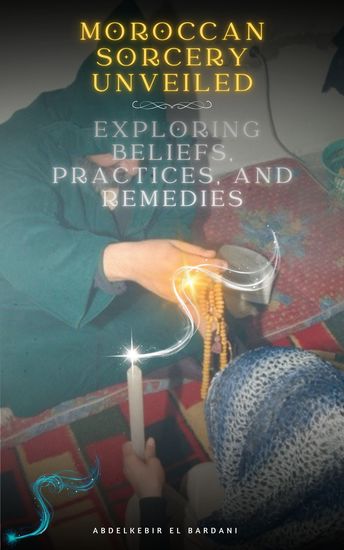
Moroccan Sorcery Unveiled: Exploring Beliefs Practices and Remedies - cover

Moroccan Sorcery Unveiled: Exploring Beliefs Practices and Remedies

abdelkebir el bardani

Casa editrice: ABDELKEBIR EL BARDANI

  • 0
  • 0
  • 0

Sinossi

Uncover the Mysteries of Moroccan Sorcery!Embark on a fascinating exploration of Moroccan sorcery with "Moroccan Sorcery Unveiled: Exploring Beliefs, Practices, and Remedies." This comprehensive eBook delves into the rich history, diverse practices, and profound cultural significance of sorcery in Moroccan society.From its ancient origins to its modern manifestations, delve into the intriguing history and general definitions of sorcery. Discover the various types of sihr (magic) and gain insights into how Islam and science interpret this phenomenon.Explore the unique role of women in Moroccan sorcery and uncover the reasons behind the practice, from psychological to economic and social factors. Learn about the detrimental effects of sorcery on Moroccan society and the prevalence of superstitious practices.Delve into Moroccan magical beliefs and rituals of witchcraft practices, including how sorcerers bring and satisfy jinn (spirits). Gain valuable insights into healing and protecting methods used by Moroccans, from holy saints and herbal remedies to amulets and the power of music and the Quran.Whether you're a curious observer or seeking solutions to personal challenges, "Moroccan Sorcery Unveiled" offers a captivating journey into the mystical world of Moroccan sorcery. Unlock the secrets, unravel the mysteries, and empower yourself with knowledge and understanding like never before.
Disponibile da: 27/04/2024.
Lunghezza di stampa: 43 pagine.

Altri libri che potrebbero interessarti

  • Great Powers Club The: The History of the Kingdoms that Dominated the Near East in the Late Bronze Age - cover

    Great Powers Club The: The...

    Charles River Editors

    • 0
    • 0
    • 0
    By the time of Egypt’s Nineteenth Dynasty, the Egyptians had created a vast empire that stretched from what would be the modern region of northern Sudan in the south to southern Syria in the north (Kuhrt 2010, 1:185). With control of such a vast empire, the Egyptians were able to export valuable minerals such as gold and silver, which were much rarer in the other Near Eastern kingdoms, and imported horses, timber, and chariots that they used to build their impressive military. A chronological examination of ancient Egypt during the New Kingdom reveals the process in which Egypt transitioned from a regional kingdom to an international empire. The examination will demonstrate that the New Kingdom was a fairly complex system that brought about several changes in pharaonic culture before ultimately collapsing.  
    Compared to some of their contemporaries – including the Egyptians, Assyrians, and Babylonians – the Hittites were somewhat distant both culturally and geographically. The Hittites were an Indo-European speaking in an ocean of Afro-Asiatic and Semitic groups, their homeland was to the north of Mesopotamia, and it contained no major river like the Nile, Tigris, or Euphrates Rivers. The Hittite empire was also far less enduring than its neighbors, as it only existed from about 1800-1200 BCE (van de Mieroop 2007, 156), which was considerably shorter than most of the other major kingdoms of the Near East.  
    Like a number of ancient individuals and empires in that region, the negative perception of ancient Assyrian culture was passed down through Biblical accounts, and regardless of the accuracy of the Bible’s depiction of certain events, the Assyrians clearly played the role of adversary for the Israelites. Indeed, Assyria (Biblical Shinar) and the Assyrian people played an important role in many books of the Old Testament and are first mentioned in the book of Genesis.
    Mostra libro
  • Warfare in Ancient Greece: The History of the Greeks’ Wars on Land and Sea in Antiquity - cover

    Warfare in Ancient Greece: The...

    Editors Charles River

    • 0
    • 0
    • 0
    Although the armies of the ancient Greek, or “Hellenic”, city-states (poleis, singular polis) included both cavalry (hippeis) and light infantry (psiloi, peltastes, gymnetes), their mainstay was undoubtedly the heavy infantry known today as hoplites. Armed to the teeth with their distinctive round shield (aspis or hoplon), high-crested helmet (corys) and long spear (dory), the hoplites were some of the most efficient soldiers of their time. They fought in the tight phalanx formation, and beyond the confines of their small poleis, Greek hoplites were also prized as mercenaries throughout the ancient world.  
    	Most historians believe that the hoplite became the dominant infantry soldier in nearly all the Greek city-states around the 8th century BCE. Hoplites were responsible for acquiring their own equipment, so not every hoplite might have been equally armed, but considering the style of warfare, they needed as much uniformity as possible. Like most infantry outside of Greece, the hoplites also carried spears, but while the Persian weapons were short and light for example, the Greek spears were thick shafts anywhere between seven and nine feet long. These spears were topped by a 9-inch spearhead, with a “lizard-sticker” buttspike at the bottom which could be used as a secondary spearhead if the main weapon was snapped off, or to plant the spear upright when at rest. Each hoplite also carried a shortsword, designed specifically for thrusting in the close confines of a melee (the Spartan weapon, the xiphos, was so short as to be virtually a dagger, its blade barely over a foot long).  
    It was only with the advent of the more mobile Roman legion, and the defeat of phalanxes in battles like Cynoscephalae (197 BCE) and Pydna (168 BCE), that the hoplite phalanx was finally outclassed
    Mostra libro
  • Phaedo - Socrates on the Immortality of the Soul – A Profound Meditation on Death and the Afterlife - cover

    Phaedo - Socrates on the...

    Plato, Tim Zengerink

    • 0
    • 0
    • 0
    What if a single voice could turn the fear of death into a hymn of hope? 
    Experience Plato’s Phaedo in vivid audio: 
    •	A Living Dialogue – Engaging narration and carefully paced exchanges place you in the prison chamber on Socrates’ final morning. 
    •	Immortality Made Audible – Hear the logical ascent from doubt to conviction, each proof delivered with clarity and dramatic weight. 
    •	A Meditation for the Modern Listener – Brief scene introductions keep the philosophy accessible while preserving the dialogue’s emotional intimacy. 
    •	Inspiration Beyond Philosophy – Let Socrates’ serenity become a companion during reflection, travel, or daily routines. 
    Press play and discover why the philosopher’s last words still echo across centuries.
    Mostra libro
  • History Of The Conquest Of Peru - William Hickling Prescott - cover

    History Of The Conquest Of Peru...

    William Hickling Prescott

    • 0
    • 0
    • 0
    "History of the Conquest of Peru" by William Hickling Prescott is a classic work of historical narrative that tells the story of the Spanish conquest of the Inca Empire in the 16th century. The book was first published in 1847 and is widely regarded as one of the greatest works of American historical writing. 
    Prescott's account of the conquest is rich in detail and offers a vivid portrayal of the people, places, and events involved. He draws on a wide range of sources, including contemporary accounts and first-hand reports, to provide a comprehensive and authoritative history of the conquest. 
    The book begins with an overview of the Inca Empire and its society and culture, before moving on to describe the arrival of the Spanish and the conquest itself. Prescott provides a detailed account of the major battles and campaigns, as well as the personal rivalries and conflicts among the Spanish conquistadors. 
    Throughout the book, Prescott offers a nuanced analysis of the political, social, and cultural factors that contributed to the conquest, and he reflects on the broader significance of the events for the history of the Americas and for global history more generally. 
    Overall, "History of the Conquest of Peru" is a masterful work of historical narrative that offers a compelling and detailed account of one of the most significant events in the history of the Americas. It is a must-read for anyone interested in the history of the region or in the broader themes of conquest, colonization, and cultural encounter.
    Mostra libro
  • The Israeli-Palestinian Conflict - What Everyone Needs to Know® - cover

    The Israeli-Palestinian Conflict...

    Dov Waxman

    • 0
    • 0
    • 0
    No conflict in the world has lasted as long, generated as many news headlines, or incited as much controversy as the Israeli-Palestinian conflict. Yet, despite, or perhaps because of, the degree of international attention it receives, the conflict is still widely misunderstood. While Israelis and Palestinians and their respective supporters trade accusations, many outside observers remain confused by the conflict's complexity and perplexed by the passion it arouses. 


    The Israeli-Palestinian Conflict: What Everyone Needs to Know® offers an even-handed and judicious guide to the world's most intractable dispute. Writing in an engaging, jargon-free Q&A format, Dov Waxman provides clear and concise answers to common questions, from the most basic to the most contentious. Covering the conflict from its nineteenth-century origins to the latest developments of the twenty-first century, this book explains the key events, examines the core issues, and presents the competing claims and narratives of both sides. Listeners will learn what the Israeli-Palestinian conflict is all about, how it has evolved over time, and why it continues to defy diplomatic efforts at a resolution.
    Mostra libro
  • Platanides - Through The Eye of The Storm - cover

    Platanides - Through The Eye of...

    William Planes

    • 0
    • 0
    • 0
    Many Christians lived in Asia Minor (later Turkey) before the Armenian and Greek genocide by the Muslims at the outset of the twentieth century. The author; Planes, cronicals his father’s true life experience in an effort to make clear the precious freedoms that we have in the United States. 
    This book presents the true story of a Christian boy and his escape from the genocide of Greek and Armenian Christians. This is a true story of the life of this boy who was born in Asia Minor in 1908; howhe, with his family managed to escape the genocide of Greek and Armenian Christians at the hands of Kamel Ataturk on September 13, 1922; how the boy’s family lived as refugees of genocide on the Island of Crete Greece where they survied World War II; how the boy left his family and immigrated to America; and the boy’s life in America. The book draws a contraxt of the family’s experiences as genocide refugees living in Crete and the boy’s life in America; how these events and those of World War II on the Greek island of Crete influenced them and their children; and his relationship as adults with the boy’s son, the author. The author emphasizes the Christian Orthodox Faith which was tousht to him by his parents. In response to a question about his Faith, the book and why he has written this book, the author stated “It was a lesson by my father to his kids that no matter what you’re confronted with in life if you trust in Christ and you believe without a doubt that Christ is with you, you can get through anything. That was what we learned at a very early age and that’s what stuck with me throughout my life.".....
    Mostra libro