Junte-se a nós em uma viagem ao mundo dos livros!
Adicionar este livro à prateleira
Grey
Deixe um novo comentário Default profile 50px
Grey
Assine para ler o livro completo ou leia as primeiras páginas de graça!
All characters reduced
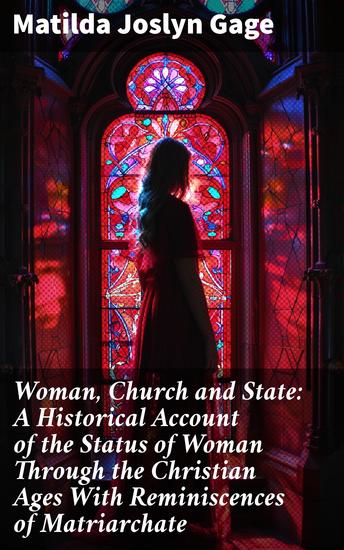
Woman Church and State: A Historical Account of the Status of Woman Through the Christian Ages With Reminiscences of Matriarchate - Unveiling Women's Struggles in Christian History - cover
LER

Woman Church and State: A Historical Account of the Status of Woman Through the Christian Ages With Reminiscences of Matriarchate - Unveiling Women's Struggles in Christian History

Matilda Joslyn Gage

Editora: Good Press

  • 0
  • 0
  • 0

Sinopse

In her seminal work, "Woman, Church and State: A Historical Account of the Status of Woman Through the Christian Ages With Reminiscences of Matriarchate," Matilda Joslyn Gage presents a comprehensive historical analysis of women's roles within the context of Christian ecclesiastical power. Gage employs a meticulous scholarly approach, intertwining rich historical narratives with a passionate argument for women's rights. The book, infused with a feminist lens, critiques the marginalization of female figures and voices throughout Christian history, while examining the resonance of matriarchal systems that preceded patriarchal dominance. Gage's literary style is both assertive and eloquent, effectively challenging prevailing narratives and urging a reevaluation of women's societal status from antiquity to modernity. Matilda Joslyn Gage, an influential suffragist and co-founder of the National Woman Suffrage Association, was deeply rooted in the 19th-century struggle for women's rights. Her extensive research into women'Äôs historical contributions and her advocacy against religious and societal patriarchy uniquely positioned her to write this groundbreaking work. Gage'Äôs intersectional approach not only highlights the oppression of women under religious institutions but also celebrates the matriarchal traditions that have historically empowered women. This book is essential for readers interested in feminist history, social justice, and the intersections between religion and gender. Gage's arguments resonate powerfully, offering historical insights that continue to challenge contemporary discourse on women's rights. "Woman, Church and State" is not merely a historical account; it is a clarion call for recognition and reformation, making it a crucial addition to any library committed to understanding the complexities of gender and power.
Disponível desde: 16/11/2023.
Comprimento de impressão: 423 páginas.

Outros livros que poderiam interessá-lo

  • Jack the Ripper - The WhiteChapel Mystery - cover

    Jack the Ripper - The...

    David G. Stone

    • 0
    • 0
    • 0
    This audiobook is narrated by an AI Voice.   
    **Jack the Ripper: The Whitechapel Mystery** 
    *By David G. Stone* 
    In the fog-shrouded streets of Victorian London, a killer stalked the night. Between August and November 1888, the impoverished district of Whitechapel became the hunting ground for history's most infamous serial killer—Jack the Ripper. 
    David G. Stone meticulously reconstructs one of criminology's greatest unsolved mysteries, taking listeners deep into the gaslit alleyways where terror reigned supreme. Through careful examination of police reports, witness testimonies, and contemporary newspaper accounts, Stone brings to life the grimy, desperate world of London's East End—a place where the vulnerable became victims and a shadowy figure earned immortal infamy. 
    Who was Jack the Ripper? Was he a deranged surgeon with anatomical knowledge? A member of the royal family? A local butcher? Or someone else entirely? Stone explores the most compelling theories while painting a vivid portrait of Victorian society's dark underbelly—the poverty, desperation, and social inequalities that created the perfect storm for these horrific crimes. 
    More than just a recounting of murders, this is a fascinating exploration of Victorian police work, early forensic science, and the birth of modern criminal investigation. Stone examines how the Ripper case changed law enforcement forever and why, more than a century later, we remain captivated by these unsolved murders. 
    Prepare to walk the shadowy streets of Whitechapel, where every doorway held secrets and every footstep echoed with dread. The mystery of Jack the Ripper has never been more compelling—or more chilling. 
    *A gripping true crime investigation that will keep you listening late into the night.*
    Ver livro
  • A Rare Recording of Hunter S Thompson - cover

    A Rare Recording of Hunter S...

    Hunter S. Thompson

    • 0
    • 0
    • 0
    Hunter Stockton Thompson (July 18, 1937 - February 20, 2005) was an American journalist and author who founded the gonzo journalism movement, a style in which the writer becomes a central figure and participant in the events of the narrative. He rose to prominence with the publication of Hell's Angels (1967) and Fear and Loathing in Las Vegas (1972). The following is from a 1975 interview on gonzo journalism.
    Ver livro
  • The Republic - cover

    The Republic

    Plato

    • 0
    • 0
    • 0
    The Republic (Greek: Politeia) is a Socratic dialogue, written by Plato around 380 BC, concerning the definition of (justice), the order and character of the just city-state and the just man, reason by which ancient readers used the name On Justice as an alternative title (not to be confused with the spurious dialogue also titled On Justice). The dramatic date of the dialogue has been much debated and though it must take place some time during the Peloponnesian War, "there would be jarring anachronisms if any of the candidate specific dates between 432 and 404 were assigned".    It is Plato's best-known work and has proven to be one of the most intellectually and historically influential works of philosophy and political theory. In it, Socrates along with various Athenians and foreigners discuss the meaning of justice and examine whether or not the just man is happier than the unjust man by considering a series of different cities coming into existence "in speech", culminating in a city (Kallipolis) ruled by philosopher-kings; and by examining the nature of existing regimes.    The participants also discuss the theory of forms, the immortality of the soul, and the roles of the philosopher and of poetry in society. Short Summary (Epilogue): X.1—X.8. 595a—608b. Rejection of Mimetic Art X.9—X.11. 608c—612a. Immortality of the Soul X.12. 612a—613e. Rewards of Justice in Life X.13—X.16. 613e—621d. Judgment of the Dead The paradigm of the city — the idea of the Good, the Agathon — has manifold historical embodiments, undertaken by those who have seen the Agathon, and are ordered via the vision. The centre piece of the Republic, Part II, nos. 2–3, discusses the rule of the philosopher, and the vision of the Agathon with the allegory of the cave, which is clarified in the theory of forms.    The centre piece is preceded and followed by the discussion of the means that will secure a well-ordered polis (City). Part II, no. 1, concerns marriage, the community of people and goods for the Guardians, and the restraints on warfare among the Hellenes. It describes a partially communistic polis. Part II, no. 4, deals with the philosophical education of the rulers who will preserve the order and character of the city-state. In Part II, the Embodiment of the Idea, is preceded by the establishment of the economic and social orders of a polis (Part I), followed by an analysis (Part III) of the decline the order must traverse. The three parts compose the main body of the dialogues, with their discussions of the "paradigm", its embodiment, its genesis, and its decline. The Introduction and the Conclusion are the frame for the body of the Republic.    The discussion of right order is occasioned by the questions: "Is Justice better than Injustice?" and "Will an Unjust man fare better than a Just man?" The introductory question is balanced by the concluding answer: "Justice is preferable to Injustice". In turn, the foregoing are framed with the Prologue (Book I) and the Epilogue (Book X). The prologue is a short dialogue about the common public doxai (opinions) about "Justice". Based upon faith, and not reason, the Epilogue describes the new arts and the immortality of the soul.
    Ver livro
  • CDL Prep Exam : General Knowledge - Study Guide For Commercial Driving License - cover

    CDL Prep Exam : General...

    Mile One Press

    • 0
    • 0
    • 0
    Let's make studying for the CDL exam easier. Our comprehensive CDL Exam Prep Books are designed to help truckers like you get a passing grade on your tests. Practice tests are scientifically proven to increase exam pass rates. See how CDL PREP EXAM: GENERAL KNOWLEDGE can help to improve your chances of passing your CDL written tests. The commercial driver industry is fast-growing yet continuously faced with a shortage of certified CDL drivers. Certification starts with passing the CDL written exam and that's where many fall short. We aim to change that trend. We also aim to enhance the learning experience of new commercial drivers and improve their driving capabilities. The beginning of a new career path in the transportation industry starts with the CDL test. We're here to help you or your students over that speed bump and onto the next mile. We are obsessed with helping our customers improve their CDL pass rates. We know how a CDL certification or endorsement can transform your future. It did ours. So, we never stop working to improve our resources to ensure you can make your mark in this lucrative, in-demand career path.
    Ver livro
  • The War that invented Indian Banking - cover

    The War that invented Indian...

    Amit Schandillia

    • 0
    • 0
    • 0
    The 17th-century Jagat Seths are often referred to as India's Medicis for their wealth. Rich enough to sponsor the British win at Plassey, they were India's largest moneylenders of their time. The bull run came to an end with the execution of its patriarchs in 1763. With the single largest source of loans gone the British were soon scrambling for funds to pay for expensive military campaigns. One such campaign against Tipu Sultan proved back-breaking expensive and led to the establishment of India's first banking service 20 years after the Jagat Seths collapsed. It was called the Bank of Bengal!
    Ver livro
  • The Roman Empire's Provinces - A Journey through Its Territories - cover

    The Roman Empire's Provinces - A...

    Rogan Fish

    • 0
    • 0
    • 0
    In the early days of the Roman Empire, provinces played a pivotal role in maintaining and expanding Roman control over vast territories. The establishment and management of these provinces were essential to Rome’s transition from a republic to an imperial power. As the empire grew, the need for efficient governance led to the development of a provincial system that would become the backbone of Roman administration. 
    The formation of Roman provinces began during the Republic, but it was under Augustus, the first emperor, that the system became more structured and organized. Augustus divided the provinces into two categories: senatorial and imperial. Senatorial provinces were typically peaceful and long-standing territories governed by proconsuls appointed by the Senate. In contrast, imperial provinces were often frontier areas or regions requiring a significant military presence, administered by legates appointed by the emperor. This division allowed Augustus to maintain control over the army while giving the Senate a role in governance. 
    Provincial boundaries were often drawn based on previous territorial conquests or strategic needs. As Rome continued to expand, new provinces were added, including those in the east after the defeat of Egypt and in the west following the conquest of Gaul and Hispania. Each new territory brought diverse cultures and
    Ver livro