¡Acompáñanos a viajar por el mundo de los libros!
Añadir este libro a la estantería
Grey
Escribe un nuevo comentario Default profile 50px
Grey
Suscríbete para leer el libro completo o lee las primeras páginas gratis.
All characters reduced
From Missouri - The Adventures of A Schoolteacher inThe West - cover

From Missouri - The Adventures of A Schoolteacher inThe West

Zane Grey

Editorial: DigiCat

  • 0
  • 0
  • 0

Sinopsis

Zane Grey's "From Missouri" is a vivid exploration of frontier life and the quintessential American spirit, tracing the journey of its protagonist, a young man navigating both the challenges of his rural upbringing and the allure of a broader world. Set against the backdrop of late 19th-century America, Grey employs a rich, descriptive style that immerses readers in the landscapes of both Missouri and the wild West. This novel serves not only as a coming-of-age tale but also as a commentary on the rugged individualism that characterized American society at the time, melding elements of romance and adventure with a keen observation of human nature. Zane Grey, an accomplished author and avid outdoorsman, drew heavily from his own experiences in the American West, which undoubtedly inspired the vivid settings and complex characters of this work. Born in 1872, Grey's background in baseball and his passion for adventure profoundly shaped his literary voice, allowing him to weave authenticity into his storytelling. His significance in American literature is marked by the way he illuminated the life of the pioneer through the lens of realism, making his characters relatable and dynamic. "From Missouri" is a must-read for those captivated by the struggle for self-discovery against the vast, unforgiving landscape of America. Grey's masterful prose invites readers to traverse not only the geographical plains but also the emotional and moral terrains of his characters. This novel is a testament to the enduring spirit of resilience and exploration, making it a rewarding read for anyone seeking to understand the essence of American life.
Disponible desde: 24/11/2023.
Longitud de impresión: 28 páginas.
Otros libros que te pueden interesar

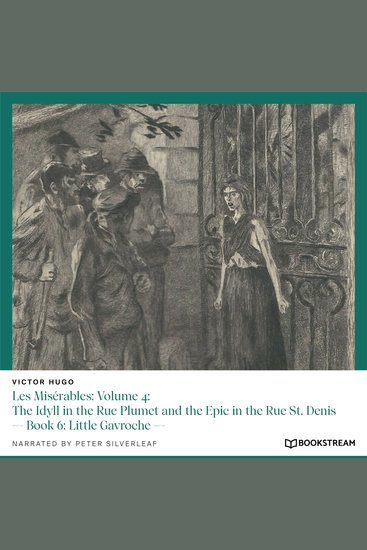
  • Les Misérables: Volume 4: The Idyll in the Rue Plumet and the Epic in the Rue St Denis - Book 6: Little Gavroche (Unabridged) - cover

    Les Misérables: Volume 4: The...

    Victor Hugo

    • 0
    • 0
    • 0
    Victor-Marie Hugo (26 February 1802 - 22 May 1885) was a French poet, novelist, essayist, playwright, and dramatist of the Romantic movement. During a literary career that spanned more than sixty years, he wrote abundantly in an exceptional variety of genres: lyrics, satires, epics, philosophical poems, epigrams, novels, history, critical essays, political speeches, funeral orations, diaries, and letters public and private, as well as dramas in verse and prose.
    BOOK 6: LITTLE GAVROCHE: Since 1823, when the tavern of Montfermeil was on the way to shipwreck and was being gradually engulfed, not in the abyss of a bankruptcy, but in the cesspool of petty debts, the Thénardier pair had had two other children; both males. That made five; two girls and three boys.
    Ver libro
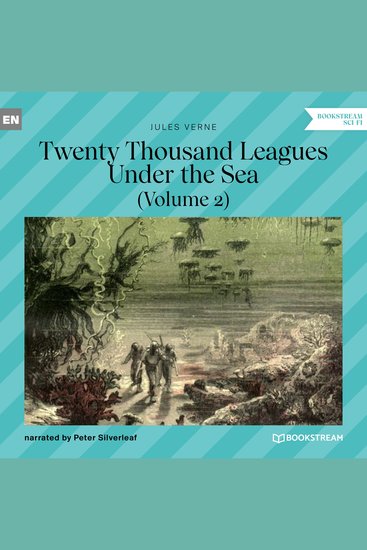
  • Twenty Thousand Leagues Under the Sea - Volume 2 (Unabridged) - cover

    Twenty Thousand Leagues Under...

    Jules Verne

    • 0
    • 0
    • 0
    Jules Verne is considered to be an important author in France and most of Europe, where he has had a wide influence on the literary avant-garde and on surrealism. His reputation was markedly different in the Anglosphere where he had often been labeled a writer of genre fiction or children's books, largely because of the highly abridged and altered translations in which his novels have often been printed. Since the 1980s, his literary reputation has improved.
    VOLUME 2: We now come to the second part of our journey under the sea.
    The first ended with the moving scene in the coral cemetery which left such a deep impression on my mind. Thus, in the midst of this great sea, Captain Nemo's life was passing, even to his grave, which he had prepared in one of its deepest abysses.
    Ver libro
  • A Responsibility - From their pens to your ears genius in every story - cover

    A Responsibility - From their...

    Henry Harland

    • 0
    • 0
    • 0
    The bookshelves of American literature are incredible collections that have gathered together centuries of very talented authors.  From this continent their fame spread and whilst among their number many are now forgotten or neglected their talents endure.  Among them is Henry Harland.
    Ver libro
  • The Murderer - Bulgakov expertly explores life and death choices set on the backdrop of the Bolshevik Revolution - cover

    The Murderer - Bulgakov expertly...

    Mikhail Bulgakov

    • 0
    • 0
    • 0
    Mikhail Bulgakov was born on 15th May 1891 in Kiev, in the Kiev Governorate of the Russian Empire, into a Russian family.  He was one of seven children. 
     
    In 1901, Bulgakov attended the First Kiev Gymnasium, and developed a keen interest in Russian and European literature, theatre and opera.  After the death of his father in 1907, his mother assumed responsibility for his education.  After graduating Bulgakov entered the Medical Faculty of Kiev University and then took up a post as physician at the Kiev Military Hospital. 
     
    At the outbreak of the First World War, he volunteered as a doctor and was sent directly to the front, where he was badly injured at least twice.  To suppress chronic pain, especially in the abdomen, he injected morphine.  It took years to wean himself off. 
     
    He now took up medical posts in various towns and in 1919, he was mobilised by the Ukrainian People's Army and assigned to the Northern Caucasus.  There, he became seriously ill with typhus and barely survived.  
     
    After this illness, Bulgakov abandoned his medicine to pursue writing.  He moved to Vladikavkaz and had two plays staged there with great success.  He wrote too for various newspapers and other outlets, but his critics were many.  And growing. 
     
    When a Moscow's theatre director severely criticised Bulgakov, Stalin personally protected him, saying that a writer of Bulgakov's quality was above ‘party words’ like ‘left’ and ‘right’.   Indeed, it is said that Stalin watched ‘The Days of the Turbins’ at least 15 times. 
     
    It was not to last and by March 1929, Bulgakov's career was ruined when Government censorship stopped publication of any of his work and plays. 
     
    In despair, Bulgakov wrote a personal letter to Stalin.  He requested permission to emigrate.  He received a phone call from the Soviet leader, who asked the writer whether he really desired to leave. He replied that a Russian writer cannot live outside of his homeland.  Stalin thus gave him permission to continue working. In May 1930, he re-joined the theater, as stage director's assistant.  
     
    During the last stressful decade of his life, and in poor health, Bulgakov continued to work on ‘The Master and Margarita’, wrote plays, critical works, stories, and continued translations and dramatisations of novels.  Many of them were not published, others were derided by critics.  
     
    On 10th March 1940, Mikhail Afanasyevich Bulgakov died from nephrosclerosis.  He was 48. 
     
    ‘The Master and Margarita’ was not published in any form until the mid-1960’s 
     
    Here Bulgakov relates a story as told by a doctor describing the terrible things that humanity is capable of doing in times of war.
    Ver libro
  • A Broken Trust - From their pens to your ears genius in every story - cover

    A Broken Trust - From their pens...

    Elizabeth Corbett

    • 0
    • 0
    • 0
    Elizabeth Burgoyne Corbett was born on the 16th August 1846 at Standishgate, near Wigan. 
    After a good education she worked as a journalist for the Newcastle Daily Chronicle and went on to become a widespread and popular writer of adventure and society novels. 
    As a feminist writer it is a little bizarre that she published as Mrs George Corbett.  Her most ardent feminist work was ‘New Amazonia: A Foretaste of the Future,’ though other of her works were also similarly themed and dealt with one of the great issues of the day in Victorian society. 
    She married George Corbett in Sheffield in 1868.  They went on to have 4 children, of which only 3 survived. 
    As a writer she was not overly prolific but was perhaps most admired for her female detectives.  During her literary career Detective books were all the rage and authors of both sexes attempted to bring new and unusual angles of characters and narratives before the voracious public.   
    Corbett’s first was in a collection of short stories ‘Adventures of a Lady Detective featuring Dora Bell'.  A later novel introduced a further detective in the guise of Annie Cory. 
    Elizabeth Corbett died on in 1930.
    Ver libro
  • The Telegram - cover

    The Telegram

    Konstantin Paustovsky, Marlene...

    • 0
    • 0
    • 0
    Konstantin Paustovsky was a Russian writer nominated for the Nobel Prize for literature in 1965, 1966,1967,1968.
    Paustovsky began writing while still in Gymnasium. His first works were imitative poetry but he restricted his writing to prose after Ivan Bunin wrote in a letter to him: "I think that your sphere, your real poetry, is prose. It is here, if you are determined enough, that I am sure you can achieve something significant."
    Paustovsky's prose, steeped in nostalgia and quiet sorrow, reaches its finest expression in The Telegram—a story of distance, both physical and emotional, and the irreversible weight of unsaid words.
    The Telegram is not merely a story; it is a whisper across time, a plea too late, a love unspoken until the silence swallows it whole. In Paustovsky's world, distance is more than geography—it is the fragile thread between duty and regret, between those who leave and those who wait. The past lingers in unmailed letters, in the hush of an empty house, in the shadow of a mother's gaze.
    His words do not shout—they murmur, they breathe, they break the heart with a tenderness that lingers long after the final sentence.
    Ver libro