Join us on a literary world trip!
Add this book to bookshelf
Grey
Write a new comment Default profile 50px
Grey
Subscribe to read the full book or read the first pages for free!
All characters reduced
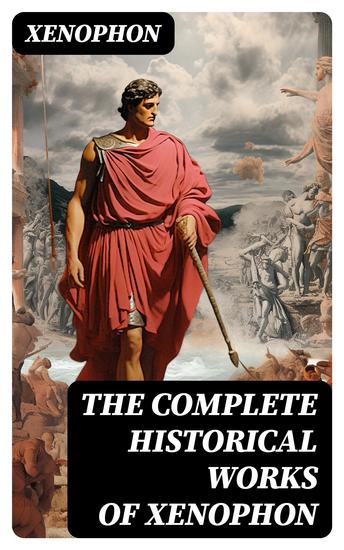
The Complete Historical Works of Xenophon - Anabasis Cyropaedia Hellenica Agesilaus Polity of the Athenians - cover

The Complete Historical Works of Xenophon - Anabasis Cyropaedia Hellenica Agesilaus Polity of the Athenians

Xenophon

Translator Henry Graham Dakyns

Publisher: DigiCat

  • 0
  • 0
  • 0

Summary

In "The Complete Historical Works of Xenophon," the celebrated ancient Greek historian presents a rich tapestry of narrative that encompasses his contemporary political and military experiences, philosophical reflections, and insights into leadership. With a writing style that blends both earnest observation and compelling rhetoric, Xenophon offers a window into the complexities of Greek city-states, the Peloponnesian War, and the socio-political landscape of his time. His works, characterized by clarity and directness, provide a unique counterpoint to Thucydides, emphasizing not only events but also the ethical dimensions of statesmanship and military command. Xenophon, a student of Socrates, was deeply influenced by his philosophical education, which molded his understanding of virtue and governance. Often considered a soldier, a historian, and a philosopher, Xenophon's own experiences as a mercenary and his engagement with various Greek leaders equipped him with firsthand knowledge that deeply informs his writings. His dual role as both participant and chronicler of the tumultuous era allows for a nuanced portrayal of historical events, blending personal narrative with broader analysis. This comprehensive collection is indispensable for readers seeking a deeper understanding of ancient Greece. Those interested in history, philosophy, and the interplay of power and ethics will find Xenophon's works not only enlightening but profoundly relevant to the complexities of leadership today.
Available since: 11/09/2023.
Print length: 1014 pages.


Other books that might interest you

  • Lady Jane Grey and the Succession Crisis of 1553 - A Tudor Quick Studies Book on the Nine Day's Queen - cover

    Lady Jane Grey and the...

    Heather Teysko

    • 0
    • 0
    • 0
    This course explores the dramatic events of the 1553 Succession Crisis, a pivotal moment in Tudor history. It begins with Edward VI’s declining health and the controversial "Devise for the Succession," leading to Lady Jane Grey's nine-day reign. You’ll follow Mary I’s determined campaign to reclaim the throne, examine the trials and executions of key figures, and understand the broader impact on the Tudor dynasty. The course also delves into the complex religious and political dynamics of the era, highlighting lessons about legitimacy, power, and governance.
    Show book
  • An Infinite Fountain of Light - Jonathan Edwards for the Twenty-First Century - cover

    An Infinite Fountain of Light -...

    George M. Marsden

    • 0
    • 0
    • 0
    Christians need to pause once in a while to get their bearings. For perspective on our own times and how we got here, it helps to listen to wise guides from other eras. In An Infinite Fountain of Light, the renowned American historian George Marsden illuminates the landscape with wisdom from one such mentor: Jonathan Edwards.
    Drawing on his deep expertise on Edwards and American culture, Marsden explains where Edwards stood within his historical context and sets forth key points of his complex thought. By also considering Benjamin Franklin and George Whitefield, two of Edwards's most influential contemporaries, Marsden unpacks the competing cultural and religious impulses that have shaped our times. In contrast, Edwards offered us an exhilarating view of the centrality of God's beauty and love. Christians' love for God, he taught, can be the guiding love of our lives, opening us to transformative joy and orienting all our lesser loves.
    "There is an infinite fullness of all possible good in God, a fullness of every perfection, of all excellency and beauty, and of infinite happiness," wrote Edwards. "This infinite fountain of light should, diffusing its excellent fullness, pour forth light all around."
    With Marsden's guidance, readers will discover how Edwards's insights can renew our own vision of the divine, of creation, and of ourselves.
    Show book
  • 40 Game Changers in World History (2 In 1) - A Note on the Lives and Impact of these Great Minds & Historical Figures (Military Religious Explorers Scientists Philosophers Emperors Artists+) - cover

    40 Game Changers in World...

    Patrick Marcus

    • 0
    • 0
    • 0
    Unlock the Giants of History: Unveil Their Extraordinary Stories 
    Are you yearning to delve into the monumental lives of history's titans without drowning in information overload? Look no further. 
    Meet the Masters of History in Series 1 (with Series 2 awaiting):Thomas Edison (Nikola Tesla)Sigmund Freud (Carl Jung)Julius Caesar (Marcus Aurelius)Jesus Christ (Prophet Muhammad)Sir John Franklin (Roald Amundsen)Sun Tzu (Miyamoto Musashi)Genghis Khan (Napoleon)Leif Erikson (Ragnar Lothbrok)Mahatma Gandhi (Nelson Mandela)Joan of Arc (Anne Frank)Charles Ponzi (Frank Abagnale)Fyodor Dostoevsky (Victor E. Frankl)Isaac Newton (Charles Darwin)Albert Einstein (Georges Lemaître)Leonardo Da Vinci (Michelangelo)Cleopatra (Marie Curie)Socrates (Plato)Mozart (Beethoven)Emmeline Pankhurst (Rosa Parks)Gautama Buddha (Lucifer) 
    Click the “Buy Now” button and add this Unique Book Series to your collection
    Show book
  • Elevate Your SAT Vocabulary: Simple Strategies for Instant Mastery - "Ace your SAT with ease! Discover our impactful audio lessons that make vocabulary mastery simple and fun!" - cover

    Elevate Your SAT Vocabulary:...

    Tarquin Radcliff

    • 0
    • 0
    • 0
    Elevate Your SAT Vocabulary: Simple Strategies for Instant Mastery  
    ⭐⭐ A Simplified Guide with Easy Explanations ⭐⭐ 
    Are you eager to advance in your career and sharpen your knowledge by successfully mastering SAT vocabulary?   
    In search of a thorough guide that encompasses everything you need to enhance your vocabulary skills?   
    Your quest ends here!   
    This guide is your ultimate resource for deepening comprehension, applying your skills, and engaging in practical exercises. With this, you're on the path to success.   
    Updated for the latest SAT Vocabulary requirements.   
    Key features of this enhanced guide: 
    - In-depth insights into effective vocabulary strategies   
    - Clear explanations of essential vocabulary concepts   
    - Proven techniques for mastering vocabulary and boosting comprehension   
    What sets our guide apart is its exhaustive coverage, crucial for your vocabulary mastery. We don't just skim over concepts; we explore them thoroughly and with clarity.   
    Crafted with a well-organized structure and straightforward language, our SAT Vocabulary Guide ensures seamless transitions between topics. Say goodbye to complex jargon and embrace clear, precise, and technically sound content.   
    So, why wait? Click the BUY NOW button, secure your guide, and embark on your journey to SAT vocabulary mastery!   
    Elevate your vocabulary and watch your confidence soar!
    Show book
  • Popular Works Volume 1 - The Vocation of the Scholar The Nature of the Scholar and The Vocation of Man - cover

    Popular Works Volume 1 - The...

    Johann Gottleib Fitche

    • 0
    • 0
    • 0
    History placed Johann Gottlieb Fichte (1762-1814) between two giants of German philosophy – Immanuel Kant (1724-1804) and Georg Hegel (1770-1831) – so it was not surprising that his light may have dimmed as the 19th century developed. It didn’t help that he also was regarded as one of the proponents of German nationalism, a legacy that spilled over into the darker times of the 20th century.  
    However, his singular character and his role in developing, (following Kant), transcendental idealism has resulted in a re-evaluation in recent years. His views on ethics, a practical approach towards the matter of free will, and the value he placed on culture, the intellect and the self, informed his output. 
    The three works in this collection, Volume 1, offer a steady insight into Fichte’s thought and personality. Many of his key works emerged in the form of lectures rather than books, and as such are eminently accessible: Fichte was certainly a popular speaker. When at the University of Jena (1794-1799) he drew large audiences for the five lectures which comprise The Vocation of the Scholar (1794). The main principles of the Enlightenment are examined here, in terms of culture, education, morality. As he writes in his Preface: ‘That the Ideal cannot be manifested in the Actual world, we know as well as they do, perhaps better. All we maintain is, that the Actual must be judged by the Ideal, and modified in accordance with it by those who feel themselves capable of such a task.’ 
    In 1799, he was dismissed from his post at Jena following accusations of atheism, and the last two works in this collection appeared while he was at the University of Berlin. The Nature of the Scholar and its Manifestations dates from 1806 and comprises 10 lectures which develop ideas initially presented in The Vocation of the Scholar. The final work here, The Vocation of Man, appeared in book form rather than as a series of lectures and is regarded as one of his most important. In it, Fichte sets out to examine ‘the true purpose of man’.  
    It is divided into three sections, Doubt, Knowledge, Faith. He addresses issues of free will and cause and effect, natural existence and perceived reality; and, finally, the ‘guiding’ matter of faith and God.
    Show book
  • Rome’s Conquest of North Africa: The History of the Conflicts that Led to the Establishment of Roman Provinces in Africa - cover

    Rome’s Conquest of North Africa:...

    Editors Charles River

    • 0
    • 0
    • 0
    Certain foreign policy decisions led to continuing enmity between Carthage and the burgeoning power of Rome, and what followed was a series of wars which turned from a battle for Mediterranean hegemony into an all-out struggle for survival. Although the Romans gained the upper hand in the wake of the First Punic War, Hannibal brought the Romans to their knees for over a decade during the Second Punic War. While military historians are still amazed that he was able to maintain his army in Italy near Rome for nearly 15 years, scholars are still puzzled over some of his decisions, including why he never attempted to march on Rome in the first place. 
    Before the Numidians were conquered by the Romans and Numidia was officially made part of Roman Africa, they developed a culture that was as sophisticated and unique as any in the ancient world. The Numidians were a Berber people who emerged from the edge of the desert in the late 2nd millennium BCE, and despite the harshness of their environment (or perhaps because of it), they eventually became the most powerful people in North Africa. The Numidians found success on the backs of horses, which they rode to countless military victories, and when they could not defeat their enemies with conventional tactics, they were not afraid to resort to asymmetrical warfare. 
    The end of the Ptolemies also happened to coincide with the most famous period of Roman history. In the latter 1st century BCE, men like Julius Caesar, Mark Antony, and Octavian participated in two civil wars that would spell the end of the Roman Republic and determine who would become the Roman emperor. In the middle of it all was history’s most famous woman, Cleopatra, who famously seduced both Caesar and Antony and thereby positioned herself as one of the most influential people in a world of powerful men. Indeed, she was a legendary figure even to contemporary Romans and the ancient world.
    Show book