¡Acompáñanos a viajar por el mundo de los libros!
Añadir este libro a la estantería
Grey
Escribe un nuevo comentario Default profile 50px
Grey
Suscríbete para leer el libro completo o lee las primeras páginas gratis.
All characters reduced
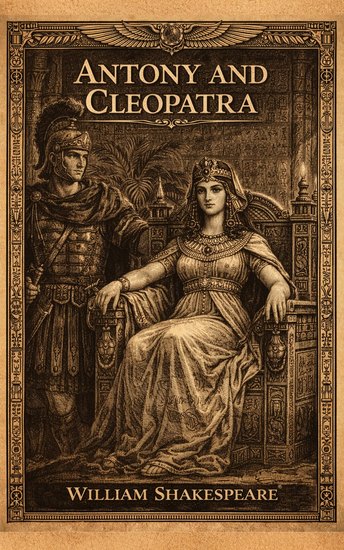
Antony and Cleopatra - cover

Antony and Cleopatra

William Shakespeare

Editorial: CLXBX

  • 0
  • 0
  • 0

Sinopsis

Antony and Cleopatra is one of William Shakespeare's most powerful and emotionally charged tragedies—a sweeping drama of passion, politics, loyalty, and betrayal set against the grandeur of the ancient world. Blending historical events with poetic brilliance, Shakespeare brings to life the tumultuous romance between Mark Antony, a Roman general, and Cleopatra, the captivating Queen of Egypt.

At the center of the play is a love affair that defies reason, duty, and empire. Antony, one of Rome's triumvirs and a celebrated military leader, becomes enthralled by Cleopatra's charisma and allure. Their relationship, intense and all-consuming, places Antony at odds with his responsibilities to Rome and his political alliances. As tensions rise between Antony and his rival Octavius Caesar, the personal and political become inseparably intertwined.

Cleopatra is portrayed as complex and commanding—passionate, strategic, theatrical, and fiercely proud. Her dynamic with Antony is marked by devotion and volatility, tenderness and manipulation. Together, they create a partnership that is both intoxicating and destructive, as ambition and emotion collide on a global stage.

Shakespeare masterfully contrasts the disciplined, duty-bound world of Rome with the sensual, opulent atmosphere of Egypt. Through this contrast, the play explores themes of power, identity, honor, sacrifice, and the struggle between public obligation and private desire. The shifting landscapes—from battlefields to royal courts—mirror the instability of the characters' fortunes and the fragile nature of political authority.

As war looms and allegiances fracture, Antony's decisions lead him toward inevitable tragedy. Cleopatra, faced with defeat and humiliation, must choose her own destiny in a world dominated by imperial ambition. Their story becomes not only a tale of romantic devotion but also a meditation on legacy, mortality, and the cost of greatness.

Rich in poetic language and dramatic intensity, Antony and Cleopatra remains one of Shakespeare's most mature and complex works. It is a timeless exploration of love and power at their most magnificent and destructive—an epic tragedy that continues to captivate readers and audiences with its emotional depth and historical grandeur.
Disponible desde: 19/02/2026.
Longitud de impresión: 97 páginas.
Otros libros que te pueden interesar

  • Life (Bronte Version) - cover

    Life (Bronte Version)

    Charlotte Brontë

    • 0
    • 0
    • 0
    LibriVox volunteers bring you 11 recordings of Life by Charlotte Brontë. This was the weekly poetry project for March 8th, 2009.
    Ver libro
  • A Waiter Made of Glass - Stories and Poems - cover

    A Waiter Made of Glass - Stories...

    Verlyn Flieger

    • 0
    • 0
    • 0
    Award-winning author Verlyn Flieger takes readers through a series of insightful short stories exploring tragic aspects of human nature. A few of the tales are dark, others a bit lighter, but all celebrate the creativity of storytelling. The second part of the book is a collection of new poetry unearthing the wonders of language, the mundane, and grief and mourning as part of life—the dark spot within the light. Death is the inevitable, inescapable result of mortality, and grief is the price the living pay for that condition. Readers are invited to join in the journey, take some comfort in the knowledge of shared darkness, and know that even within the dark moments, there is always at least a speck of splintered light.
    Ver libro
  • Home Burial - Poem about the challenges of everyday life from a Pulitzer prize winner - cover

    Home Burial - Poem about the...

    Robert Frost

    • 0
    • 0
    • 0
    Robert Lee Frost was born on the 26th March 1874 in San Francisco, California. 
    His father found providing for the family a constant challenge and he died, when Frost was 11, from tuberculosis and left an estate valued at only $8.  The family moved east to Lawrence, Massachusetts, and a better life with his grandfather. 
    After graduating from High School, and then a few months at Dartmouth college, he returned home to take on a variety of menial jobs to help support his mother.  Their drudgery and poor money encouraged him to move in a different direction: a career as a poet. 
    He sold his first poem in 1894 for $15.  With this milestone he proposed to his high school sweetheart who declined as she was still studying at university.  The following year she graduated and they married.  A year later the first of their six children arrived.   
    After a stint at Harvard for two years he received the gift of a farm from his ailing grandfather.  Frost worked the farm and wrote unpublished poetry for several years before turning to a teaching position. 
    Upon the death of one of his children the grief-stricken family decided to quit everything and live in England, moving across the Atlantic in 1912.  The following year he published his first poetry book and with it came critical acclaim.  He was now in his late thirties. 
    The onset of World War I saw Frost return to America with a glowing reputation, and here he launched himself into a career of writing, teaching and lecturing.  
    In 1924 he received the first of four Pulitzer Prizes, for his book ‘New Hampshire: A Poem with Notes and Grace Notes’.  He received a second Pulitzer in 1931 for ‘Collected Poems’.  A third Pulitzer Prize was presented in 1937 for ‘A Further Range’.  His fourth Pulitzer was awarded in 1943 for ‘A Witness Tree’. 
    Frost was also nominated for the Nobel Prize in Literature 31 times. 
    During these years personal tragedy had enveloped him.  A daughter had died in her late 20s from the effects of her puerperal fever at childbirth, his wife had died of breast cancer, and a son had committed suicide.  
    Then, at the age of 86, was asked to read his poem ‘The Gift Outright’ at President John F Kennedy’s inauguration on the 20th January, 1961.  
    Robert Frost died on the 29th January 1963 in Boston of complications arising from prostate surgery.  He was 88.
    Ver libro
  • Here We Go Again - cover

    Here We Go Again

    Ronald Franklin Saia

    • 0
    • 0
    • 0
    Here We Go Again evolved from Heartland Inspirations, Kentucky Wonder and Inspirations Anew for You, continuing my being inspired by life and the desire to lift up others. Everyone needs an occasional lift from life's challenges which tests our coping ability. I believe Here We Go Again will provide that moment for you. 
    Ronald Franklin Saia was born a grandson to a Italian from Sutera, Sicily. Growing up in rural Kansas gave Ronald a deep feeling in his soul for the outdoors. He hunted, trapped, rode his buckskin mare old Beauty, slept under the stars and cooked supper over an open camp fire. He is a real American patriot. While Ronald worked his way through college, he lived at home with his precious mother, Mary, and father, Victor. What a blessing it was for God to have chosen them for this parents. 
    For a time, he worked in Venezuela where he met his wife, Barb. He has traveled in South/Central America and Europe. Ronald's inspirations/poetry are straight from his heart and represent a true appreciation for creation and God's works along with life's experiences and personal observations.
    Ver libro
  • Shakespeare Monologues Collection vol 04 - cover

    Shakespeare Monologues...

    William Shakespeare

    • 0
    • 0
    • 0
    LibriVox readers present the fourth collection of monologues from Shakespeare’s plays. Containing 20 parts.William Shakespeare (April 26, 1564 – April 23, 1616) remains widely to be considered the single greatest playwright of all time. He wrote in such a variety of genres - tragedy, comedy, romance, &c - that there is always at least one monologue in each of his plays. Some of these teach a lesson, some simply characterize Shakespeare at his best, some are funny, some sad, but all are very moving. Each monologue will touch everybody differently. Some people will be so moved by a particular monologue that they will want to record it. (summary by Shurtagal)
    Ver libro
  • My Land of Freedom - A poem of war and freedom - cover

    My Land of Freedom - A poem of...

    Ifeanyi Njoku

    • 0
    • 0
    • 0
    This poem is a powerful reflection on war, displacement, and the struggle for freedom. It tells the tragic story of a people who fought for liberation but were met with violence, loss, and eventual surrender. Likely referencing the Igbo experience during the Nigerian Civil War, it captures the pain of oppression and the resilience of those who endured it. 
    The poem begins with a contradiction: "In my land of freedom, I walked with fear." This highlights the irony of living in a place meant to be free but being consumed by anxiety. The people demand justice, yet their cries are silenced by violence. The line "Killing our brothers, and leaving us undone" conveys both physical loss and emotional devastation. 
    The imagery of "scorching soil" and "separated from families" paints a picture of suffering and displacement. War does not just take lives—it tears families apart and leaves hearts unable to thrive. The mention of "refugee camps" emphasizes how many were forced from their homes, left to question their identity: "Are we unlucky, to be Igbo?" This speaks to a deep sense of abandonment and injustice. 
    The poem also highlights betrayal, as leaders fail to protect their people. "Everyone was a soldier, in this war we couldn't win." This line captures the grim reality of a war where survival itself was a battle. Despite their bravery, they were up against overwhelming forces. 
    The final lines are heartbreaking: "We had to surrender, and say goodbye to our pride." This is not just a loss of battle but a loss of dignity. Yet, even in surrender, their story lives on. This poem is a tribute to resilience, a reminder of suffering, and a call to remember those who fought, even when the world turned away.
    Ver libro