Join us on a literary world trip!
Add this book to bookshelf
Grey
Write a new comment Default profile 50px
Grey
Subscribe to read the full book or read the first pages for free!
All characters reduced
Bi-sexual love; the homosexual neurosis - cover

Bi-sexual love; the homosexual neurosis

Wilhelm Stekel

Publisher: Librorium Editions

  • 0
  • 1
  • 0

Summary

The present work is the English version of a part of one of the volumes in the author’s massive series of clinical studies bearing the generic title, Disorders of the Instincts and Emotions and covering the whole range of the so-called Parapathic Maladies. The translation represents approximately one-half of the Homosexualität of the volume entitled Onanie und Homosexualität, and bearing the sub-title, Die Homosexuelle Neurose. The balance of the Homosexual Neurosis and the author’s clinical study of Autoerotism are also translated and will appear shortly.
Available since: 12/05/2021.

Other books that might interest you

  • Your Word is Your Wand - cover

    Your Word is Your Wand

    Florence Scovell Shinn

    • 0
    • 0
    • 0
    "Your Word is Your Wand" by Florence Scovel Shinn is a timeless self-help classic that delves into the transformative power of words and thoughts in shaping our reality. In this beautifully illustrated edition, Shinn's profound teachings are brought to life through visual elements that enhance the understanding and impact of her wisdom.
    Shinn explores the idea that our words are like wands, wielding the power to manifest our desires or create obstacles. Through anecdotes, affirmations, and practical examples, she guides readers on a journey of self-discovery, emphasizing the importance of positive thinking and the conscious use of language.
    This edition serves as a visual and intellectual feast, inviting readers to explore the profound impact of their words and thoughts on their lives. Florence Scovel Shinn's timeless wisdom, combined with captivating illustrations, makes this book a valuable resource for those seeking to harness the creative power within their own words.
    Show book
  • The Art of Letting Go - Releasing Past Burdens - cover

    The Art of Letting Go -...

    Fiona Zenith

    • 0
    • 0
    • 0
    In The Art of Letting Go: Releasing Past Burdens, Fiona Zenith offers a compassionate and practical guide to freeing yourself from the emotional weights that hold you back. Through a blend of insightful psychology, mindfulness techniques, and real-life stories, this book provides the tools you need to navigate the complexities of anxiety, depression, and emotional attachments. Whether you're struggling with unresolved past experiences, fear of change, or the challenges of self-doubt, this book will help you cultivate resilience, embrace self-awareness, and build a life of inner peace and balance. With actionable exercises, reflective prompts, and inspiring narratives, The Art of Letting Go is your roadmap to emotional freedom, empowering you to release what no longer serves you and step into a brighter, more fulfilling future. Let this book be your companion on the journey to healing, growth, and lasting joy.
    Show book
  • This Part Is Silent - A Life Between Cultures - cover

    This Part Is Silent - A Life...

    SJ Kim

    • 0
    • 0
    • 0
    A searing essay collection that explores displacement and loss, creativity and change, institutional power and progress. 


    Born in Korea, raised in the American South, and trying her best to survive British academia, SJ Kim probes her experiences as a writer, a scholar, and a daughter to confront the silences she finds in the world. With curiosity and sensitivity, she writes letters to the institutions that simultaneously support and fail her, intimate accounts of immigration, and interrogations of rising anti-Black and anti-Asian racism. She considers the silences between generations—especially within the Asian diaspora in the West—as she finds her way back to her own family during the pandemic lockdown. 


    Embracing the possibilities and impossibilities of language, Kim rejoices in the similes of Korean, her mother tongue, and draws inspiration from K-dramas and writers across cultures who sustain her. As borders close in and nations enter lockdown, the journey that Kim traces is fraught—and at once illuminates that the act of remaining present has its own power, allowing boundless hope.
    Show book
  • Holy Roman Empire’s Conflicts with the Vatican The: The History of the Medieval Wars that Fractured Germany and Italy - cover

    Holy Roman Empire’s Conflicts...

    Charles River Editors

    • 0
    • 0
    • 0
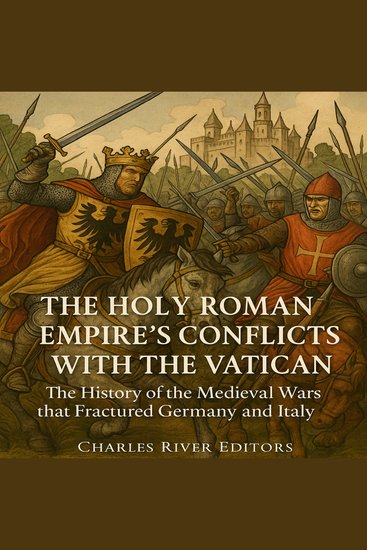
    It has been famously pointed out that the Holy Roman Empire was neither holy, nor Roman, but it was also not an empire in the sense people expect when hearing the term. In theory, the emperor was the highest prince in Christendom, and his dominion extended the length and breadth of Western Europe. The empire had been created by the papacy in 801 when Pope Leo the Third famously crowned the supposedly unwitting Charlemagne in Saint Peter’s Basilica, intending to recreate the Western Roman Empire. In truth, the imperial power did not extend beyond central Europe, which by the beginning of the 16th century included Germany, northern Italy, and the Netherlands. Even in these lands, however, the emperor struggled to command obedience. His dominion over northern Italy was theoretical only, the cities of the Netherlands were deeply conscious of their ancient rights and privileges, and Germany had long ceased to be compliant. The latter had become a collection of principalities, dukedoms and bishoprics which vied with each other and pursued their own agendas. They were, however, united in only one sense: denying the emperor power and resisting attempts to centralize the government.  
    	At the same time, the secular sovereigns frequently butted heads with religious authorities back in Rome, and arguably none of the conflicts were as crucial as the War of the Keys and the Investiture Controversy. The tensions between the Holy Roman Empire and Church over the power to invest bishops with authority led to decades of civil war in Germany on the way to establishing the relationship between Church and state, elevating the status of the papacy and weakening the Holy Roman Empire. What is crucial in understanding the conflicts is to not view them with the benefit of hindsight. Most importantly, no nation as people recognize it today yet existed, as England, France, Germany, and Italy were largely geographical expressions, not national identities.
    Show book
  • The Age of Empires - Conquest and Colonization - cover

    The Age of Empires - Conquest...

    Nova Ashford

    • 0
    • 0
    • 0
    The Age of Empires, a period marked by conquest and colonization, spans several centuries and had a profound impact on global history. From the late 15th century through the early 20th century, European powers embarked on ambitious campaigns of territorial expansion, driven by the pursuit of wealth, resources, and political dominance. This era saw the rise and fall of vast empires, each of which left an indelible mark on the world. The motivations behind empire-building were multifaceted, rooted in the quest for economic gain, military supremacy, and the spread of cultural, religious, and political ideologies. 
    The Age of Empires can trace its origins to the Renaissance, a period of intellectual and cultural awakening in Europe. The revival of classical learning, coupled with advancements in navigation, shipbuilding, and cartography, laid the groundwork for the age of exploration. This era saw European nations eager to find new trade routes and territories, driven by the promise of wealth from spices, silks, and other exotic goods. The expansion of European power also coincided with a period of intense competition among European states, each vying to claim territories and secure dominance over lucrative trade routes. 
    In 1492, Christopher Columbus’ famous voyage to the New World marked the beginning of a new era in exploration and conquest. Columbus’ journey, sponsored by Spain, led to the discovery of the Americas, setting off a wave of Spanish, Portuguese, British, French, and Dutch exploration and colonization. Spain and Portugal were the earliest and most successful empires in this period, establishing colonies in the Americas, Africa, and Asia. The Spanish empire, in particular, amassed incredible wealth through the exploitation of native populations and the vast resources found in the Americas, including precious metals like gold and silver.
    Show book

  • At Your Command - Complete and Original Edition - cover

    At Your Command - Complete and...

    Neville Goddard, Mitch Horowitz

    • 0
    • 0
    • 0
    Commands, to be effective, must be short and to the point: the greatest command ever recorded is found in the few simple words, “And God said, ‘Let there be light.’”Experience a complete understanding of mystical teacher Neville Goddard’s method for using the true nature of your imaginative powers of creativity as he succinctly lays out his ideas in this, his first full-length book, written in 1939. It is idealist philosophy taken to its razor-edge, argued with Neville’s typically jewel-like precision. Neville, one of the most remarkable mystical thinkers of the past century, discloses his extraordinary and testable claim that your awakened imagination is God Itself. In more than ten books and thousands of lectures, Neville expanded on that one core prin¬ciple. “The only God,” he told audiences, “is your own wonderful human imagination.”A compelling presence at metaphysical churches, spiritual centers and auditoriums, Neville was not widely known during his lifetime, but today his books and lectures have attained new popularity as a new generation is discovering and testing Neville's core principle: imagining creates reality.This edition includes a new Introduction by PEN Award-winning historian, Mitch Horowitz.
    Show book