¡Acompáñanos a viajar por el mundo de los libros!
Añadir este libro a la estantería
Grey
Escribe un nuevo comentario Default profile 50px
Grey
Suscríbete para leer el libro completo o lee las primeras páginas gratis.
All characters reduced
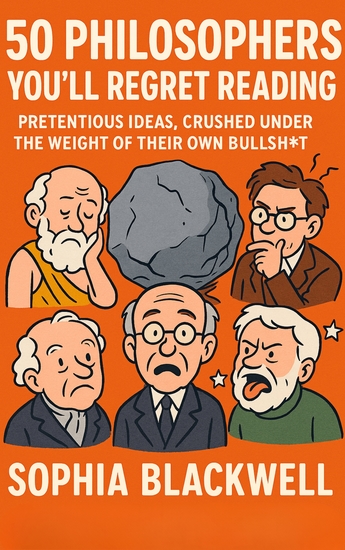
50 Philosophers You’ll Regret Reading - Pretentious Ideas Crushed Under the Weight of Their Own Bullsht* - cover

50 Philosophers You’ll Regret Reading - Pretentious Ideas Crushed Under the Weight of Their Own Bullsht*

Sophia Blackwell

Editorial: Cogito Ergo Nope

  • 0
  • 0
  • 0

Sinopsis

Are you tired of pretending to understand philosophers who write like they're being paid per syllable of confusion?This book is your revenge.In 50 Philosophers You’ll Regret Reading, author Sophia Blackwell takes a sledgehammer to the ivory tower with biting wit, dark humor, and no patience for footnote fetishism. From the cosmic gibberish of Parmenides to Derrida’s textual striptease, this is the ultimate roast of Western philosophy’s most unreadable minds.✔️ Kant’s 800-page snoozefest? Ripped to shreds.✔️ Nietzsche’s gym-bro metaphysics? Dismantled with flair.✔️ Husserl’s bracketed nightmare? Unbracketed, unhinged, and exposed.With each chapter, you'll meet one of history’s “great” thinkers—then watch their ideas implode under the weight of their own self-importance. No reverence. No mercy. Just sharp, irreverent commentary from someone who’s had enough of being told these books are “essential reading.”Whether you're a philosophy dropout, a smug academic, or just someone who once tried to read Being and Time and ended up crying into a thesaurus, this book will validate every frustrated groan you’ve ever had in the presence of a philosopher who thinks clarity is for cowards.Warning: Contains savage takes, too many references to ontological migraines, and the lingering suspicion that maybe—just maybe—you’re smarter than you thought.
Disponible desde: 10/06/2025.
Longitud de impresión: 121 páginas.

Otros libros que te pueden interesar

  • The Secret of Mental Efficiency - cover

    The Secret of Mental Efficiency

    Warren Hilton

    • 0
    • 0
    • 0
    "The Secret of Mental Efficiency" by Warren Hilton explores methods to enhance mental performance and efficiency. It delves into techniques for improving focus, concentration, and decision-making, providing valuable insights for personal development and increased productivity. Hilton's book is a guide to unlocking one's mental potential for a more efficient and successful life. Read in English, unabridged.
    Ver libro
  • Fans - A Journey into the Psychology of Belonging - cover

    Fans - A Journey into the...

    Michael Bond

    • 0
    • 0
    • 0
    Read by the author, Michael BondFans takes you on a journey into the world of superfans – in all of its strange, sometimes dark, and complicated forms.'A celebration of human idiosyncrasy and of our talent for building shared meaning and solidarity out of the strangest material' – TLSFascinating and thought-provoking, Fans is a story of communities, of what happens to us when we interact with people who share our passions. The human brain is wired to reach out, and while our groupish tendencies can bring much strife (religious intolerance, racism, war, etc.), they are also the source of some of our greatest satisfactions.Fandoms offer much of the pleasure of tribalism with little of the harm: a feeling of belonging and of shared culture, a sense of meaning and purpose, improved mental well-being, reassurance that our most outlandish convictions will be taken seriously, and the freedom to try to emulate (and dress like) our hero.But acclaimed science writer Michael Bond shows that despite these benefits, the world of fandoms is not without its dark underside, from the “copycat effect” fuelling mass shootings to the delusions that can accompany the parasocial relationships that fans feel they have with their heroes.In Fans, Michael Bond draws on the work of social psychologists and anthropologists to understand how people behave in groups and why such groups have such a profound effect on human culture.
    Ver libro
  • The Overconfidence Bias - Overestimating Your Knowledge and Abilities - cover

    The Overconfidence Bias -...

    William Rands

    • 0
    • 0
    • 0
    Overconfidence is a cognitive bias that affects the way we perceive our abilities, knowledge, and future outcomes. It leads individuals to overestimate their competence and the precision of their knowledge, often resulting in flawed decision-making. At its core, overconfidence is an inflated sense of self-assurance that distorts reality. While a certain level of confidence is essential for success, excessive confidence can cloud judgment and lead to risky choices. 
    The overconfidence bias has been widely studied in psychology, with researchers highlighting its profound impact on decision-making processes. One of the primary reasons for overconfidence is the human tendency to focus on positive outcomes while downplaying potential risks or failures. People who are overconfident tend to believe they have more control over situations than they actually do, leading them to take on challenges that they are not fully prepared for. This overestimation of abilities can be seen in various domains, from personal life to professional settings, where individuals frequently believe they know more or can perform tasks better than they truly can. 
    Overconfidence is not just about the belief that one can succeed in a particular task or scenario; it also involves an overestimation of how much one knows. For instance, individuals may feel confident in their knowledge of a topic but may be unaware of the gaps in their understanding. This phenomenon is particularly noticeable in fields such as finance, medicine, and law, where professionals often make critical decisions based on incomplete or flawed information, assuming their knowledge is comprehensive. Overconfidence can also manifest in the form of the "illusion of control," where individuals believe they can influence outcomes that are largely governed by chance.
    Ver libro
  • Summary: Forgiving What You Can't Forget - Discover How to Move On Make Peace with Painful Memories and Create a Life That's Beautiful Again by Lysa TerKeurst: Key Takeaways Summary & Analysis Included - cover

    Summary: Forgiving What You...

    Brooks Bryant

    • 0
    • 0
    • 0
    Disclaimer: This is not the official book, but a summary & it does not accompany the official. 
    Struggling with the shackles of unforgiveness? Discover healing with our incisive summary of Lysa TerKeurst's 'Forgiving What You Can't Forget.' Dive into a transformative guide that explores the intricate pathway toward forgiveness, even when it seems unfathomable. 
    TerKeurst provides you with practical tools and spiritual wisdom, but our summary distills her groundbreaking methods into digestible insights that you can apply today. Find out how to liberate yourself from the torment of resentment and let go of the grudges that hold you back. 
    Is it possible to forgive when your heart screams 'never'? Is there a way to move on without giving up your right to justice? Our summary answers these questions and more, setting you on a journey toward peace and emotional freedom. 
    If you're ready to step out of the past and into a future defined by joy and freedom, this is your go-to guide. Unlock the strength of forgiveness and reclaim your well-being now
    Ver libro
  • Civil War in 1862 The: The Battles that Saved Both the North and South - cover

    Civil War in 1862 The: The...

    Editors Charles River

    • 0
    • 0
    • 0
    Americans have long been fascinated by the Civil War and its biggest battles, particularly Gettysburg, Antietam, and Shiloh, all of which involved Robert E. Lee or Ulysses S. Grant. But one of the 6 biggest battles of the war, and the one that took the heaviest toll by % on both armies was fought at the end of 1862 in Tennessee, and it involved neither of those generals.  
    	In late December 1862, William Rosecrans’s Union Army of the Cumberland was contesting Middle Tennessee against Braxton Bragg’s Army of Tennessee, and for three days the two armies savaged each other as Bragg threw his army at Rosecrans in a series of desperate assaults. Bragg’s army was unable to dislodge the Union army, and he eventually withdrew his army after learning that Rosecrans was on the verge of receiving reinforcements. Though the battle was stalemated, the fact that the Union army was left in possession of the field allowed Rosecrans to declare victory and embarrassed Bragg.  
    	Though Stones River is mostly overlooked as a Civil War battle today, it had a decisive impact on the war. The two armies had both suffered nearly 33% casualties, an astounding number in 1862 that also ensured Rosecrans would not start another offensive campaign in Tennessee until the following June. The Union victory also ensured control of Nashville, Middle Tennessee, and Kentucky for the rest of the war, prompting Lincoln to tell Rosecrans, “You gave us a hard-earned victory, which had there been a defeat instead, the nation could scarcely have lived over." The battle and its results also set into motion a chain of events that would lead to Rosecrans and Bragg facing off at the crucial battle of Chickamauga in September 1863, a battle that is often viewed as the last gasp for the Confederates’ hopes in the West. 
    Ver libro
  • Foolproof - Why Misinformation Infects Our Minds and How to Build Immunity - cover

    Foolproof - Why Misinformation...

    Sander van der Linden

    • 0
    • 0
    • 0
    From fake news to conspiracy theories, from inflammatory memes to misleading headlines, misinformation has swiftly become the defining problem of our era. The crisis threatens the integrity of our democracies, our ability to cultivate trusting relationships, even our physical and psychological well-being—yet most attempts to combat it have proven insufficient. 


    With remarkable clarity, Sander van der Linden explains why our brains are so vulnerable to misinformation. Like a virus, misinformation infects our minds, exploiting shortcuts in how we see and process information to alter our beliefs, modify our memories, and replicate at astonishing rates. Once the virus takes hold, it's very hard to cure. 


    But we aren't helpless. As van der Linden shows based on award-winning original research, we can cultivate immunity through the innovative science of "prebunking": inoculating people against false information by preemptively exposing them to a weakened dose, thus empowering them to identify and fend off its manipulative tactics. Deconstructing the characteristic techniques of conspiracies and misinformation, van der Linden gives listeners practical tools to defend themselves and others against nefarious persuasion—whether at scale or around their own dinner table.
    Ver libro