Join us on a literary world trip!
Add this book to bookshelf
Grey
Write a new comment Default profile 50px
Grey
Subscribe to read the full book or read the first pages for free!
All characters reduced
The Way of All Flesh - cover

The Way of All Flesh

Samuel Butler

Publisher: Phoemixx Classics Ebooks

  • 0
  • 0
  • 0

Summary

The Way of All Flesh Samuel Butler - The Way of All Flesh (sometimes called Ernest Pontifex, or the Way of All Flesh) is a semi-autobiographical novel by Samuel Butler that attacks Victorian-era hypocrisy.[1] Written between 1873 and 1884, it traces four generations of the Pontifex family. Butler dared not publish it during his lifetime, but when it was published (in 1903) it was accepted as part of the general reaction against Victorianism.In 1998, the Modern Library ranked The Way of All Flesh twelfth on its list of the 100 best English-language novels of the 20th century."
Available since: 12/24/2021.
Print length: 555 pages.

Other books that might interest you

  • Palmistry - Your Plain & Simple Guide to Reading Destiny in Your Hands - cover

    Palmistry - Your Plain & Simple...

    Sasha Fenton

    • 0
    • 0
    • 0
    Your Plain & Simple Guide to Reading Destiny in Your Hands.   This delightful and practical guide demonstrates how easy it is to read hands for fun and insight. The basic premise here is that our hands provide a glimpse of our personalities, health, strengths, and weaknesses—and even what may happen to us in the future. Each line, mound, and finger is a clue that can easily be deciphered if you have the right information.   In Palmistry, Fenton covers the basics of hand reading, including the lines, mounts, fingers, and thumb. She shows readers how to judge someone’s character, health, love and relationship interests, moneymaking ability, and long-term destiny.   Chapters include:  The Map of the Hand  The Phalanges (bones between the fingers and joints)  The Major Lines  The Minor Lines  Love and Relationships  How to Make Handprints    With this plain and simple guide, you’ll be reading hands like a pro in no time!   This book was previously published as Palmistry Plain & Simple.
    Show book
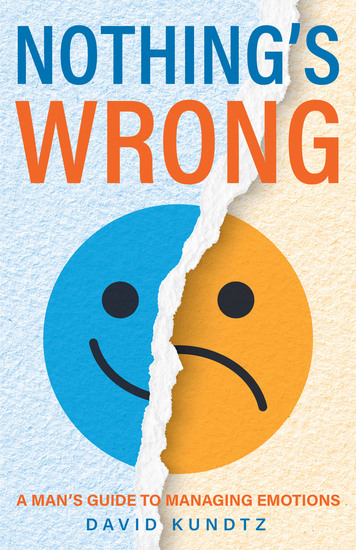
  • Nothing's Wrong - A Man's Guide to Managing Emotions - cover

    Nothing's Wrong - A Man's Guide...

    David Kundtz

    • 0
    • 0
    • 0
    Men, It’s Time to Master your EmotionsToo often Men are told to bottle up how they feel which leads to emotional numbness. Men, take the reins back and master your emotions with this guide to emotional healing.Every man has a deep bed of emotions. Emotions and feelings shouldn’t be ignored. To get the great and healthy relationships you desire, you need to change the way that you manage your emotions. David Kundtz has created this full guide to steer you towards emotional healing.Men, master your emotions. Emotions are diverse, learn all of different ways to spot your emotions and how to better express emotions. Become comfortable with your emotions, tune in to the emotions around you, and learn good communication skills.  Men, this book is for you. This motivational book is dedicated to teenage boys, young men, fathers, and grandfathers. Build your emotional confidence and your communication skills. The language, tools, and the exercises inside of this book are designed to help you express the deep, vibrant and ever-present emotions that you hold inside of you.  Nothing’s Wrong is packed with:Processes to identify and master your emotionsInformation for teenage boys, young men, fathers, and grandfathers  Tips and Tools to aide you on your path towards emotional healingIf you enjoyed motivational books like Cry Like A Man, Master Your Emotions, or The Mental Toughness, then you’ll love Nothing’s Wrong.
    Show book
  • American Indians and the American Dream - Policies Place and Property in Minnesota - cover

    American Indians and the...

    Kasey R. Keeler

    • 0
    • 0
    • 0
    Nearly seven out of ten American Indians live in urban areas, yet studies of urban Indian experiences remain scant. Studies of suburban Natives are even more rare. Today's suburban Natives, the fastest-growing American Indian demographic, highlight the tensions within federal policies working in tandem to move and house differing groups of people in very different residential locations. In American Indians and the American Dream, Kasey R. Keeler examines the long history of urbanization and suburbanization of Indian communities in Minnesota. 


    American Indians and the American Dream analyzes the dispossession of Indian land, property rights, and patterns of home ownership through programs and policies that sought to move communities away from their traditional homelands to reservations and, later, to urban and suburban areas. Keeler begins this analysis with the Homestead Act of 1862, then shifts to the Indian Reorganization Act in the early twentieth century, the creation of Little Earth in Minneapolis, and Indian homeownership during the housing bubble of the early 2000s. 


    American Indians and the American Dream investigates the ways American Indians accessed homeownership, working with and against federal policy, underscoring American Indian peoples' unequal and exclusionary access to the way of life known as the American dream.
    Show book
  • Lucky Lindy and Lady Lindy - cover

    Lucky Lindy and Lady Lindy

    Editors Charles River

    • 0
    • 0
    • 0
    In many ways, Charles Lindbergh represented the best and worst of America during the first half of the 20th century. Lindbergh became famous for being an aviation pioneer whose solo flight across the Atlantic captured the imagination of an entire world, yet he was an isolationist who wanted to keep American freedoms safe for Americans and no one else. Lindbergh was the quintessential family man, yet he fathered illegitimate children and suffered an unspeakable tragedy that became known as “The Crime of the Century.” Lindbergh embodied some of his era’s greatest virtues and harbored some of its worst prejudices.  
    Lindbergh was a 25 year old U.S. Air Mail pilot who was probably best known for two crashes before shooting to fame with his non-stop flight across the Atlantic from New York City to Paris on May 20-21, 1927. Lindbergh was Time Magazine’s first Man of the Year in 1927, and he used his newfound fame to promote the development of commercial flight and become a spokesman and symbol for advances in aviation.  
    In 1928, Amelia Earhart was the first woman to fly across the Atlantic Ocean, but she was disappointed that she had to do so as a passenger, complaining, “I was just baggage, like a sack of potatoes.” But by the mid-1930s, Earhart had set a multitude of altitude and distance records, but she wanted to attempt a circumnavigation of the world. After an ill-fated first attempt, Earhart and Fred Noonan set off on another attempt, creating one of the 20th century’s most enduring mysteries. Earhart and Noonan were to land on Howland Island, 1700 miles southwest of Hawaii, but radio transmissions ceased between the plane and authorities on the ground the morning of July 2, 1937. Earhart and Noonan had disappeared, never to be seen again, despite one of the nation’s largest and costliest manhunts to date.  
    The speculation over exactly what happened to Earhart and the mystery of her disappearance remain.
    Show book
  • The Ending of Psychological Knowledge - Brockwood Park 1980 - Dialogue 9 - cover

    The Ending of Psychological...

    Jiddu Krishnamurti

    • 0
    • 0
    • 0
    The roots of psychological conflict. 1 April 1980. Has humanity taken a wrong turn?What is the root of this tremendous inward conflict of humanity?When I am trying to become something, it is a constant battle.Can the brain itself see that it is caught in time and as long as it is moving in that direction conflict is eternal, endless?Can the mind realise, resolve a psychological problem immediately?
    Show book
  • On Forgiveness - cover

    On Forgiveness

    Russell Hasan

    • 0
    • 0
    • 0
    This is an essay on forgiveness, not in the religious sense, but in a purely secular meaning, as in, when one person forgives another person for something they did wrong. The primary focus is on self-forgiveness, where a person forgives themselves, a concept which this essay explains as "moral bankruptcy," using debts and credits and bankruptcy and economics and finance as a metaphor for the moral debts and moral credits that you owe to yourself and to others, that you owe it to yourself to be a good person, and you owe it to other people to be good to them, and, where you fail, you owe them a debt. The human brain evolved in such a way that humans tend to subconsciously seek to repay moral debts through the infliction of emotional pain, either inflicting emotional pain upon the self for debts owed to self (guilt), inflicting pain upon the self for debts owed to others (shame), or inflicting pain upon others for debts they owe to you (anger). This essay, despite being atheistic and secular in nature, does explore forgiveness in the context of areas that are commonly thought of as religious sins: lust, greed, pride, envy, and evil, as well as shame and guilt. The key central idea is that self-forgiveness, "moral bankruptcy," can help set you free from any guilt, shame, and anger that is holding you back in your life, and forgiveness will enable you to live a happier life, by giving you the confidence to act, and to achieve, with a greater resistance to fear of feeling guilt or shame if you fail, thereby tranquilizing fear of rejection or fear of failure or fear of disappointment. This theory of emotions will define honor, emotional maturity, self-esteem, and confidence, as well as explaining all of the seven major emotions: happiness, sadness, love, fear, guilt, shame, and anger. This book is cold, logical, no-nonsense wisdom about forgiveness, and is not mere wishy-washy empty generalities like most self-help books.
    Show book