Join us on a literary world trip!
Add this book to bookshelf
Grey
Write a new comment Default profile 50px
Grey
Subscribe to read the full book or read the first pages for free!
All characters reduced
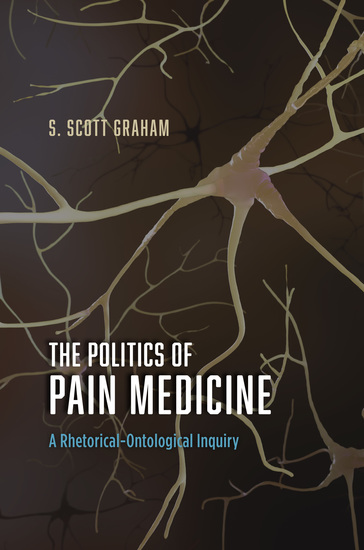
The Politics of Pain Medicine - A Rhetorical-Ontological Inquiry - cover

The Politics of Pain Medicine - A Rhetorical-Ontological Inquiry

S. Scott Graham

Publisher: The University of Chicago Press

  • 0
  • 0
  • 0

Summary

Chronic pain is a medical mystery, debilitating to patients and a source of frustration for practitioners. It often eludes both cause and cure and serves as a reminder of how much further we have to go in unlocking the secrets of the body. A new field of pain medicine has evolved from this landscape, one that intersects with dozens of disciplines and subspecialties ranging from psychology and physiology to anesthesia and chiropractic medicine. Over the past three decades, researchers, policy makers, and practitioners have struggled to define this complex and often contentious field as they work to establish standards while navigating some of the most challenging philosophical issues of Western science. In The Politics of Pain Medicine: A Rhetorical-Ontological Inquiry, S. Scott Graham offers a rich and detailed exploration of the medical rhetoric surrounding pain medicine. Graham chronicles the work of interdisciplinary pain management specialists to found a new science of pain and a new approach to pain medicine grounded in a more comprehensive biospychosocial model. His insightful analysis demonstrates how these materials ultimately shape the healthcare community’s understanding of what pain medicine is, how the medicine should be practiced and regulated, and how practitioner-patient relationships are best managed. It is a fascinating, novel examination of one of the most vexing issues in contemporary medicine.
Available since: 11/17/2015.
Print length: 253 pages.
Other books that might interest you

  • Summary - The Lean Startup - Based On The Book By Eric Ries - cover

    Summary - The Lean Startup -...

    Fastbooks Publishing

    • 0
    • 0
    • 0
    SUMMARY 
      
    THE LEAN STARTUP 
    BASED ON THE BOOK BY ERIC RIES 
      
    SUMMARY WRITTEN BY: FASTBOOKS PUBLISHING 
      
    CONTENT 
    Introduction to Lean Startup 
    Vision 
    Define 
    Learn 
    Experiment 
    Steer 
    Pivot or Persevere 
    Accelerate 
    Join the Movement 
    General Analysis 
      
    ABOUT THE ORIGINAL BOOK 
    The Lean Startup by Eric Ries introduces a groundbreaking methodology for building successful startups in an environment of extreme uncertainty. The book emphasizes the importance of innovation, continuous learning, and testing assumptions through rapid experimentation. It challenges traditional business planning, advocating instead for a process focused on customer feedback, iterative development, and validated learning. By applying principles from lean manufacturing, startups can avoid unnecessary waste and adapt quickly to changing conditions. Ries highlights real-world examples of entrepreneurs using this approach to build sustainable businesses, offering practical strategies for anyone aiming to bring innovative ideas to life.
    Show book
  • Art of Receiving and Giving The: The Wheel of Consent - cover

    Art of Receiving and Giving The:...

    D.C. Betty Martin, Robyn Dalzen

    • 0
    • 0
    • 0
    Why would most people endure unwanted or unsatisfying touch, rather than speak up for their own boundaries and desires? It’s a question with a myriad of answers – and one that Dr. Betty Martin has explored in her 40+ years as a hands-on practitioner, first as a chiropractor and later as a Somatic Sex Educator, Certified Surrogate Partner and Sacred Intimate. In her client sessions, she noticed a pattern wherein many clients would “allow” or go along with discomfort or unease rather than speak up for what they wanted or didn’t want. Betty discovered there was a major component missing for people -- the confidence that we have a choice about what is happening to us. 
    In her framework, “The Wheel of Consent®” Betty traces the fundamental roots of consent back to our childhood conditioning. As children, we are taught that to be “good” we must ignore our body’s discomfort and be compliant: to finish our food even if we’re full, to go to bed - even if we’re not tired, to let relatives hug and kiss us even if we don’t want to. We learn that our feelings don’t matter more than what is happening, and that we don’t have a choice but to go along, whether or not we want it. 
    As adults, this conditioning remains with us until we have an opportunity to unlearn it, which is why consent violations are often only called out after the violation has occurred - because we have not been taught or empowered to notice our boundaries, much less value or express our internal signals as the unwanted action is happening. 
    In this book, Betty guides the reader through the Wheel of Consent framework, and shares practices to help us recover the ability to notice what we want and set clear boundaries.
    Show book
  • Peak Life's Work - Find Your Gift and Give It Away - cover

    Peak Life's Work - Find Your...

    Said Hasyim

    • 0
    • 0
    • 0
    Live a life you are proud of, one in which you’re realizing your true potential and making a difference in the world.Do you drag yourself to work every morning to a job you hate? Do you feel like you’re just going through the motions with no real purpose in life? Do you feel you have a special talent to offer the world but are not even sure what it is? 
    Start your journey to self-discovery and growth in this inspiring book to learn:Science-backed methods that world-class performers use to accelerate skills acquisition that you can implement nowThe brutal truth why some very smart people fail while some mediocre ones succeed5 shockingly fast and effortless ways to ignite your creativity and generate more innovative ideasHow to exploit your gifts to discover lucrative opportunities bestowed upon you that you didn’t know were there all along3 unexpected common sense choices that often waste your time and lead you farther away from attaining a lifetime of fulfilmentProven essential strategies to cultivate a talent hotbed that you can employ at home to raise successful children 
    Prove wrong the naysayers who think you can’t pursue your dream because you are just not talented enough. Peak Life’s Work will show you how to find your niche in the world sooner, so that you can experience the joy of waking up each day to the work you were born to do.
    Show book
  • Summary - A Man Called Ove - Based On The Book By Fredrik Backman - cover

    Summary - A Man Called Ove -...

    Library Of Stories

    • 0
    • 0
    • 0
    SUMMARY 
      
    A MAN CALLED OVE 
    BASED ON THE BOOK BY FREDRIK BACKMAN 
      
    SUMMARY WRITTEN BY: LIBRARY OF STORIES 
      
    CONTENT 
    Introduction to Ove 
    A Man Called Ove Buys a Computer That Is Not a Computer 
    A Man Called Ove and His Neighbors 
    A Man Called Ove and a Bicycle 
    A Man Who Was Ove 
    A Man Called Ove and the Cat 
    A Man Called Ove and Unexpected Friendships 
    A Man Called Ove and the Weight of Loss 
    A Man Called Ove’s Final Act of Kindness 
    General Analysis of A Man Called Ove 
      
    ABOUT THE ORIGINAL BOOK 
    “A Man Called Ove” by Fredrik Backman follows the story of Ove, a grumpy, solitary 59-year-old man who struggles with grief after the death of his wife, Sonja. Ove’s strict routines and bitterness isolate him from the world, but his life is disrupted when new neighbors move in, including a pregnant woman named Parvaneh. As Ove begrudgingly becomes involved in their lives, he begins to confront his loneliness and past losses. The novel explores themes of grief, human connection, and redemption, blending humor and heartache as Ove learns to open his heart to others.
    Show book
  • Summary - Getting To Yes - Based On The Book By Roger Fisher And William Ury - cover

    Summary - Getting To Yes - Based...

    Fastbooks Publishing

    • 0
    • 0
    • 0
    SUMMARY 
      
    GETTING TO YES 
    BASED ON THE BOOK BY ROGER FISHER AND WILLIAM URY 
      
    SUMMARY WRITTEN BY: FASTBOOKS PUBLISHING 
      
    CONTENT 
    Put Yourself in Your Shoes 
    Develop Your Inner B.A.T.N.A. 
    Reframe Your Picture 
    Stay in the Zone 
    Respect Them Even If 
    Give and Receive 
    From Win-Lose to Win-Win-Win 
    Change the Game: Expand the Pie 
    Staying the Course: How to Make the Agreement Work 
    General Analysis of the Book 
      
    ABOUT THE ORIGINAL BOOK 
    “Getting to Yes” by Roger Fisher and William Ury presents a framework for principled negotiation, focusing on finding mutually beneficial solutions in conflicts. The book emphasizes the importance of separating people from the problem, prioritizing interests over positions, and creating options for mutual gain. Through real-life examples and practical strategies, the authors show how to approach negotiations with respect, creativity, and collaboration. The book explores how to move away from adversarial tactics toward a cooperative mindset, aiming for win-win solutions that satisfy both parties' needs, making it applicable in both personal and professional situations.
    Show book
  • Summary: Hidden Potential - The Science of Achieving Greater Things By Adam Grant: Key Takeaways Summary and Analysis - cover

    Summary: Hidden Potential - The...

    Brooks Bryant

    • 0
    • 0
    • 0
    DISCLAIMER: THIS IS NOT THE OFFICIAL BOOK. 
    This is a summary, and it does not accompany the official 
    "Hidden Potential: The Science of Achieving Greater Things" by Adam Grant challenges the notion of talent worship in our society. While we often celebrate those with innate advantages, Grant reminds us of our capacity for growth and skill development. He presents a fresh perspective on raising aspirations and exceeding expectations, emphasizing that progress is more about effective learning than sheer effort. Grant's book draws on compelling evidence and stories from various contexts, illustrating that our potential is not determined solely by our innate genius but by the character we cultivate. He explores how to develop the character skills and motivations necessary to unlock our hidden potential and design systems that offer opportunities to those who have been underrated or overlooked. Ultimately, the book inspires readers to focus on the journey of personal growth rather than fixating on the peak they aim to reach.
    Show book