¡Acompáñanos a viajar por el mundo de los libros!
Añadir este libro a la estantería
Grey
Escribe un nuevo comentario Default profile 50px
Grey
Suscríbete para leer el libro completo o lee las primeras páginas gratis.
All characters reduced
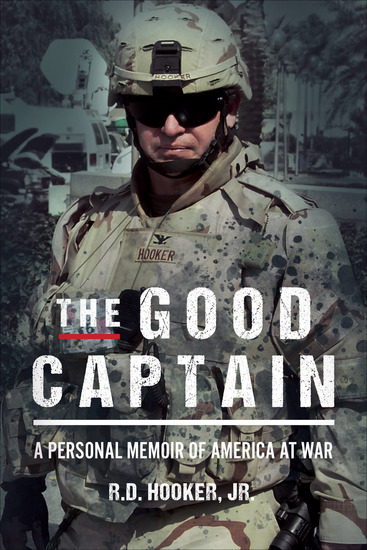
The Good Captain - A Personal Memoir of America at War - cover

The Good Captain - A Personal Memoir of America at War

R.D. Hooker

Editorial: Casemate

  • 0
  • 0
  • 0

Sinopsis

The veteran soldier, Pentagon advisor and White House staffer recounts his long and distinguished military career in this acclaimed memoir. 
 
A combat soldier and leader in five wars, R. D. Hooker also served as a White House staff member in four different administrations. He retired in 2010 as the most decorated colonel in the US Army. Beginning with his enlistment at 18 in 1975, this memoir chronicles his experiences in the post-Vietnam Army as a young paratrooper, West Point cadet, and combatant in the many military conflicts which followed.  
 
Hooker served in Grenada, Somalia. Rwanda, Bosnia, and Kosovo. He played a key role in the response to 9/11 and returned to combat in Iraq and Afghanistan. He commanded a paratroop company, battalion and brigade and served in the continental US, Latin America, Europe, the Middle East, Africa and Southwest Asia. When not deployed, he taught at West Point and served in several high-level Pentagon assignments and in the White House in the administrations of George H. W. Bush, Bill Clinton, George W. Bush and Donald Trump. 
 
In The Good Captain, Hooker recounts his storied career with insights and lessons learned through five different conflicts. He also describes each of these campaigns from a strategic and policy perspective informed by his White House and Pentagon experiences as well as years of academic training.
Disponible desde: 30/06/2022.
Longitud de impresión: 298 páginas.


Otros libros que te pueden interesar

  • Inside the NRA - Armed and Dangerous—An Exposè - cover

    Inside the NRA - Armed and...

    Jack Anderson

    • 0
    • 0
    • 0
    A chilling examination of the NRA and its powerful influence on America.In 1996, deaths by gun violence in the United States totaled roughly 14,000. With so many casualties— along with an astounding rise of armed militias and the discovery of huge caches of weapons stockpiled in private residences— Americans were forced to re-examine what it meant to have the "right to bear arms." The scrutinizing public eye wasted no time in looking for answers from the National Rifle Association, a group whose foundation and lifeblood is founded in the Second Amendment. Famed muckraker Jack Anderson went behind the scenes of the NRA to produce this blistering expose. Nearly thirty years later— as gun violence has escalated and America endures mass shootings on an almost weekly basis— Anderson' s scathing portrait of the NRA rings as true as ever.
    Ver libro
  • From Pessimism to Promise - Lessons from the Global South on Designing Inclusive Tech - cover

    From Pessimism to Promise -...

    Payal Arora, Charles Hayes

    • 0
    • 0
    • 0
    When it comes to tech, the mainstream headlines are bleak: Algorithms control and oppress. AI will destroy democracy and our social fabric, and possibly even drive us to extinction. While legitimate concerns drive these fears, we need to equally account for the fact that tech affords young people something incredibly valuable—a rare space for self-actualization. In From Pessimism to Promise, award-winning author Payal Arora explains that, outside the West, where most of the world's youth reside, there is a significant different outlook on tech: in fact, there is a contagion of optimism toward all things digital. These users, especially those in marginalized contexts, are full of hope for new tech. 


    Drawing on field insights in diverse global contexts such as Brazil, India, and Bangladesh, Arora describes what drives Gen Z to embrace new technologies. From Pessimism to Promise discusses the shift to relationally-driven approaches to design; how to create "algorithms of aspiration"; how to reimagine the digital space for sex, pleasure, and care; and, what we can learn from feminist digital activists and women's collectives in the Global South on shared digital provenance and value, as well as indigenous approaches to sustainability, that challenges sacred ideas on degrowth, circular economy, and the doughnut economy.
    Ver libro
  • Cognitive Behavioral Therapy - Rewiring the Mind for Positive Change - cover

    Cognitive Behavioral Therapy -...

    Vivian Westlake

    • 0
    • 0
    • 0
    Cognitive Behavioral Therapy (CBT) is a widely recognized and effective approach to mental health treatment that focuses on the powerful connection between our thoughts, emotions, and behaviors. The premise behind CBT is simple: our thoughts shape how we feel, and how we feel influences how we behave. In turn, our behaviors can either reinforce or challenge our thought patterns. By learning to identify, challenge, and reframe negative or distorted thoughts, CBT offers a roadmap to breaking unhealthy cycles and fostering positive change. 
    The key to lasting improvement in mental health often lies in addressing the underlying thought patterns that influence our emotional states. Our minds can become entrenched in negative thinking habits, which can lead to persistent feelings of sadness, anxiety, or stress. These patterns can often seem automatic or out of our control, but through CBT, we gain the tools to not only understand but actively change how we think. 
    The first step in this process is understanding the role of thought patterns in mental health. We all experience a wide range of thoughts throughout the day, some positive and others negative. While we may not always be able to control what thoughts arise, we can gain control over how we respond to them. Negative thoughts such as self-doubt, catastrophizing, and overgeneralizing can trigger emotional distress, which in turn influences our behaviors. If left unaddressed, these cycles can become entrenched, affecting our overall well-being and quality of life.
    Ver libro
  • Philosophy of Language - Words Meaning and Reality - cover

    Philosophy of Language - Words...

    Hector Davidson

    • 0
    • 0
    • 0
    Language plays a fundamental role in human life, functioning not only as a means of communication but as a structure that shapes the way we think, perceive, and understand the world. The philosophy of language seeks to unravel the complex relationships between words, meanings, and reality, exploring how language functions, how it conveys meaning, and how it relates to the world and our experiences. This chapter serves as an introduction to these foundational issues and provides an overview of the central questions and debates within the philosophy of language. 
    At its core, language is a system of symbols—words, phrases, and sentences—that represent concepts, objects, and actions. Understanding language, however, requires more than just examining its structure. It involves questioning how words acquire meaning, how those meanings change in different contexts, and how language can both represent and distort reality. This inquiry into meaning is not limited to how words correspond to things in the world, but also explores how they function in communication, how they shape thought, and how they reflect the underlying structures of human experience. 
    The structure of language itself is another crucial aspect. Language is governed by rules—such as syntax, grammar, and semantics—that allow words to be combined in meaningful ways. Syntax provides the framework for sentence structure, while grammar dictates how words should be used within that structure. Semantics, on the other hand, deals with the meaning of words and how they combine to form meaning within a sentence. Each of these aspects must be understood in relation to each other to grasp how language functions at a deeper level.
    Ver libro
  • Dasher - The Kevin Wheatley VC Story - cover

    Dasher - The Kevin Wheatley VC...

    Michael C Madden

    • 0
    • 0
    • 0
    Kevin ‘Dasher’ Wheatley VC is one of the most extraordinary characters in Australian history. Dasher was a husband, father, champion footballer and one of the finest soldiers this country has ever produced. The story of his sacrifice is used by the ADF as a perfect example of valour and mateship to this day. Although he is one of the most famous Victoria Cross recipients of all time, his story has never been fully told. Until now. 
     
    Dasher: The Kevin Wheatley VC Story was written with firsthand accounts from Dasher’s family and the men who served and fought alongside him. It tells not only the story of an unlikely lad from the mean streets of Sydney, but that of a soldier whose death devastated the ranks of three armies and changed the way Australia dealt with the overseas loss of service people forever. 
     
    Everyone who met the man has a Dasher Wheatley story of larrikin behaviour, outstanding soldiering, stunning valour, or all three. 
     
    Forwarded by Keith Payne, this book also investigates other gallantry awards Wheatley qualified for but was never given. 
     
    “The Dasher Wheatley story is one that all Australians should know and be proud of.” HIS EXCELLENCY GENERAL THE HONOURABLE DAVID HURLEY AC DSC (Retd General), Governor-General of Australia 
     
    “I never met Dasher Wheatley VC, but I would have liked to share a beet with a man whose decision to stay with a dying mate cost him his life. His compelling courage, that choice, characterise the values that make Australia.” KERRRY STOKES, AC Chairman Australian War Memorial.
    Ver libro
  • Babylon - Its Dynasty Kings and Downfall - cover

    Babylon - Its Dynasty Kings and...

    Kelly Mass

    • 0
    • 0
    • 0
    Babylon was an old city that was home to some of the world's most effective empires. It was the capital of the Babylonian Empire and was considered a center of commerce, art, and more. It's thought to have been the world's biggest early city, perhaps the first to reach a population of more than 200,000 people. 
    The age-old city featured high embankments put up along both banks of the Euphrates River to include the river's seasonal floods. 
    Prophets in the Bible have predicted the “great fall of Babylon” and the Babylonian Empire has, since long ago, it has just been a sometimes-forgotten speck in history. What was it about the Babylonians that was considered so evil? Or what was it that kept their society together for so long? What is their significance now? 
    In this book, I hope you will find some answers.
    Ver libro