¡Acompáñanos a viajar por el mundo de los libros!
Añadir este libro a la estantería
Grey
Escribe un nuevo comentario Default profile 50px
Grey
Suscríbete para leer el libro completo o lee las primeras páginas gratis.
All characters reduced
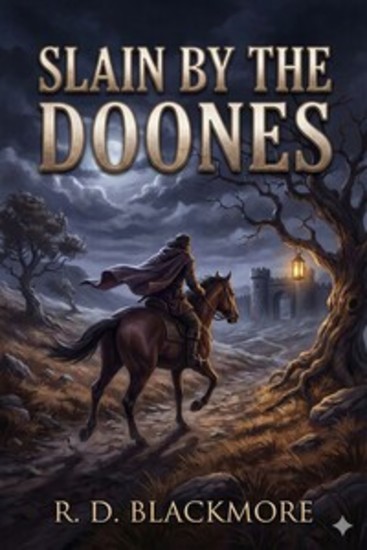
Slain By The Doones - cover

Slain By The Doones

R. D. Blackmore

Editorial: Bu Classics Books

  • 0
  • 0
  • 0

Sinopsis

The shadows of Exmoor grow long as the infamous Doone outlaws return in this collection of gritty tales centered on their violent legacy. Vengeance and survival are the primary forces driving these stories of individuals caught in the crossfire of a brutal clan war. Each narrative deepens the lore of the wilderness and the outlaws who ruled it with an iron hand.
Disponible desde: 06/03/2026.
Longitud de impresión: 46 páginas.

Otros libros que te pueden interesar

  • Stories for Vlad: Volume 2 - Stories for children and parents - cover

    Stories for Vlad: Volume 2 -...

    Geo Mihalache

    • 0
    • 0
    • 0
    Do you want to enjoy the silence in the car and at home? Well, try the stories in the series "Stories for Vlad" 
    In this volume: 
    Pic and Miron on the 'great adventure' - the tomcats go to the forest and return hungry and scared at home after a series of adventures; 
    Tarzanica and the Walnut Tree - the puppy helps a small walnut tree to get out from under a pile of twigs; 
    The Walnut Tree and the Beetle - the disappointment of the walnut tree that loses its leaves for the first time; 
    The Beetle and Winter - the dream of a small green beetle; 
    Pic Locked in the Cellar - the adventure of the curious cat who remains locked in the cellar; 
    Pic, Miron and the New Kitten - in the grandparents' house there is a new kitten that Pic treats at first as a competitor. 
    I invite you to find other stories in the series. 
    Love, 
    Geo
    Ver libro
  • The Spike - From their pens to your ears genius in every story - cover

    The Spike - From their pens to...

    George Orwell

    • 0
    • 0
    • 0
    Eric Arthur Blair was born on 25th June 1903 in Motihari, Bihar, in what was then British India. When Eric was one his mother took him to England and they settled at Henley-on-Thames in Oxfordshire.  
    His education was at the nearby convent school before moving on to St Cyprian's School at Eastbourne and finally Eton where his academic studies were sidelined in favour of work on college publications. 
    University could not be achieved without a scholarship, which depended on good grades, and so it was decided that Eric should join the Imperial Police. Now 19 he chose a posting in Burma, then a province of British India. He was appointed an Assistant District Superintendent in November 1922. In Burma, he was an outsider. However, he acquired a moustache and some local tattoos—small badly drawn blue circles on his knuckles. 
    In 1927 he contracted dengue fever and returned to England to convalesce. At home he reappraised his life and resigned his job to become a writer. His police experiences were later used for ‘Burmese Days’.  
    By 1932 he had a literary agent who secured him an offer to publish a non-fiction work ‘Down and Out in London and Paris’ for a £40 advance, through the radical and socialist Victor Gollancz publishing house.  It was published in January 1933 as ‘by George Orwell’, it was modestly successful. 
    ‘Burmese Days’ (1934) and ‘A Clergyman's Daughter’ (1935) were published whilst Orwell kept on with writing ‘Keep the Aspidistra Flying’.  In January 1936, he set out by public transport to research life for the ordinary man and woman in Wigan. From these experiences emerged ‘The Road to Wigan Pier’. He also caught the eye of Special Branch who kept him under surveillance until the year before the release of ‘Nineteen Eighty-Four’. 
    Later in December 1936 Orwell set out to fight in the Spanish Civil War. Initially stationed at Alcubierre 1,500 feet above sea level, in the depth of winter on the Aragon Front. Military action was scant as was the lack of munitions, food and firewood. In April, Orwell returned to Barcelona and was caught up in the Barcelona May Days and its factional in-fighting. Returning to the Aragon Front he was almost immediately hit by a sniper's bullet through the throat. The bullet barely missed the artery but he survived.  His experiences were expressed in ‘Homage to Catalonia’ (1938) but, out of fashion with its times, it was a commercial failure.  
    When World War Two started Orwell was declared ‘unfit for any kind of military service’ but finally obtained ‘war work’ with the BBC's Eastern Service.  In September 1943, after two years Orwell left the BBC to concentrate on a new idea: ‘Animal Farm’.  
    By April 1944 ‘Animal Farm’ was ready for publication. It was a huge and resounding success.   
    Orwell left London for the island of Jura in April 1947 to work on ‘Nineteen Eighty-Four’. Once more health became an issue and in December a chest specialist was summoned from Glasgow who diagnosed tuberculosis.  By the end of July Orwell was able to return to Jura to finish ‘Nineteen Eighty-Four’. It was published the following June to immediate critical and popular acclaim. 
    By Christmas Orwell's health had again begun to decline. Early on the morning of 21st January, an artery burst in Orwell's lungs. It was fatal. He was dead at 46.
    Ver libro
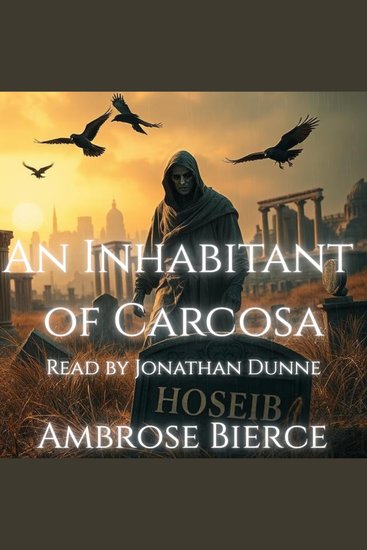
  • Inhabitant of Carcosa An - cover

    Inhabitant of Carcosa An

    Ambrose Bierce

    • 0
    • 0
    • 0
    Title: An Inhabitant of Carcosa 
    Author: Ambrose Bierce 
    Narrator: Jonathan Dunne 
    Original Publication: 1886 
    Public Domain: Yes 
    Series Placement: Number 46 in the Timeless Terrors series 
    Description: 
    An Inhabitant of Carcosa by Ambrose Bierce is a haunting vision of death, memory, and cosmic revelation. In a desolate landscape shrouded in silence, a lost soul named Hoseib wanders among ancient ruins, struggling to recall who he is and how he came to be there. As he journeys through the remnants of a forgotten civilization, a terrible truth emerges — he walks through the ruins of his own world, long dead and buried. 
    Through its eerie stillness and philosophical depth, Bierce’s story anticipates the cosmic unease later explored by Chambers and Lovecraft. It is one of the earliest works to hint at a vast, indifferent universe — where death is not an ending, but an eternal realization. 
    Narrated by Amazon bestselling horror author Jonathan Dunne, this performance captures the quiet terror and melancholy beauty of Bierce’s prose — the slow unveiling of mortality beneath a sky where even the stars seem mournful. While the text is in the public domain, this narration is an original performance and copyright © 2025 Jonathan Dunne. 
    Part of Timeless Terrors, a series devoted to resurrecting the masters of the macabre and uncanny, An Inhabitant of Carcosa endures as a cornerstone of early cosmic horror — a whisper from the grave reminding us that the dead may still walk among the ruins.
    Ver libro
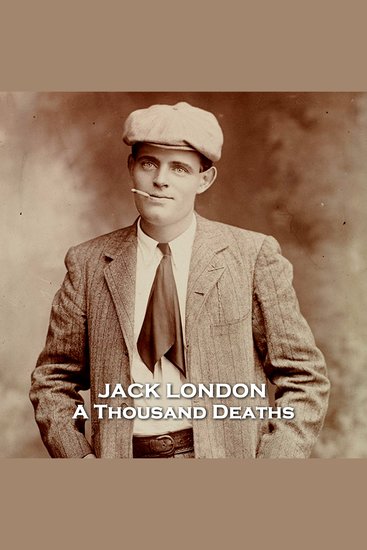
  • A Thousand Deaths - From their pens to your ears genius in every story - cover

    A Thousand Deaths - From their...

    Jack London

    • 0
    • 0
    • 0
    John Griffith Chaney was born on January 12th, 1876 in San Francisco.   
    His father, William Chaney, was living with Flora Wellman when she became pregnant.  Chaney insisted she have an abortion.  Flora's response was to turn a gun on herself.  Although her wounds were not severe the trauma made her temporarily deranged. 
    In late 1876 his mother married John London and the young child was brought to live with them as they moved around the Bay area, eventually settling in Oakland where now, calling himself Jack, he completed grade school. 
    Jack worked hard at several jobs, sometimes 12-18 hours a day, but his dream was university.  He studied hard and borrowed the money to enrol in the summer of 1896 at the University of California in Berkeley. 
    In 1897, at 21, Jack searched out newspaper accounts of his mother's suicide attempt and for the name of his biological father. He wrote to Chaney, then living in Chicago, who claimed he could not be Jack’s father because he was impotent and casually asserted that London's mother had relations with other men.  Jack, devastated by the response, quit Berkeley and went to the Klondike. Other accounts suggest that his dire finances presented Jack with the excuse he needed to leave. 
    In the Klondike Jack began to gather material for his writing but also accumulated many health problems, including scurvy, which together with hip and leg problems he would carry for the rest of his life. 
    During the late 1890's Jack was regularly publishing short stories and by the turn of the century full blown novels. 
    By 1904 Jack had married, fathered two children and was now in the process of divorcing.  A stint as a reporter on the Russo-Japanese war of 1904 was equal amounts trouble and experience. But that experience was always put to good use in a continuing and remarkable output of work. 
    In 1905 he married Charmian Kittredge who at last was a soul and companion who brought him some semblance of peace despite his advancing alcoholism and his incurable wanderlust. 
    Twelve years later Jack had amassed both wealth and a literary reputation through such classics as ‘The Call of the Wild’, ‘White Fang’ and many others. He had a reputation as a social activist and was a tireless friend of the workers.   
    Jack London died suffering from dysentery, late-stage alcoholism and uremia, aged only 40, on November 22nd 1916 at his property in Glen Elen in California.
    Ver libro

  • Horrid Henry's Family Fortunes - cover

    Horrid Henry's Family Fortunes

    Lucinda Whiteley

    • 0
    • 0
    • 0
    Join Horrid Henry on his adventures with his family! Contains 5 Horrid Henry stories, performed by the show's full cast. Catch up with Henry and family in "Home Improvement", "How To Be Good", "My Life", "Planet Of The Grapes" and "Grown Ups".
    Ver libro
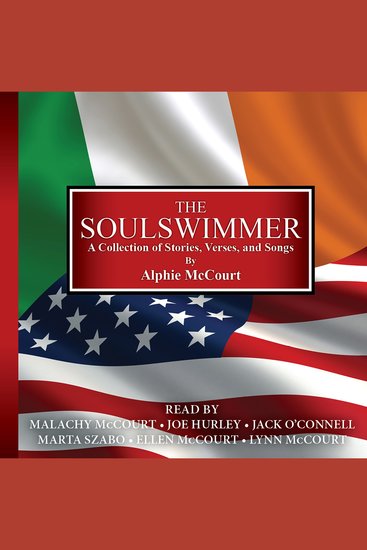
  • The Soulswimmer - cover

    The Soulswimmer

    Alphie McCourt

    • 0
    • 0
    • 0
    The Soulswimmer is a witty and insightful collection of stories, verses, and songs by Alphie McCourt, the youngest of the literary McCourt brothers famous for their Irish memoirs.
    Ver libro