Rejoignez-nous pour un voyage dans le monde des livres!
Ajouter ce livre à l'électronique
Grey
Ecrivez un nouveau commentaire Default profile 50px
Grey
Abonnez-vous pour lire le livre complet ou lisez les premières pages gratuitement!
All characters reduced
Two Years in the Forbidden City - cover

Two Years in the Forbidden City

Princess Der Ling

Maison d'édition: DigiCat

  • 0
  • 0
  • 0

Synopsis

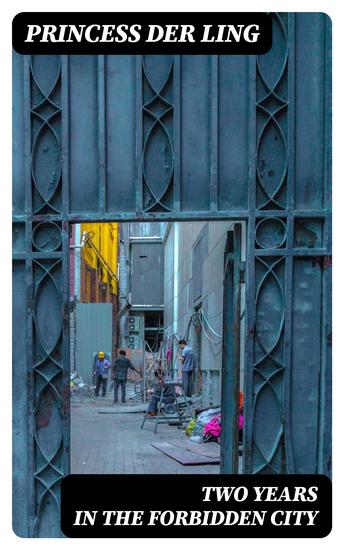
In "Two Years in the Forbidden City," Princess Der Ling offers an unparalleled glimpse into the enigmatic world of Beijing's imperial court during the last decades of the Qing Dynasty. Written with an engaging blend of vivid descriptive prose and intimate narrative style, the book functions as both a memoir and a historical document. The literary context surrounding this work is particularly noteworthy as it juxtaposes the personal experiences of a Chinese noblewoman with the broader political upheavals of early 20th-century China, capturing the tension between tradition and modernity as Western influences began encroaching upon a once insular society. Princess Der Ling, born in 1885 to a Manchu family, holds a unique position as one of the few women who gained access to the inner workings of the Forbidden City. Her intimate relationships with figures such as Empress Dowager Cixi, against the backdrop of her experiences as a lady-in-waiting, imbue the narrative with authenticity. This insider perspective is further enriched by her life journey, which bridged two cultures, allowing her to reflect critically on both her heritage and the Western world. This compelling memoir is a must-read for those interested in feminist literature, history, and cross-cultural narratives. It not only illuminates the complexities of life in imperial China but also invites readers to ponder the evolving roles of women in societies both past and present.
Disponible depuis: 28/05/2022.
Longueur d'impression: 214 pages.

D'autres livres qui pourraient vous intéresser

  • The Search for Reagan - The Appealing Intellectual Conservatism of Ronald Reagan - cover

    The Search for Reagan - The...

    Craig Shirley

    • 0
    • 0
    • 0
    Never before has anyone explored the mind, soul, and heart of Ronald Reagan. The Search for Reagan explores the challenges and controversies in Reagan's life and how he successfully dealt with each, depicting a man who was never as conservative as some conservatives wanted him to be, but rather as conservative as he was comfortable being—a man who wanted to win on his own terms and integrity. 


    Ronald Reagan was a singularly unique man and conservative who championed a wildly successful revolution—leading to more freedom and less government for the American people and to the fall of communism, while boosting American morale. He was the first president in many years who believed optimism from the Oval Office had a direct bearing on the affairs of the nation. As a consequence, he left office more popular than when he entered, with a whopping 73 percent approval. He understood that American conservatism was based upon the individual and not the group. In his presidency, he solved the mystery of high inflation that had bedeviled his predecessor, high interest rates, and high gas prices. He created over twenty million new jobs, and the number of American millionaires grew from 4,414 to 34,944. He is considered by most historians to be one of our four greatest presidents, along with George Washington, Abraham Lincoln, and Franklin Roosevelt.
    Voir livre
  • Blacksound - Making Race and Popular Music in the United States - cover

    Blacksound - Making Race and...

    Matthew D. Morrison

    • 0
    • 0
    • 0
    A new concept for understanding the history of the American popular music industry. 


    Blacksound explores the sonic history of blackface minstrelsy and the racial foundations of American musical culture from the early 1800s through the turn of the twentieth century. With this namesake book, Matthew D. Morrison develops the concept of "Blacksound" to uncover how the popular music industry and popular entertainment in general in the United States arose out of slavery and blackface. 


    Blacksound as an idea is not the music or sounds produced by Black Americans but instead the material and fleeting remnants of their sounds and performances that have been co-opted and amalgamated into popular music. Morrison unpacks the relationship between performance, racial identity, and intellectual property to reveal how blackface minstrelsy scripts became absorbed into commercial entertainment through an unequal system of intellectual property and copyright laws. By introducing this foundational new concept in musicology, Blacksound highlights what is politically at stake—for creators and audiences alike—in revisiting the long history of American popular music.
    Voir livre
  • Bubsie and the Boys - The first journey around Australia by car - cover

    Bubsie and the Boys - The first...

    David Riley

    • 0
    • 0
    • 0
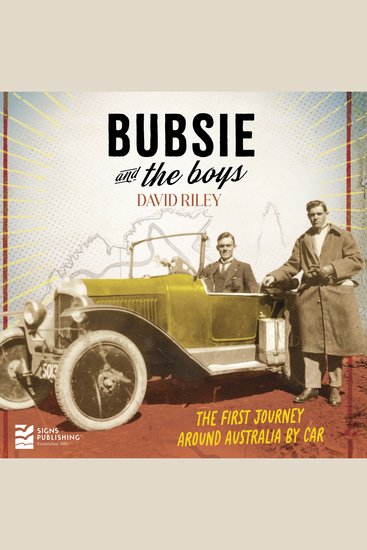
    In the winter of 1925, a pair of 21-year-old men drove out of Perth in a small second-hand Citroen nicknamed “Bubsie” headed for Darwin. At the time, no motor vehicle had ever drive to Darwin from Perth and their borrowed Citroen had less horsepower than a modern-day lawn mower. There were no serviced roads north of Meekatharra and few petrol stations. With most of the routes north unmapped cattle station tracks, the boys—Nevill Westwood and Greg Davies—would need to rely on the generosity of cattle station managers for food and fuel. 
    Getting to Darwin was adventure enough, but their journey took an unexpected turn when a car dealer encouraged them to keep driving to the east coast instead of returning to Perth via steam ship. It was a journey that would make Australian motoring history—the first car to drive around Australia—and the original vehicle is now housed at the National Museum as a vehicle of national significance.
    Voir livre
  • Mother Country - A Story of Love and Lies - cover

    Mother Country - A Story of Love...

    Monique Charlesworth

    • 0
    • 0
    • 0
    Inge was German, half-Jewish and a Holocaust survivor, all of which she chose to deny. Talented and able, charismatic and infuriating, she surged through life constantly reinventing herself. Sent out of Nazi Germany to the souks of Meknès, she fled a freezing attic in war-torn Brussels to land in a council estate in Birkenhead. London offered the escapee a new start until her past caught up with her. Triumph finally came in France where nobody knew who she was – least of all the friends who adored her. 
    Led by emotions she could barely understand, let alone control, Inge divided, and often she conquered. After her death, deep secrets emerged. Her daughters knew that she had always misled others – but not that they, too, might be collateral damage. 
    Compelling, frank, and witty, this memoir is part detective story, part daughterly fury. Drawn to embrace the identity her mother could not bear, Monique Charlesworth has dug deep into Inge’s story, unveiling tragedy, passion, heartbreak and, finally, the truth.
    Voir livre
  • The Portraitist - Frans Hals and His World - cover

    The Portraitist - Frans Hals and...

    Steven M. Nadler

    • 0
    • 0
    • 0
    A biography of the great portraitist Frans Hals that takes the listener into the turbulent world of the Dutch Golden Age. 


    Frans Hals was one of the greatest portrait painters in history, and his style transformed ideas and expectations about what portraiture can do and what a painting should look like. 


    Hals was a member of the great trifecta of Dutch Baroque painters alongside Rembrandt and Vermeer, and he was the portraitist of choice for entrepreneurs, merchants, professionals, theologians, intellectuals, militiamen, and even his fellow artists in the Dutch Golden Age. His works, with their visible brush strokes and bold execution, lacked the fine detail and smooth finish common among his peers, and some dismissed his works as sloppy. But for others, they were fresh and exciting, filled with a sense of the sitter's animated presence captured with energy and immediacy. 


    Steven Nadler gives us the first full-length biography of Hals in many years and offers a view into seventeenth-century Haarlem and this culturally rich era of the Dutch Republic. He tells the story not only of Hals's life, but also of the artistic, social, political, and religious worlds in which he lived and worked.
    Voir livre
  • Freckles - From their pens to your ears genius in every story - cover

    Freckles - From their pens to...

    William Pett Ridge

    • 0
    • 0
    • 0
    William Pett Ridge was born at Chartham, near Canterbury, Kent, on 22nd April 1859. 
    His family’s resources were certainly limited. His father was a railway porter, and the young Pett Ridge, after schooling in Marden, Kent became a clerk in a railway clearing-house. The hours were long and arduous, but self-improvement was Pett Ridge’s goal.  After working from nine until seven o’clock he would attend evening classes at Birkbeck Literary and Scientific Institute and then to follow his passion; the ambition to write.  He was heavily influenced by Dickens and several critics thought he had the capability to be his successor. 
    From 1891 many of his humourous sketches were published in the St James's Gazette, the Idler, Windsor Magazine and other literary periodicals of the day. 
    Pett Ridge published his first novel in 1895, A Clever Wife. By the advent of his fifth novel, Mord Em'ly, a mere three years later in 1898, his success was obvious.  His writing was written from the perspective of those born with no privilege and relied on his great talent to find humour and sympathy in his portrayal of working class life. 
    Today Pett Ridge and other East End novelists including Arthur Nevinson, Arthur Morrison and Edwin Pugh are being grouped together as the Cockney Novelists.   
    In 1924, Pugh set out his recollections of Pett Ridge from the 1890s: “I see him most clearly, as he was in those days, through a blue haze of tobacco smoke. We used sometimes to travel together from Waterloo to Worcester Park on our way to spend a Saturday afternoon and evening with H. G. Wells. Pett Ridge does not know it, but it was through watching him fill his pipe, as he sat opposite me in a stuffy little railway compartment, that I completed my own education as a smoker... Pett Ridge had a small, dark, rather spiky moustache in those days, and thick, dark, sleek hair which is perhaps not quite so thick or dark, though hardly less sleek nowadays than it was then”. 
    With his success, on the back of his prolific output and commercial success, Pett Ridge gave generously of both time and money to charity. In 1907 he founded the Babies Home at Hoxton.  This was one of several organisations that he supported that had the welfare of children as their mission.  
    His circle considered Pett Ridge to be one of life's natural bachelors. In 1909 they were rather surprised therefore when he married Olga Hentschel.  
    As the 1920’s arrived Pett Ridge added to his popularity with the movies. Four of his books were adapted into films.  
    Pett Ridge now found the peak of his fame had passed. Although he still managed to produce a book a year he was falling out of fashion and favour with the reading public and his popularity declined rapidly.  His canon runs to over sixty novels and short-story collections as well as many pieces for magazines and periodicals. 
    William Pett Ridge died, on 29th September 1930, at his home, Ampthill, Willow Grove, Chislehurst, at the age of 71. 
    He was cremated at West Norwood on 2nd October 1930.
    Voir livre