Begleiten Sie uns auf eine literarische Weltreise!
Buch zum Bücherregal hinzufügen
Grey
Einen neuen Kommentar schreiben Default profile 50px
Grey
Jetzt das ganze Buch im Abo oder die ersten Seiten gratis lesen!
All characters reduced
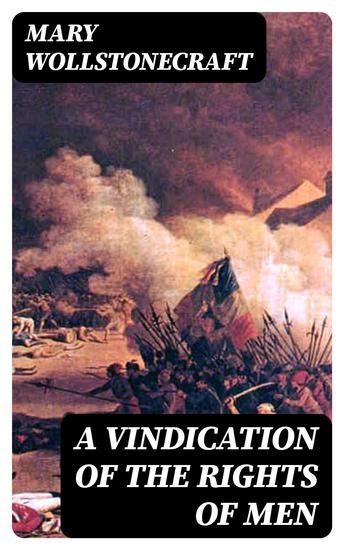
A vindication of the rights of men - A letter to Edmund Burke; occasioned by his Reflections on the Revolution in France - cover

A vindication of the rights of men - A letter to Edmund Burke; occasioned by his Reflections on the Revolution in France

Mary Wollstonecraft

Verlag: DigiCat

  • 0
  • 0
  • 0

Beschreibung

In "A Vindication of the Rights of Men," Mary Wollstonecraft presents a powerful critique of the political and social injustices of her time, advocating for the principles of reason, equality, and individual rights. Written in direct response to Edmund Burke's "Reflections on the Revolution in France," Wollstonecraft employs a rigorous argumentative style, blending emotive prose with logical reasoning. Her work is steeped in the Enlightenment ideals of rationalism, challenging the status quo while articulating a vision for a more equitable society that recognizes the inherent rights of all individuals, irrespective of gender or class. Mary Wollstonecraft, an early feminist and philosopher, is often regarded as a foundational figure in the fight for human rights. Her life experiences, marked by personal struggles and a fervent commitment to education and reform, deeply influenced her writing. Wollstonecraft's own challenges within a patriarchal society fueled her advocacy for universal rights, and her critical engagement with contemporary political discourse reflects her passion for social change and justice. This seminal work is essential reading for anyone interested in the history of political thought, feminist theory, or the fight for human rights. Wollstonecraft's compelling arguments and eloquent prose provide a profound insight into the struggles for equality and offer timeless lessons that resonate in today's societal debates.
Verfügbar seit: 13.06.2022.
Drucklänge: 65 Seiten.

Weitere Bücher, die Sie mögen werden

  • The Invented State - Policy Misperceptions in the American Public - cover

    The Invented State - Policy...

    Emily Thorson

    • 0
    • 0
    • 0
    In The Invented State, Emily Thorson argues that a problematic and understudied aspect of political misinformation reflects widespread public misperception about what the government does. Because much of public policy is invisible to the public, there is fertile ground for false beliefs to flourish, leading to what Thorson terms the "invented state": systematic misperceptions about public policy. However, people get the facts wrong not because they are stupid or blinded by partisan loyalty. Misperceptions are created when three conditions are met: when citizens have incomplete information about an issue, when their own biases color their understanding of it, and when they feel that the issue is important. The invented state is created by exposure to misinformation and by individuals' cognitive errors. 


    Correcting these policy misperceptions is highly effective at reducing false beliefs. Providing people with corrective information has downstream effects on attitudes. When they learn how policies really work, their approval increases and they also shift their policy priorities. Contrary to pundits' assumptions of a public who is largely indifferent to policy, there is a deep public desire to learn basic facts about how the government works. Thorson meets that desire with analysis on how the media can identify and correct substantive policy misperceptions.
    Zum Buch
  • A World of Struggle - How Power Law and Expertise Shape Global Political Economy - cover

    A World of Struggle - How Power...

    David Kennedy

    • 0
    • 0
    • 0
    How today's unjust global order is shaped by uncertain expert knowledge—and how to fix itA World of Struggle reveals the role of expert knowledge in our political and economic life. As politicians, citizens, and experts engage one another on a technocratic terrain of irresolvable argument and uncertain knowledge, a world of astonishing inequality and injustice is born.In this provocative book, David Kennedy draws on his experience working with international lawyers, human rights advocates, policy professionals, economic development specialists, military lawyers, and humanitarian strategists to provide a unique insider's perspective on the complexities of global governance. He describes the conflicts, unexamined assumptions, and assertions of power and entitlement that lie at the center of expert rule. Kennedy explores the history of intellectual innovation by which experts developed a sophisticated legal vocabulary for global management strangely detached from its distributive consequences. At the center of expert rule is struggle: myriad everyday disputes in which expertise drifts free of its moorings in analytic rigor and observable fact. He proposes tools to model and contest expert work and concludes with an in-depth examination of modern law in warfare as an example of sophisticated expertise in action.Charting a major new direction in global governance at a moment when the international order is ready for change, this critically important book explains how we can harness expert knowledge to remake an unjust world.
    Zum Buch
  • People Power Change - Organizing for Democratic Renewal - cover

    People Power Change - Organizing...

    Marshall Ganz

    • 0
    • 0
    • 0
    At a moment in which our everyday practice of democracy has atrophied, and political, economic, and technological forces have weakened our capacity for collective action, People, Power, Change is a once-in-a-generation book for anyone who wants to create real and lasting change. 
     
    Marshall Ganz is one of the world’s leading authorities on democratic leadership, organizing, and action and this book is the culmination of his decades of teaching, research, and practice. In People, Power, Change Ganz offers students, educators, and organizers access to the craft he has learned, adapted, and shared over the last half-century of creating effective collective action. It is not a blueprint, but a road map.  
     
    Ganz explores the values, ideas, and craft core to the practice of organizing and offers an actionable framework for how to actually do it. He focuses the book on the creation and substance of relationships, the fuel of values and narrative, the resources and power of strategy, the necessity of structure, and the accountability of action. Across these five organizing practices, Ganz weaves in his personal experiences from a lifetime of organizing in iconic social movements and campaigns to illustrate how collective action actually works and to build the practices and skills that must be developed to do it with intention and with success. 
     
    “If there was ever a moment when this message needed to be heard, this is it! Read it, and then get to work!”—Bill McKibben, founder of 350.org and Third Act 
     
    This audiobook contains a supplemental PDF.
    Zum Buch
  • Beyond Baseball’s Color Barrier - The Story of African Americans in Major League Baseball Past Present and Future - cover

    Beyond Baseball’s Color Barrier...

    Rocco Constantino

    • 0
    • 0
    • 0
    A fascinating history celebrating Black players in Major League Baseball from the 1800s through today, with special insight into what the future may hold. 


    In Beyond Baseball's Color Barrier, Rocco Constantino chronicles the history of generations of ballplayers, showing how African Americans have influenced baseball from the 1800s to the present. He details how the color line was drawn, efforts made to erode it, and the progress towards Jackie Robinson's debut—including a pre-integration survey in which players unanimously promoted integration years before it actually happened. Personal accounts and colorful stories trace the exponential growth of diversity in the sport since integration, from a boom in participation in the 1970s to peak participation in the early 1990s, but also reveal the current downward trend in the number of African American players to percentages not seen since the 1960s. 


    Beyond Baseball's Color Barrier not only explores the stories of icons like Hank Aaron, Willie Mays, and Satchel Paige but also considers contributions made by players like Vida Blue, Mudcat Grant, and Dwight Gooden. Exclusive interviews with former players and individuals involved in the game, including the President of the Negro Leagues Baseball Museum, add first-hand expert insight into the history of the topic and what the future holds.
    Zum Buch
  • Lost to the World - A Memoir of Faith Family and Five Years in Terrorist Captivity - cover

    Lost to the World - A Memoir of...

    Shahbaz Taseer

    • 0
    • 0
    • 0
    Shahbaz Taseer’s memoir of his five-year-long captivity at the hands of the Islamic Movement of Uzbekistan. In late August 2011, Shahbaz Taseer was driving to his office in Lahore when he was dragged from his car at gunpoint and kidnapped by members of the Islamic Movement of Uzbekistan (IMU), a Taliban-affiliated Uzbek terrorist group. Shahbaz’s father, the late Pakistani governor, had recently been assassinated. His crime: speaking in support of a Christian woman who had been accused of blasphemy and sentenced to death. Though Taseer himself wasn’t much interested in politics, he was somewhat of a public figure, and he represented a more tolerant, internationally connected Pakistan that the IMU despised.What followed was nearly five years of torture and harrowing danger while Taseer was held captive, his fate determined by the infighting of the IMU, the Taliban, and ISIS. Lost to the World is his memoir of that time—a story of extraordinary sorrow but also of goodness and faith. While deeply dramatic, this tale is also comedic; for Taseer, humor, as much as the Koran, provided a light by which to see his own humanity, even under the most inhumane conditions, and to find a way back to his family.In a time when Western leaders use fear-mongering rhetoric to paint all followers of Islam as dangerous fundamentalists, Lost to the World illustrates the chasm between Muslim terrorists and ordinary Muslim citizens, and how terrorist organizations gain strength from the war on terror.A Macmillan Audio production from Farrar, Straus and Giroux.
    Zum Buch
  • Nato's Role - An International Coalition During the War in Afghanistan - cover

    Nato's Role - An International...

    Vince Bywaters

    • 0
    • 0
    • 0
    NATO, or the North Atlantic Treaty Organization, is a military alliance formed in 1949 to provide collective defense against aggression, primarily focused on safeguarding the democratic values and security of its member nations. Over time, its role has expanded from traditional defense to addressing global security challenges, including the fight against terrorism and the stabilization of conflict zones. The War in Afghanistan became a key test for NATO's evolving mission, showcasing its capabilities in out-of-area operations far beyond the traditional borders of its members. 
    The decision to involve NATO in Afghanistan followed the September 11, 2001, terrorist attacks on the United States, which were planned and orchestrated by al-Qaeda, a terrorist group harbored by Afghanistan's Taliban regime. In response, NATO invoked Article 5 of its founding treaty for the first time in its history, declaring an attack on one member as an attack on all. The alliance's commitment to fighting terrorism led to the deployment of NATO forces in Afghanistan, initially through Operation Enduring Freedom, and later through the more expansive International Security Assistance Force (ISAF) mission. 
    NATO’s intervention was multi-faceted, aiming not only to eliminate terrorist threats but also to assist in rebuilding a war-torn nation. The alliance’s involvement extended beyond military operations, focusing on stabilizing Afghanistan by promoting security, governance, and economic development. This commitment was based on the understanding that military force alone would not bring lasting peace. NATO recognized that its mission required close collaboration with local Afghan forces, international organizations, and governments, all working together to achieve a stable and secure Afghanistan.
    Zum Buch