Rejoignez-nous pour un voyage dans le monde des livres!
Ajouter ce livre à l'électronique
Grey
Ecrivez un nouveau commentaire Default profile 50px
Grey
Abonnez-vous pour lire le livre complet ou lisez les premières pages gratuitement!
All characters reduced
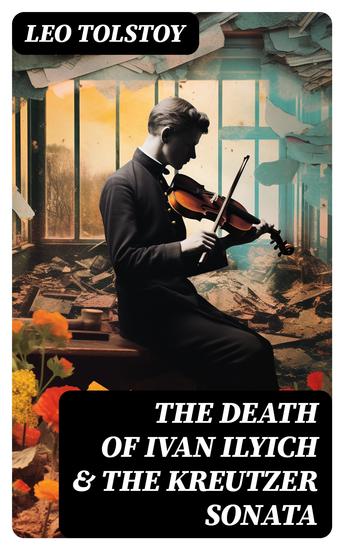
The Death of Ivan Ilyich & The Kreutzer Sonata - Two Psychological Novellas - cover

The Death of Ivan Ilyich & The Kreutzer Sonata - Two Psychological Novellas

Leo Tolstoy

Traducteur Aylmer Maude, Benjamin Tucker

Maison d'édition: DigiCat

  • 0
  • 0
  • 0

Synopsis

In "The Death of Ivan Ilyich" and "The Kreutzer Sonata," Leo Tolstoy explores the profound themes of mortality, existential despair, and the complexities of human relationships. While the former exists as a poignant novella revealing the stark confrontation between life and death, emphasizing the futility of materialism, the latter takes the form of a powerful novella that critiques bourgeois marriage and explores moral dilemmas surrounding love and sexuality. Tolstoy's succinct prose combines realism with deep philosophical inquiries, painting psychological portraits steeped in the author's introspective style. These works reflect the social context of 19th-century Russia, as the author scrutinizes the moral decay of society amidst the quest for authenticity and truth. Leo Tolstoy, a titan of literature and philosophy, was inspired by his own experiences with existential crises and spiraling disillusionment with the superficial nature of contemporary society. After personal tragedies and spiritual awakenings, Tolstoy distilled his observations into narrative form, compelling readers to confront their own lives. His moral reflections were shaped by the tumultuous transformations of Russian society and his internal battles between faith, love, and duty. Both novellas remain essential reading for anyone engaged with the human condition, as they invite introspection about life, love, and death. Engaging with Tolstoy's works is not merely an academic exercise but a profound journey towards understanding one's own existence and moral choices.
Disponible depuis: 09/11/2023.
Longueur d'impression: 177 pages.
D'autres livres qui pourraient vous intéresser

  • Foreordained - From their pens to your ears genius in every story - cover

    Foreordained - From their pens...

    Anthony Hope

    • 0
    • 0
    • 0
    Sir Anthony Hope Hawkins was born on 9th February 1863 in Clapton, London.  
    He was educated at St John's School, Leatherhead, Marlborough College and Balliol College, Oxford.  Hope trained as a lawyer and barrister and was called to the Bar by the Middle Temple in 1887. Despite what was thought to be a promising legal career he had literary ambitions and wrote in his spare time. 
    His early works appeared in various periodicals of the day but for his first book ‘A Man of Mark’ (1890), with no publisher interested, he published with his own resources.  
    More novels and short stories followed, including the mildly successful ‘Mr Witt's Widow’ in 1892. Hope even found time to run as the Liberal candidate for Wycombe in the election that same year but was unsuccessful. 
    His first major literary success came with ‘The Dolly Dialogues’, a collection of previously published magazine pieces followed very quickly by his instant classic, ‘The Prisoner of Zenda’. He now gave up the vestiges of his legal career to pursue writing full-time. 
    Despite never again reaching the same pinnacle of success he was popular and wrote prolifically across novels, plays and of course, short stories though his writing output rapidly diminished after the war. 
    In 1918 he was knighted for his contribution to propaganda efforts during World War I.  
    His short stories are delicate, mannered and often surprising with their wit, humour and interplay of characters who say one thing and usually mean another.  He was very definitely a writer of escapist rather than serious fare but they are no less enjoyable for that. 
    Anthony Hope died of throat cancer on 8th July 1933 at his country home, Heath Farm at Walton-on-the-Hill in Surrey. He was 70.
    Voir livre
  • The Horse Dealer's Daughter - Poignant story exploring death and its effects by the author of Sons And Lovers - cover

    The Horse Dealer's Daughter -...

    D H Lawrence

    • 0
    • 0
    • 0
    David Herbert Lawrence was born on the 11th September 1885 in Eastwood, Nottinghamshire, a coal mining town where the reality of a harsh life was only useful as experiences for future literary works. 
     
    He was educated at Beauvale Board School and became the first local boy to receive a scholarship to attend Nottingham High School. After 3 years he became a junior clerk in Haywood’s surgical appliances factory. He was also attempting a literary career which, in the short term, led to a teacher training position in Eastwood and later a teaching qualification from University College, Nottingham.  
     
    Lawrence’s first efforts were poems, short stories and a draft of ‘The White Peacock’. Moving to London and a teaching position in Croydon his writing attracted the attention of Ford Madox Ford, editor of The English Review, and he commissioned him to write ‘Odour of Chrysanthemums’.  
     
    Wanting to write full-time he now began work on what would become ‘Sons and Lovers.   
     
    In 1912 he met the older and married mother-of-three Frieda Weekley. They eloped to Germany and here Lawrence could see for himself the growing tensions with France.  So keen was his interest that he was arrested and accused of being a British spy.  
     
    In early 1914 Frieda obtained her divorce and they returned to Britain to be married just days before the outbreak of war. Owing to her German parentage, and his own public dislike of militarism and violence, the couple were treated with contempt and suspicion throughout the war years.  
     
    Despite this he continued to write but his reputation in England was so tarnished and, mirrored by his own disdain for the country, he and Frieda left England in November 1919, first for Europe and then America via Ceylon and Australia. 
     
    They bought a ranch in Taos, New Mexico and visited Mexico several times. The third visit in March 1925 caused a near fatal attack of malaria. To convalesce they moved to Florence. Here he continued work on ‘Lady Chatterley’s Lover’ which for many years would cause controversy. A renewed interest in oil painting resulted in an exhibition in 1929 which was raided by the police and several works were confiscated.  
     
    D H Lawrence died of complications arising from a bout of tuberculosis on the 2nd of March 1930 in Vence, France.  He was 44. 
     
    In ‘The Horse Dealers daughter’ a young woman begins a relationship with a young doctor and a friend of her brothers.  What should be straight forward is intimately investigated by Lawrence’s foraging pen.
    Voir livre
  • Diary of a Lunatic - From their pens to your ears genius in every story - cover

    Diary of a Lunatic - From their...

    Leo Tolstoy

    • 0
    • 0
    • 0
    Leo Tolstoy was born in 1828 in the Russian province of Tula to a wealthy noble family. As a child, he had private tutors but he showed little interest in any formal education. When he went to the University of Kazan in 1843 to study oriental languages and law, he left without completing his courses.  Life now was relaxed and idle but with some writing also taking place.  Gambling debts forced an abrupt change of path and he joined the army to fight in the Crimean War.  He was commended for his bravery and promoted but was appalled at the brutality and loss of life.  He recorded these and other earlier experiences in his diaries which formed the basis of several of his works. 
    In 1852 ‘Childhood’ was published to immediate success and was followed by ‘Boyhood’ and ‘Youth’. 
    His experience in the army and the horrors he witnessed resulted in ‘The Cossacks’ in 1862 and the trilogy ‘Sevastopol Tales’. After the war he travelled around Europe, visiting London and Paris and meeting such luminaries as Victor Hugo and Charles Darwin.  
    It was now that Tolstoy began his masterpiece, ‘War and Peace’. Published in 1869 it was an epic work that changed literature. He quickly followed this with ‘Anna Karenina’.  
    These successes made Tolstoy rich and helped him accomplish many of his dreams but also brought problems as he grappled with his faith and the lot of the oppressed poor. These revolutionary views became so popular that the authorities now kept him under surveillance.  
    He led a life of asceticism and vegetarianism and put his socialist ideals into practice by establishing numerous schools for the poor and food programmes. He also believed in giving away his wealth, which caused much discord with his wife.  
    His writing continued to bring forth classics such as ‘The Death of Ivan Ilyich’ and many brilliant and incisive short stories such as ‘How Much Land Does A Man Need’.  
    In 1901 Tolstoy was excommunicated from the Church and controversially deselected for the Nobel Prize for Literature. 
    Whilst undertaking a pilgrimage by train in October 1910 with his daughter Aleksandra he caught pneumonia in the nearby town of Astapovo.  Leo Tolstoy died on November 9th, 1910, he was 82.
    Voir livre
  • The God of His Fathers - cover

    The God of His Fathers

    Jack London

    • 0
    • 0
    • 0
    The God of His Fathers: Tales of The Klondyke, It was written by Jack London in the 1919 year. 
    As a young man in the summer of 1897, Jack London joined the Klondike gold rush. From that seminal experience emerged these gripping, inimitable wilderness tales, which have endured as some of London's best and most defining work. With remarkable insight and unflinching realism, London describes the punishing adversity that awaited men in the brutal, frozen expanses of the Yukon, and the extreme tactics these adventurers and travelers adopted to survive.
    This is more literary, a deeper examination of the human condition, and a homage to the beauty, purity and ease with which one can lose one's life to nature, the elements or other fellow travelers.
    Voir livre
  • The Luft Bad - cover

    The Luft Bad

    Katherine Mansfield

    • 0
    • 0
    • 0
    The Luft Bad is a short story by Katherine Mansfield: I think it must be the umbrellas which make us look ridiculous. – When I was admitted into the enclosure for the first time, and saw my fellow-bathers walking about very nearly “in their nakeds,” it struck me that the umbrellas gave a distinctly “Little Black Sambo” touch...
    Voir livre
  • Anna Karenina (Part 5) - cover

    Anna Karenina (Part 5)

    Leo Tolstoy

    • 0
    • 0
    • 0
    Part 5: Kostya and Kitty marry and start their new life on his country estate. Although the couple are happy, they undergo a bitter and stressful first three months of marriage. Kostya feels dissatisfied at the amount of time Kitty wants to spend with him and dwells on his inability to be as productive as he was as a bachelor. When the marriage starts to improve, Kostya learns that his brother, Nikolai, is dying of consumption. Kitty offers to accompany Kostya on his journey to see Nikolai and proves herself a great help in nursing Nikolai. Seeing his wife take charge of the situation in an infinitely more capable manner than he could have done himself without her, Kostya's love for Kitty grows. Kitty eventually learns that she is pregnant.
    Anna Karenina is a novel by the Russian author Leo Tolstoy, first published in book form in 1878. Many writers consider Anna Karenina the greatest work of literature ever, and Tolstoy himself called it his first true novel. It was initially released in serial installments from 1873 to 1877 in the periodical The Russian Messenger.
    Voir livre