Join us on a literary world trip!
Add this book to bookshelf
Grey
Write a new comment Default profile 50px
Grey
Subscribe to read the full book or read the first pages for free!
All characters reduced
Tao Te Ching - Ancient Masterpiece of Philosophy - cover

Tao Te Ching - Ancient Masterpiece of Philosophy

Lao Tzu

Publisher: DigiCat

  • 0
  • 0
  • 0

Summary

The "Tao Te Ching," attributed to the ancient Chinese philosopher Lao Tzu, is a seminal text in Taoist philosophy that elegantly conveys profound insights on the nature of existence, governance, and harmony. Written in a poetic and aphoristic style, the text consists of 81 short chapters which juxtapose simplicity and complexity through paradoxical statements. This work serves as a foundational document not only for Taoism but also for broader Eastern philosophical thought, advocating for a deep connection to the natural world and promoting principles of wu wei (non-action) and natural order. Lao Tzu, a contemporary of Confucius, is often regarded as the father of Taoism, though much of his life remains shrouded in legend. His teachings emerged during a time of social upheaval in ancient China, fostering a counter-cultural ideology that embraced simplicity and introspection over societal conventions and rigidity. It is believed Lao Tzu's experiences as a historian and philosopher guided him to prioritize the harmony between individuals and the cosmos, reflecting a wisdom far ahead of his time. "Tao Te Ching" is highly recommended for those seeking spiritual depth and philosophical insight. Its layered meanings invite readers to reflect upon their own lives and the world around them, making it a timeless guide for personal growth and ethical living. Engaging with this text offers an invaluable opportunity to explore the art of living harmoniously within the complexities of existence.
Available since: 05/25/2022.
Print length: 144 pages.
Other books that might interest you

  • Why Is Communication So Difficult? - Particularly Between Lovers - cover

    Why Is Communication So...

    Osho

    • 0
    • 0
    • 0
    'OSHO SINGLE': This is a short audio talk by Osho, selected from one of the many series of Osho Talks to listeners from around the world.
    Communication as such is difficult. Of course, it is more difficult between lovers. But first you have to understand the general difficulty of communication. Each mind has been conditioned by different parents, different teachers, different priests, and different politicians. It is a different world in itself. And when two minds try to communicate, as far as the ordinary mundane things are concerned, there is no difficulty. But the moment they start moving beyond things into the world of concepts, communication starts becoming more and more difficult.
    © & ℗ 1987 OSHO International Foundation
    Show book
  • Life Is Short - An Appropriately Brief Guide to Making It More Meaningful - cover

    Life Is Short - An Appropriately...

    Dean Rickles

    • 0
    • 0
    • 0
    Why life's shortness—more than anything else—is what makes it meaningful 


    Death might seem to render pointless all our attempts to create a meaningful life. Doesn't meaning require transcending death through an afterlife or in some other way? On the contrary, Dean Rickles argues, life without death would be like playing tennis without a net. Only constraints—and death is the ultimate constraint—make our actions meaningful. In Life Is Short, Rickles explains why the finiteness and shortness of life is the essence of its meaning—and how this insight is the key to making the most of the time we do have. 


    Life Is Short explores how death limits our options and forces us to make choices that forge a life and give the world meaning. But people often live in a state of indecision, in a misguided attempt to keep their options open. This provisional way of living—always looking elsewhere, to the future, to other people, to other ways of being, and never committing to what one has or, alternatively, putting in the time and energy to achieve what one wants—is a big mistake, and Life Is Short tells listeners how to avoid this trap. By reminding us how extraordinary it is that we have any time to live at all, Life Is Short challenges us to rethink what gives life meaning and how to make the most of it.
    Show book
  • The Rest Is Memory - cover

    The Rest Is Memory

    Lily Tuck

    • 0
    • 0
    • 0
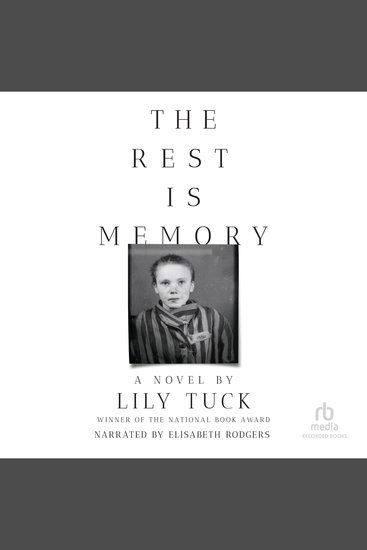
    THE HEARTBREAKING STORY OF A YOUNG CATHOLIC GIRL TRANSPORTED TO AUSCHWITZ BECOMES A RASHOMON-LIKE RONDO BY ONE OF OUR GREATEST NOVELISTS. 
     
    First glimpsed riding on the back of a boy’s motorcycle, fourteen-year-old Czeslawa comes to life in this mesmerizing novel by Lily Tuck, who imagines her upbringing in a small Polish village before her world imploded in late 1942.  
     
    Stripped of her modest belongings, shorn, and tattooed number 26947 on arriving at Auschwitz, Czeslawa is then photographed. Three months later, she is dead. 
     
    How did this happen to an ordinary Polish citizen? This is the question that Tuck grapples with in this haunting novel, which frames Czeslawa’s story within the epic tragedy of six million Poles who perished during the German occupation. A decade prior to writing The Rest Is Memory, Tuck read an obituary of the photographer Wilhelm Brasse, who took more than 40,000 pictures of the Auschwitz prisoners. Included were three of Czeslawa Kwoka, a Catholic girl from rural southeastern Poland. Tuck cut out the photos and kept them, determined to learn more about Czeslawa, but she was only able to glean the barest facts: the village she came from, the transport she was on, that she was accompanied by her mother and her neighbors, her tattoo number, and the date of her death. From this scant evidence, Tuck’s novel becomes a remarkable kaleidoscopic feat of imagination, something only our greatest novelists can do. 
     
    “Beautifully written, all the while instilling a sense of horror” (Susanna Moore), Tuck’s language swirls about, yet not a word is out of place. The subtly rotating images tumble out at us, accelerating as we learn about Czeslawa’s tragic stay in Auschwitz, the lives of real people such as the barbaric Commandant Rudolf Höss; his unconscionable wife, Hedwig; the psychiatrist and child rescuer Janusz Korczak; and the mordant Polish short story writer Tadeusz Borowski. 
     
    Although we are certain of Czeslawa’s fate, we have no choice but to keep turning the pages, thoroughly mesmerized by Tuck’s near otherworldly prose. 
     
    In Lily Tuck’s hands, The Rest Is Memory becomes an unforgettable work of historical reclamation that rescues an innocent life, one previously only recalled by a stark triptych of photographs. 
     
    “The Rest Is Memory is a literary resurrection, as shattering as it is astonishing. Lily Tuck has done the impossible; from darkness and hideous cruelty, she has woven an unforgettable paean to hope, to life, to justice.”—Junot Diaz
    Show book
  • Lead Like a Teacher - How to Elevate Expertise in Your School - cover

    Lead Like a Teacher - How to...

    Miriam Plotinsky

    • 0
    • 0
    • 0
    For the sake of students, close the empathy gap between the classroom and the front office. 


    Far too often, teachers and administrators are adversaries within a school or district and display a mutual distrust and disrespect for each other's perspectives. Yet when this dissonance can be overcome, the result is a more-harmonious school environment that promotes student achievement. 


    In Lead Like a Teacher, instructional specialist Miriam Plotinsky urges secondary school administrators to lead more effectively by actively listening to teachers and welcoming their expertise. Each chapter examines one of nine key aspects of leadership and offers specific, creative solutions to the complex challenge of empowering change. 


    Moving from a micro to a macro focus as the book progresses—from classroom instruction to schoolwide initiatives—Plotinsky provides administrators with the tools to build and maintain collaborative leadership structures. This thoughtful approach to secondary leadership provides an actionable plan to dismantle some of the biggest barriers to achieving school excellence.
    Show book
  • Joker and Philosophy - Why So Serious? - cover

    Joker and Philosophy - Why So...

    George A. Dunn, Jason T. Eberl,...

    • 0
    • 0
    • 0
    A diabolically sinister but clownish villain, Joker is a symbolically rich and philosophically fascinating character. With his enigmatic motivations, infectious irreverence, and selfless devotion to evil, Joker never fails to provoke a host of philosophical questions. 


    Bringing together essays by a diverse panel of acclaimed scholars and philosophers, this engaging book delves into the motivations, psychology, and moral philosophy of the character for whom mayhem and chaos are a source of pure delight. 


    Joker and Philosophy offers deep insights into moral and philosophical questions such as: What is a sane response to a mad world? Can laughter be liberating? Is civilization a thin veneer over our natural lawlessness? Can violence ever be justified in response to an unjust social order? Is one bad day really all it takes to create a villain? 


    Exploring a broad range of timeless issues of human nature, the metaphysics of freedom, the nature of identity, good and evil, political and social philosophy, aesthetics, and much more, Joker and Philosophy: Why So Serious? is a must-listen for all fans of one of the most fascinating villains in the DC comics universe.
    Show book
  • Fitness for Mental Health - Exercise for Stress Relief and Well-Being - cover

    Fitness for Mental Health -...

    Zane Ryder

    • 0
    • 0
    • 0
    Mental health is just as important as physical health, yet it is often overlooked when discussing overall well-being. As the world becomes more fast-paced and demanding, people are increasingly experiencing stress, anxiety, and depression. While therapy and medication are common approaches to managing mental health, an often overlooked yet highly effective method is exercise. Physical activity has been proven to be a powerful tool in improving mental health, relieving stress, and enhancing overall well-being. 
    The connection between physical and mental health has been a topic of research for decades, and studies consistently show that regular exercise positively impacts the brain. When we engage in physical activity, our bodies release endorphins, often referred to as "feel-good" hormones, which help to improve our mood and reduce feelings of anxiety and depression. Exercise has also been shown to reduce cortisol levels, a hormone associated with stress. The combination of these effects makes exercise an excellent natural remedy for mental health struggles. 
    Incorporating exercise into a daily routine provides numerous benefits beyond the body. It not only strengthens muscles and improves cardiovascular health, but it also helps with mental clarity, boosts self-esteem, and enhances cognitive function. Whether it's a brisk walk, a yoga session, or a high-intensity workout, each form of exercise offers unique benefits that contribute to mental well-being.
    Show book