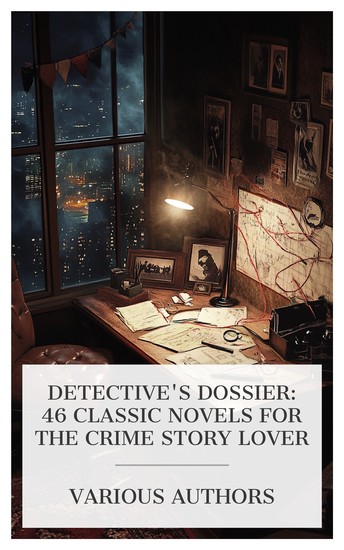
Detective's Dossier: 46 Classic Novels for the Crime Story Lover - Forty-Six Landmark Mysteries of Sleuths Locked Rooms Forensics and Criminal Conspiracies
L. T. Meade, Émile Gaboriau, Louis Tracy, Allan Pinkerton, Charles Morris, Edgar Wallace, Sax Rohmer, Agatha Christie, Catherine Louisa Pirkis, Ellis Parker Butler, John Thomas McIntyre, Anne Austin, Thomas W. Hanshew, A. Frank Pinkerton, Franklin W. Dixon, Lawrence L. Lynch, William Russell, Chester K. Steele, Hulbert Footner, T. J. Flanagan, Nicholas Carter, Thomas Furlong, Clifton R. Wooldridge, Francis Worcester Doughty, Will Levinrew, O. S. Adams, John Eyerman, INSPECTOR STARK, Roland Ashford Phillips, C. C. Waddell, Edward H. Hurlbut, MRS. CHARLES BRYCE
Publisher: e-artnow
Summary
Detective's Dossier: 46 Classic Novels for the Crime Story Lover surveys the formative breadth of crime fiction, bringing together puzzles of deduction, police investigations, sensation narratives, espionage-inflected mysteries, urban melodramas, and adventure-driven detective tales. Its varied prose registers—from methodical case reconstruction to brisk popular serial storytelling—illuminate the genre's evolution across the late nineteenth and early twentieth centuries. The volume's expansive selection foregrounds both canonical ingenuity and the energetic, often neglected, traditions of magazine and dime-novel crime writing. The contributors represent an international and transatlantic constellation of writers who shaped detective fiction for mass and literary audiences alike. Alongside major architects of the modern mystery, the collection includes practitioners of sensational fiction, private-detective adventures, juvenile series literature, and investigative narratives associated with popular publishing cultures. Their combined work reflects the emergence of professional detection, the public fascination with forensic reasoning, and the changing social landscapes of modernity. These diverse voices reveal crime fiction as a field where narrative experiment, commercial entertainment, and cultural anxieties productively converge. This dossier is recommended for devoted mystery readers, students, and scholars seeking a capacious introduction to classic crime writing. Reading across its forty-six novels offers an unusual opportunity to compare narrative methods, investigative ideals, and historical assumptions within one volume. It rewards close attention as both an entertaining archive and a rich dialogue among competing visions of justice, suspense, and detection.
Available since: 03/04/2025.
Print length: 2000 pages.