Join us on a literary world trip!
Add this book to bookshelf
Grey
Write a new comment Default profile 50px
Grey
Subscribe to read the full book or read the first pages for free!
All characters reduced
The Eighteenth Brumaire of Louis Bonaparte - cover

The Eighteenth Brumaire of Louis Bonaparte

Karl Marx

Publisher: DigiCat

  • 0
  • 0
  • 0

Summary

In "The Eighteenth Brumaire of Louis Bonaparte," Karl Marx offers a profound analysis of the political upheaval in France during the 1850s, particularly the rise of Louis Bonaparte after the 1848 revolution. Employing a blend of historical materialism and incisive political critique, Marx examines the interplay between class struggle and political power, articulating how varying social strata interact with nascent authoritarianism. The work is not merely a historical account; it is a rich commentary on the cyclical nature of history, foregrounding the concept that 'all great world-historic facts and personages appear, so to speak, twice.' Its literary style is marked by sharp irony and rigorous analysis, situating it within the broader context of Marxist theory and its critiques of modern politics. Karl Marx, a revolutionary thinker and co-author of the "Communist Manifesto," penned this influential work drawing from his deep engagement with the socio-political realities of his time. His interest in class dynamics and revolutionary movements informs the narrative structure of the book, aligning with his overarching philosophy on the role of the proletariat in historical transformation. The tumultuous socio-political landscape of mid-19th century France provided a fertile ground for Marx's exploration of the relationship between individual agency and historical determinism. For scholars, students, and anyone intrigued by the interrelations of politics and society, "The Eighteenth Brumaire of Louis Bonaparte" is essential reading. It not only illuminates the historically contingent nature of political power but also evokes timeless questions about authority and resistance. This book remains a crucial text for understanding the complexities of revolution and the dynamics of class struggle, making it indispensable for contemporary discussions on democracy and power.
Available since: 09/04/2022.
Print length: 107 pages.

Other books that might interest you

  • Volodymyr Zelenskyy Effect The: New Perspectives on Eastern Europe - A Group Perspective - cover

    Volodymyr Zelenskyy Effect The:...

    Vines Graener

    • 0
    • 0
    • 0
    The Zelensky Effect: New Perspectives on Eastern Europe and Eurasia offers an in-depth exploration of Volodymyr Zelenskyy’s unprecedented rise to power and his profound influence on global geopolitics. This audiobook delves into Zelenskyy’s transformation from comedian to president, shedding light on his leadership in the face of crisis and his role in reshaping the political landscape of Ukraine and Eastern Europe. 
    Through expert analysis, the audiobook examines Zelenskyy’s impact on the international stage, highlighting key themes such as resilience, democratic values, and Eastern European politics. It also explores the broader implications of his leadership on global security, Russia-Ukraine relations, and the future of Eurasian geopolitics. 
    Whether you're interested in international relations, Eastern European history, or contemporary political leadership, this audiobook provides fresh insights and unique perspectives. Ideal for listeners seeking to understand the dynamics of modern Eastern Europe, the rise of political outsiders, and the future of Eurasia, The Zelensky Effect is a must-listen for anyone passionate about the rapidly changing world order.
    Show book
  • The 48 Laws of Power - cover

    The 48 Laws of Power

    Robert Greene

    • 1
    • 11
    • 0
    Cunning, instructive, and amoral, this controversial bestseller distills 3,000 years of the history of power into 48 well-explicated laws. Law 1: Never Outshine the Master. Law 3: Conceal Your Intentions. Law 7: Get Others to Do the Work for You, but Always Take the Credit. Law 15: Crush Your Enemy Totally. Law 33: Discover Each Man's Thumbscrew. These are the laws of power in their unvarnished essence—the philosophies of Machiavelli (The Prince), Sun-tzu (The Art of War), Carl von Clausewitz, Talleyrand, the great seducer Casanova, con man Yellow Kid Weil, and other legendary thinkers and schemers. They teach prudence, stealth, mastery of one's emotions, the art of deception, and the total absence of mercy. Like it or not, all have practical applications in real life. Each law is illustrated with examples of observance or transgression drawn from history and featuring such famous figures as Queen Elizabeth I, Henry Kissinger, Mao, Alfred Hitchcock, P.T. Barnum, Haile Selassie, Catherine the Great, and Socrates. Convincing, practical, sometimes shocking, this book will fascinate anyone interested in gaining, observing, or defending against ultimate control.
    Show book
  • Three Weeks in July: 7 7 The aftermath and the deadly manhunt - cover

    Three Weeks in July: 7 7 The...

    Adam Wishart, James Nally

    • 0
    • 0
    • 0
    ‘Gripping, vivid and compelling’ – The Critic 
    Three Weeks in July is the extraordinary and definitive account of the events of the 7/7 London bombings, publishing on the 20th anniversary of the event. 
    Three Weeks in July delivers the definitive narrative of the 7 July 2005 London bombings and the chaos, confusion and terror that followed. 
    A true-crime investigation interwoven with high-stakes politics and history, it reveals untold accounts of the response to 7/7 by the government and the Metropolitan Police, as well as their efforts to prevent a second wave of attacks. Drawing on insights from key figures like Tony Blair, Peter Clarke (head of the Anti-Terrorist Branch at the Metropolitan Police) and Sir Ian Blair (Metropolitan Police commissioner), as well as victims and first responders, the book chronicles the frenzy of the first hours after the attack and the pivotal three weeks of police work, forensics and political machinations whose repercussions are still being felt to this day. 
    Three Weeks in July is the definitive account of one of the most tumultuous periods in modern British history, and a visceral and propulsive narrative that examines the vulnerabilities of the state and the ethical dilemmas of national security. 
    Three Weeks in July by Adam Wishart is a definitive narrative of the 2005 London bombings, offering a detailed account of the national and international response to the terror attacks. The book, a top choice in non-fiction, explores the social and political challenges of dealing with terrorism in 21st century Britain, shedding light on the ethical dilemmas of national security. 
    For fans of John L. Williams (Bloody Valentine), Adam Higginbotham (Challenger), Kate Summerscale (The Peepshow), William H. Calvin (Conversation with Neil's Brain), and Bryan Sykes (DNA USA). 
    HarperCollins 2025
    Show book
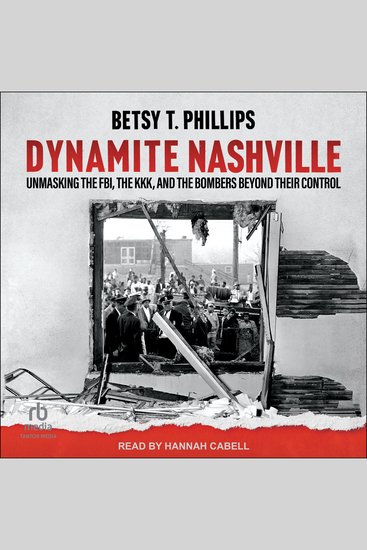
  • Dynamite Nashville - Unmasking the FBI the KKK and the Bombers beyond their Control - cover

    Dynamite Nashville - Unmasking...

    Betsy T. Phillips

    • 0
    • 0
    • 0
    New evidence in Dynamite Nashville uncovers the origin of an organized group of racist terrorists committing nationwide acts of violence against integration efforts in the late 1950's and early 1960s. Award winning historian Betsy Phillips not only paints a detailed picture of the social dynamic of the times, but details how a violent fringe of racists came to national prominence. In Dynamite Nashville, Phillips unmasks the KKK, reveals a racist terrorist network, names its principle leader, and shines a much needed historical spotlight on unsung civil rights hero Z. Alexander Looby. 


    Just as Nashville was where Civil Rights icons began, Nashville is where one of the country's most prominent organizations of racist terrorists formed. Members of The Confederate Underground would participate in least twenty bombings between 1957 and 1963. In Dynamite Nashville, Phillips revisits three unsolved Nashville bombings. Additionally, her research shows how the differing agendas of local police and the FBI allowed these bombers to escape prosecution until decades later, if at all. Dynamite Nashville is a prequel to the racist violence of the 1960s, the story of how these bombers came together to learn how to terrorize communities, and to escape any meaningful justice. It is also the story of how communities and heroes like Z. Alexander Looby pushed back.
    Show book
  • How I Changed The World: In My Own Unique Ways - cover

    How I Changed The World: In My...

    Galeeb Kachra

    • 0
    • 0
    • 0
    "Galeeb Kachra truly is one of a kind. A unique combination of optimism, can-do determination and relentless energy, he has the wiliness and moral integrity required to shake up sclerotic systems and sweep away logjams. His detailed account of five projects that mattered intensely to him, which did their little bit to make the world a better place, is sprinkled with humour and charmingly idiosyncratic, while packed with serious intent."  
    -- Michela Wrong, March 2021, author of "It's Our Turn to Eat: the Story of a Kenyan Whistleblower." 
    From the author: 
    Do you want to help achieve change, but don't know how? Other books don't give you practical examples that are within your own reach. This book showcases real cases, based on Galeeb's international experience. It covers disaster preparedness, anticorruption, youth empowerment, judicial reform, book bans, and procurement reform. Be motivated to find a way of helping others whatever your specific interests and technical skills. 
    Show book
  • Mothers of The Nation - The Ambiguous Role of Nazi Women in The Third Reich - cover

    Mothers of The Nation - The...

    Davis Truman

    • 0
    • 0
    • 0
    The Third Reich, which lasted from 1933 to 1945, was a period of extreme political and social upheaval in Germany. The Nazi regime, under the leadership of Adolf Hitler, implemented a range of policies aimed at creating a totalitarian state and achieving their vision of a "pure" Aryan race. During this time, women in Germany experienced significant changes in their social and political status. The Nazi regime held a traditional view of women, emphasizing their role as wives, mothers, and homemakers. Women were expected to support the men in their lives and maintain a pure Aryan bloodline through marriage and childbirth. However, as the war progressed, women's roles in German society began to shift, and many women took on essential roles in the war effort. Despite these changes, women faced many challenges during the Third Reich, and their experiences offered insight into the complex nature of life in Nazi Germany.
    Show book