Join us on a literary world trip!
Add this book to bookshelf
Grey
Write a new comment Default profile 50px
Grey
Subscribe to read the full book or read the first pages for free!
All characters reduced
Miles Standish the Puritan Captain - cover

Miles Standish the Puritan Captain

John S. C. Abbott

Publisher: DigiCat

  • 0
  • 0
  • 0

Summary

In "Miles Standish, the Puritan Captain," John S. C. Abbott intricately weaves a narrative that captures both the historical significance and personal complexities of its titular character. Through a blend of biographical recounting and vivid storytelling, Abbott paints a portrait of Standish as a stalwart leader among the Pilgrims, navigating the challenges of early colonial life in America. The text is marked by Abbott's engaging prose and reflective style, placing Standish within the wider context of Puritan beliefs and the early settlement's socio-political climate, thereby contextualizing his actions and motivations amidst the struggles for survival and governance in a new land. John S. C. Abbott, an American historian and writer of the 19th century, had a profound interest in shaping the understanding of American history for a burgeoning national identity. Throughout his career, Abbott demonstrated a keen ability to connect with the American populace by providing accessible interpretations of notable historical figures and events, likely influenced by his own Puritan heritage and the cultural narratives of his time. His commitment to portraying the moral and ethical dimensions of historical events is evident in this work, echoing the values he sought to instill in American society. "Miles Standish, the Puritan Captain" is a compelling read for anyone interested in colonial history, American literature, or the timeless themes of leadership and faith. Abbott's scholarship not only enriches our understanding of Standish's legacy but also provides readers with a window into the philosophical underpinnings that shaped early American life. This book is essential for history enthusiasts, educators, and casual readers alike, offering insights that resonate through the ages.
Available since: 05/28/2022.
Print length: 212 pages.

Other books that might interest you

  • Mercy - Showing Kindness to the Undeserving - cover

    Mercy - Showing Kindness to the...

    Esther Jameson

    • 0
    • 0
    • 0
    Mercy is a profound expression of kindness, compassion, and forgiveness, often extended to those who may not seem to deserve it. It goes beyond simple generosity, as it requires an intentional choice to withhold judgment or punishment in favor of grace. Unlike justice, which demands fairness and consequences, mercy offers a second chance, a moment of reprieve that can change the course of a person’s life. It is an act of the heart, one that acknowledges human weakness yet chooses understanding over condemnation. 
    Throughout history, mercy has been revered as a virtue, praised in religious teachings, philosophy, and moral discussions. It is a force that has shaped civilizations, influenced legal systems, and guided personal relationships. In many cultures, it is considered not just an act of goodness but a moral responsibility. Leaders who have shown mercy, whether in governance, war, or interpersonal dealings, are often remembered with admiration, their compassion seen as a mark of true wisdom. Conversely, the absence of mercy has been linked to cruelty, oppression, and suffering, demonstrating how vital it is in maintaining harmony in society. 
    Mercy and grace are often confused, but while they share similarities, they are not identical. Grace is the act of giving blessings freely, often without any expectation or prerequisite, while mercy is specifically about withholding deserved punishment or hardship. When someone extends mercy, they acknowledge wrongdoing or imperfection but choose to respond with kindness rather than retribution. This makes mercy one of the most powerful ways to heal relationships and restore dignity to those who have fallen short.
    Show book
  • Grad to Grown-Up - 68 Tips to Excel in Your Personal and Professional Life - cover

    Grad to Grown-Up - 68 Tips to...

    Courtney Bejgrowicz, Gene Rice

    • 0
    • 0
    • 0
    Everything you didn't learn in school but all you need to know to launch your personal and professional life. 


    Grad to Grown-Up: 68 Tips to Excel in Your Personal and Professional Life is a unique self-help book that offers a roadmap to kickstart your future. Rags-to-riches author and CEO Gene Rice and his high school English teacher daughter Courtney Bejgrowicz demystify adulthood by sharing critical information alongside professional and personal successes and failures. The five sections—life, job search, career, personal finance, and health and relationships—provide real-world insights that are often overlooked in formal education. You will learn everything from how to conquer the interview process to how to get promoted; from myths about credit scores to the impact of taxes; from the power of meditation to positively impacting society; and much more. Armed with this knowledge, you will be ready to move out on your own and move up in life.
    Show book
  • This Isn't Love - cover

    This Isn't Love

    Ann Cusack, Hope Daniels

    • 0
    • 0
    • 0
    After a life in care, with both good and bad experiences of the system, Hope knows all too well what the risks are for children in care as they approach adolescence. Lacking any sense of self-worth or belonging, children in care are often dismissed by the authorities as impossible to manage and, worse, perceived as children who have invited sexual abuse by placing themselves in 'dangerous' situations. They quickly become invisible to the authorities - too old to be perceived as 'children' by the system and yet, far too young to be safe in an adult world. Hope was brought up in care from the age of nine. Until now, she has never spoken about what happened to her once she left the security of her Highgate children's home at the age of 13 and moved into a 'secure unit'. It may have been secure but it was never 'safe'. In this new book, she lifts the lid on this untold chapter of her story and the devastating effects she experienced when she reconnected with her past. This isn't Love is a book that not only casts blame on the men and women who abuse children in care, but also on those who avert their gazes in the belief that these children are 'asking for it'. Hope's story ends on a hopeful note, championing victims of abuse and encouraging others to tell their story.
    Show book
  • Revolution - History of the French Revolution and Industrial Revolution - cover

    Revolution - History of the...

    Kelly Mass

    • 0
    • 0
    • 0
    These two titles are included in this audiobook: 
    1 - French Revolution: The Reign of terror was a period of considerable political and social change in France that started in 1789 with the starting of the Estates General and ended in the month of November 1799 with the development of the French Consulate. Tons of its ideas are now regarded important structures of liberal democracy, while terms like Liberté, égalité, and fraternité resurfaced in following revolts, which includes as the 1917 Russian Revolution, and stimulated efforts to eliminate oppression and attain universal suffrage. The causes are commonly accepted to be a mix of social, political, and financial concerns that the existing routine was not able to resolve. The Estates-General were assembled in May 1789 in reaction to considerable social discontent, and in the month of June they were become a National Assembly. The Assembly passed some remarkable reforms, and that includes the removal of feudalism, governmental control of the Catholic Church. 
    2 - Industrial Revolution: The Industrial Revolution was a period of shift in Britain, continental Europe, and the USA from around 1760 till at some point between 1820 and 1840, when new production innovations were introduced. The shift from hand to device production, new chemical and iron production strategies, increased use of steam and waterpower, the development of device tools, and the rise of the mechanized factory system were all part of this change. The Industrial Revolution also introduced a period of remarkable population growth. In regard to work, output value, and capital invested, fabrics were the most essential market throughout the Industrial Revolution. Textiles were also amongst the first markets to adopt modern production methods.
    Show book
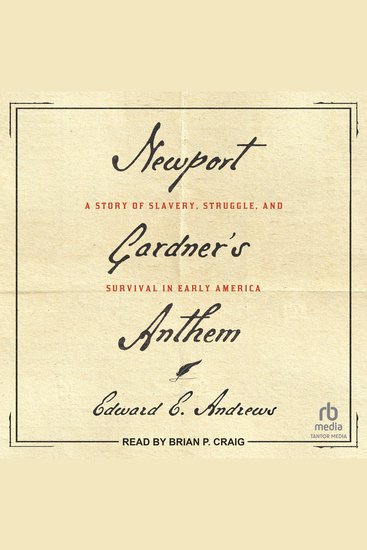
  • Newport Gardner's Anthem - A Story of Slavery Struggle and Survival in Early America - cover

    Newport Gardner's Anthem - A...

    Edward E. Andrews

    • 0
    • 0
    • 0
    Newport Gardner's Anthem explores the remarkable life of Occramer Marycoo, an enslaved African who went on to become one of early America's most important Black leaders. In the mid-eighteenth century, Marycoo was taken from West Africa to Newport, Rhode Island, where he was forced into racial bondage and given a name that symbolized the power that his new city and new enslaver held over him: Newport Gardner. In this powerful book, Edward E. Andrews pieces together newspaper articles, church records, letters, and Gardner's own writings to tell the story of his life. 
    After acquiring his freedom via a winning lottery ticket in 1791, Gardner became a kind of Founding Father for Newport's free Black community. He became a popular educator to young Black Newporters, and emerged as a key religious figure, serving as a long-standing pillar of Newport's First Congregational Church and later founding an independent Black church in the 1820s. His final act was leading a group of about three dozen Black New Englanders to Liberia, in hopes that a new start in Africa would be better than the discrimination they faced in America. 
    A richly textured account, Newport Gardner's Anthem tells the story of a forgotten Black leader while exploring the new, but tragically limited, opportunities for formerly enslaved people in the post-Revolutionary world.
    Show book
  • Crito - cover

    Crito

    Plato

    • 0
    • 0
    • 0
    "Crito" is a philosophical dialogue between Socrates and his friend Crito, taking place in Socrates' prison cell in Athens. Socrates has been sentenced to death for allegedly corrupting the youth of Athens and impiety, and the dialogue takes place in the hours leading up to his execution. Crito has come to persuade Socrates to escape from prison and flee Athens, but Socrates refuses, arguing that he must obey the laws of Athens, even if they are unjust. Socrates believes that he has a moral obligation to obey the laws, since he has lived in Athens and benefited from its laws for his entire life. He also believes that it would be unjust to break the social contract that he has entered into with the state. Read in English, unabridged.
    Show book