Junte-se a nós em uma viagem ao mundo dos livros!
Adicionar este livro à prateleira
Grey
Deixe um novo comentário Default profile 50px
Grey
Assine para ler o livro completo ou leia as primeiras páginas de graça!
All characters reduced
Of the Conduct of the Understanding - cover
LER

Of the Conduct of the Understanding

John Locke

Editora: DigiCat

  • 0
  • 0
  • 0

Sinopse

John Locke's "Of the Conduct of the Understanding" serves as a profound exploration of the principles governing human thought and knowledge. Written in a distinctly empirical style, Locke meticulously outlines the processes of understanding, emphasizing the importance of clear definitions and the avoidance of ambiguity. Situated within the context of 17th-century rationalism and the burgeoning Age of Enlightenment, this work reflects Locke's commitment to reason as a means to acquire true knowledge, ultimately guiding readers towards a more disciplined approach to thought and intellectual inquiry. As one of the most influential philosophers of his time, John Locke's views were deeply shaped by his background in medicine and natural philosophy. His experience in studying human cognition led him to advocate for a systematic approach to understanding, free from the constraints of dogmatic thinking. This work, like much of Locke's oeuvre, resonates with his belief in the transformative power of education and the need for individuals to cultivate their intellectual faculties. For readers seeking to enhance their critical thinking skills, "Of the Conduct of the Understanding" is an essential text. Locke's clear, cogent arguments provide invaluable tools for navigating the complexities of thought, making this work a vital resource for philosophers, educators, and anyone interested in the foundations of human understanding.
Disponível desde: 21/07/2022.
Comprimento de impressão: 75 páginas.

Outros livros que poderiam interessá-lo

  • Reconsidering Reparations - cover

    Reconsidering Reparations

    Olúfẹ́mi Táíwò

    • 0
    • 0
    • 0
    Reparations for slavery have become a reinvigorated topic for public debate over the last decade. Most theorizing about reparations treats it as a social justice project—either rooted in reconciliatory justice focused on making amends in the present; or, they focus on the past, emphasizing restitution for historical wrongs. Olúfémi O. Táíwò argues that neither approach is optimal, and advances a different case for reparations—one rooted in a hopeful future that tackles the issue of climate change head on, with distributive justice at its core. This view, which he calls the "constructive" view of reparations, argues that reparations should be seen as a future-oriented project engaged in building a better social order; and that the costs of building a more equitable world should be distributed more to those who have inherited the moral liabilities of past injustices. 


    This approach to reparations, as Táíwò shows, has deep and surprising roots in the thought of Black political thinkers such as James Baldwin, Martin Luther King Jr, and Nkechi Taifa, as well as mainstream political philosophers like John Rawls, Charles Mills, and Elizabeth Anderson. Táíwò's project has wide implications for our views of justice, racism, the legacy of colonialism, and climate change policy.
    Ver livro
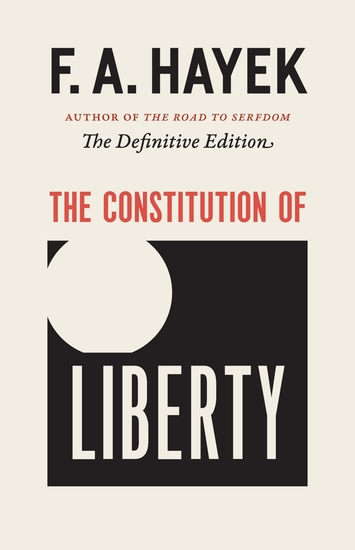
  • The Constitution of Liberty - The Definitive Edition - cover

    The Constitution of Liberty -...

    F.A. A. Hayek

    • 0
    • 0
    • 0
    “One of the great political works of our time . . . The twentieth-century successor to John Stuart Mill’s essay ‘On Liberty.’” —NewsweekConservatives and concerned citizens alike have grown increasingly fearful of big government. Enter Nobel Prize–winning economist and political theorist F. A. Hayek, whose passionate warning against empowering states with greater economic control, The Road to Serfdom, became an overnight sensation.The latest entry in the University of Chicago Press’s series of newly edited editions of Hayek’s works, The Constitution of Liberty is, like Serfdom, just as relevant to our present moment. The book is considered Hayek’s classic statement on the ideals of freedom and liberty, ideals that he believes have guided—and must continue to guide—the growth of Western civilization. Here Hayek defends the principles of a free society, casting a skeptical eye on the growth of the welfare state and examining the challenges to freedom posed by an ever expanding government—as well as its corrosive effect on the creation, preservation, and utilization of knowledge. In opposition to those who call for the state to play a greater role in society, Hayek puts forward a nuanced argument for prudence. Guided by this quality, he elegantly demonstrates that a free market system in a democratic polity—under the rule of law and with strong constitutional protections of individual rights—represents the best chance for the continuing existence of liberty.Striking a balance between skepticism and hope, Hayek’s profound insights are timelier and more welcome than ever before. This definitive edition of The Constitution of Liberty will give a new generation the opportunity to learn from his enduring wisdom.
    Ver livro
  • King John Henry III and England’s Lost Civil War - cover

    King John Henry III and...

    John Paul Davis

    • 0
    • 0
    • 0
    This sweeping history of thirteenth century England examines how the successive reigns of two very different kings established the English way of life. 


    In 1204, the great Angevin Empire was fragmenting under King John's rule. Unable to withstand France's invasion of Normandy, John also faced difficult relations with the papacy, and rising dissent among his barons. By the time John died in 1216, the failed Magna Carta gave way to civil conflict, and more than half of the country had fallen to the dauphin of France. These troubles were then passed, along with the crown, to John's nine-year-old son, Henry III. 


    Even with a regency government commanding the ship of state, Henry faced a dire threat to his royal authority. But the First Baron's War came to an end as Henry aligned himself with the pope and offered a revised Magna Carta. While this may have ensured short-term survival, living up to the promises of this foundational contract would create a more significant challenge—and lay the groundwork for the Second Baron's War.
    Ver livro
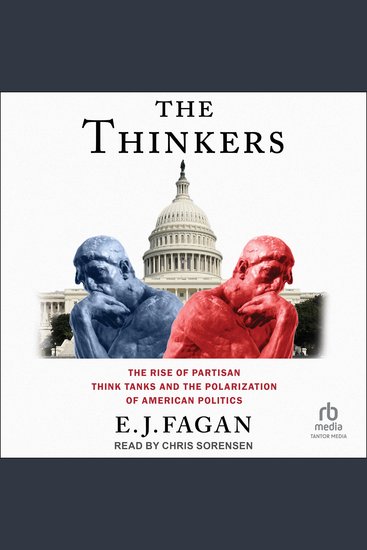
  • The Thinkers - The Rise of Partisan Think Tanks and the Polarization of American Politics - cover

    The Thinkers - The Rise of...

    E.J. Fagan

    • 0
    • 0
    • 0
    Increasingly, political parties have adopted not only different policies, but different sets of facts. As E. J. Fagan argues, partisan think tanks have helped create these alternate realities in their capacity as de facto formal party organizations. Through the analyses generated by aligned think tanks, political elites on both the left and right frequently offer radically different assessments of a policy's consequences. 


    In The Thinkers, Fagan tells the story of how partisan think tanks displaced non-partisan experts to become the closest policy advisors to the Republican and Democratic Parties. He explores their history, how they influence policymakers, and how their influence impacts the polarization of American politics. More broadly, Fagan shows that the rise of partisan think tanks tracks closely with the increase in political polarization since the 1970s. Because they are funded and staffed by strong ideologues, partisan think tanks seek to move their party's preferences to the left or right of center. When they are successful, parties take more extreme positions than if they had only drawn information from non-partisan sources, which increases polarization. A powerful account of the impact of partisan think tanks on American democracy, The Thinkers will reshape our understanding of the fundamental drivers of the US's polarized political system.
    Ver livro
  • Book Review: Outliers by Malcolm Gladwell - Challenging the myth of the self-made man - cover

    Book Review: Outliers by Malcolm...

    50 50minutes

    • 0
    • 0
    • 0
    It can be hard for busy professionals to find the time to read the latest books. Stay up to date in a fraction of the time with this concise guide.
    Outliers: The Story of Success is an engaging, thought-provoking look at the external factors that can determine an individual's personal success. Through a series of carefully selected anecdotes about highly successful individuals, Malcolm Gladwell sets out to disprove the myth of the self-made man by illustrating the opportunities, advantages and cultural factors that gave these 'outliers' in their fields the extra boost they needed to consolidate their success. Among the book's key concepts are the 10 000 Hour Rule (the hours of practice necessary to become an expert) and the Matthew Effect (the idea that advantages accumulate). Outliers is a key text in the field of 21st-century popular psychology, and has sold over 1.6 million copies worldwide to date.
    This book review and analysis is perfect for:
    •Students of psychology
    •Anyone with an interest in psychology
    •Anyone who wants to understand the hidden factors that determine success
    About 50MINUTES.COM|BOOK REVIEW
    The Book Review series from the 50Minutes collection is aimed at anyone who is looking to learn from experts in their field without spending hours reading endless pages of information. Our reviews present a concise summary of the main points of each book, as well as providing context, different perspectives and concrete examples to illustrate the key concepts.
    Ver livro
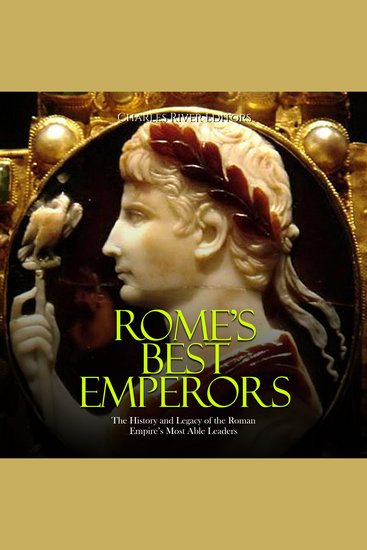
  • Rome’s Best Emperors: The History and Legacy of the Roman Empire’s Most Able Leaders - cover

    Rome’s Best Emperors: The...

    Editors Charles River

    • 0
    • 0
    • 0
    The importance of Gaius Julius Caesar Augustus (or as he was known from birth, Gaius Octavius “Octavian” Thurinus) to the course of Western history is hard to overstate. His life, his rise to power, his political, and his social and military achievements all laid the foundations for the creation of an empire which would endure for almost five centuries, and whose traditions, laws, architecture and art continue to influence much of Europe and the world today. Octavian was the first true Roman Emperor, and the first man since the Etruscan Tarquins five centuries earlier to establish a successful hereditary ruling dynasty in what had been a proud Republic for over half a millennium. He was a canny strategist, an excellent orator, a fine writer, a generous patron of the arts and enthusiastic promoter of public works, but above all he was a master politician. Octavian’s great-uncle (and adoptive father) Julius Caesar was a great general, and his rival Mark Antony was a great soldier, but as a politician Octavian outmatched them all. He still stands in bronze on Rome’s Via dei Fori Imperiali to this day, along with the likes of Caesar, Hadrian, Trajan and Marcus Aurelius, and he is forever immortalized in all Western calendars as the patron of the month of August, which was dedicated to him when he was deified, following his death, as Divus Augustus.  
    	“The Five Good Emperors,” a reference to the five emperors who ruled the Roman Empire between 96 and 180 CE (Nerva, Trajan, Hadrian, Antoninus Pius, and Marcus Aurelius), was a term first coined by Machiavelli and later adopted and popularized by historian Edward Gibbon, who said that under these men, the Roman Empire “was governed by absolute power under the guidance of wisdom and virtue.” This period of 84 years is generally regarded as the high point of the Roman Empire, at least after Augustus.
    Ver livro