Junte-se a nós em uma viagem ao mundo dos livros!
Adicionar este livro à prateleira
Grey
Deixe um novo comentário Default profile 50px
Grey
Assine para ler o livro completo ou leia as primeiras páginas de graça!
All characters reduced
The Private Life of Helen of Troy - cover
LER

The Private Life of Helen of Troy

John Erskine

Editora: DigiCat

  • 0
  • 0
  • 0

Sinopse

In "The Private Life of Helen of Troy," John Erskine intricately reimagines the life of one of mythology's most captivating figures. Set against the backdrop of the Trojan War, Erskine crafts a narrative that delves into Helen's personal experiences, emotions, and perspectives, offering a unique exploration of love, desire, and the complexities of human relationships. His literary style oscillates between lyrical prose and engaging dialogue, capturing the grandeur of epic tales while also making the narrative accessible and relatable. This work sits in the context of early 20th-century literature, reflecting a growing interest in feminist reinterpretations of classical myths. John Erskine, an influential figure in American literature and education, is known for his innovative storytelling and deeper psychological insights into characters often relegated to mere archetypes. His academic background and personal belief in the transformative power of literature contributed to his desire to explore Helen's story beyond the confines of her famously tragic narrative. Erskine's own experiences in academia and his keen interest in literature certainly influenced his decision to humanize this iconic character. This book is a must-read for those intrigued by classical mythology, history, and the intricacies of human relationships. Erskine's vivid portrayal of Helen's inner world not only sheds light on her character but also invites readers to reflect on the timeless questions of fidelity, identity, and agency. Enthusiasts of revisionist narratives will find irresistible appeal in this profound and engaging work.
Disponível desde: 21/07/2022.
Comprimento de impressão: 210 páginas.

Outros livros que poderiam interessá-lo

  • On Official Duty - cover

    On Official Duty

    Anton Chekhov

    • 0
    • 0
    • 0
    Doctor Starchenko and Lyzhin, a young deputy examining magistrate, arrive at Syrnya to attend to the case of Lesnitsky, an insurance agent, who, upon arrival to the village three days before, entered the local zemstvo house, ordered himself a samovar, unpacked his food packets, and then all of as sudden shot himself. The suicide was so bizarre, that the inquest was deemed to be necessary...
    Ver livro
  • Bensons The - A Short Story Collection - An anthology from three heralded brothers who rose to literary prominence around the turn of the century - cover

    Bensons The - A Short Story...

    E F Benson

    • 0
    • 0
    • 0
    Sibling rivalry can be a means of support but can also erupt into competitive traits of winners and losers.   
     
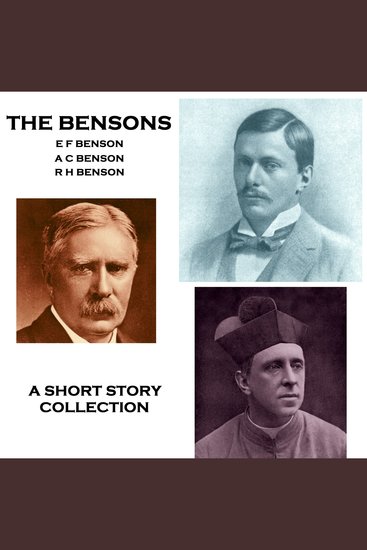
    In this literary instance dear listener, YOU are undoubtedly the recipient of this rivalry.  Having said that these are not the usual stories to be told in polite company, no, extinguish that idea immediately.  These three brothers (their sister seems far too nice to be in a volume such as this), seem to dwell with dark thoughts, in shadowed recesses and with literary creations that linger in the mind for more than a while.  Curious then that these authors are not only brothers but sons of the Bishop of Canterbury, whose 4 surviving children, never married. 
     
    Edward Frederic, better known as E F Benson, a Cambridge alumni, was one of the most popular and coveted of the turn of the century authors, with a glorious way of creating soul-searing mayhem in the span of a few pages of a short story, as well as being a novelist, biographer, memoirist and archaeologist.   
     
    His brother, Arthur Christopher, also a Cambridge graduate, and better known perhaps as A C Benson in the essay, poetry and academic circles was as accomplished and fiendish.  
     
    The third Cambridge attending brother, Robert Hugh, and yes, better known as R H Benson, was a novelist across several genres and a short story writer who was also a Catholic priest.  Perhaps that gave him an edge.  Although not as well-known as his brothers it may be that the shadows he inhabited were a grand place to meet reprobates that are better known as the subject of scurrilous conversation rather than in the flesh. 
     
    Taken together this band of brothers have the literary chops to rise above most others in the ghost and horror veins of fictional literature.  Well, we assume its fictional, don’t we? 
     
    01 - The Bensons - A Short Story Collection - An Introduction 
    02 - Mrs Amworth by E F Benson 
    03 - The Blood Eagle by R H Benson 
    04 - The Room in the Tower by E F Benson 
    05 - The Closed Window by A C Benson 
    06 - Caterpillars by E F Benson
    Ver livro
  • New Worlds for Old (Unabridged) - cover

    New Worlds for Old (Unabridged)

    H. G. Wells

    • 0
    • 0
    • 0
    This is a pre-1923 historical reproduction that was curated for quality. Quality assurance was conducted on each of these books in an attempt to remove books with imperfections introduced by the digitization process. Though we have made best efforts - the books may have occasional errors that do not impede the reading experience. We believe this work is culturally important and have elected to bring the book back into print as part of our continuing commitment to the preservation of printed works worldwide.
    Ver livro
  • Yah! Yah! Yah! - cover

    Yah! Yah! Yah!

    Jack London

    • 0
    • 0
    • 0
    “Yah! Yah! Yah!” written by Jack London: He was a whiskey-guzzling Scotchman, and he downed his whiskey neat, beginning with his first tot punctually at six in the morning, and thereafter repeating it at regular intervals throughout the day till bedtime, which was usually midnight. He slept but five hours out of the twenty-four, and for the remaining nineteen hours he was quietly and decently drunk. During the eight weeks I spent with him on Oolong Atoll, I never saw him draw a sober breath. In fact, his sleep was so short that he never had time to sober up. It was the most beautiful and orderly perennial drunk I have ever observed.
    Ver livro
  • The Adventure of the Speckled Band - cover

    The Adventure of the Speckled Band

    Sir Arthur Conan Doyle

    • 0
    • 0
    • 0
    The Adventure of the Speckled Band is one of the 56 short Sherlock Holmes stories written by Sir Arthur Conan Doyle. It is the eighth story of twelve in the collection The Adventures of Sherlock Holmes. Originally published in Strand Magazine in February 1892, "The Speckled Band" is a classic locked-room mystery that deals with themes of parental greed, inheritance, and freedom. Tinged with Gothic elements, it is considered by many to be one of Doyle's finest works, with the author himself calling it his best story.
    Ver livro
  • White Fang - cover

    White Fang

    Jack London

    • 0
    • 0
    • 0
    It was the she-wolf who had first caught the sound of men's voices and the whining of the sled-dogs; and it was the she-wolf who was first to spring away from the cornered man in his circle of dying flame. The pack had been loath to forego the kill it had hunted down, and it lingered for several minutes, making sure of the sounds, and then it, too, sprang away on the trail made by the she-wolf. Running at the forefront of the pack was a large grey wolf—one of its several leaders.    It was he who directed the pack's course on the heels of the she-wolf. It was he who snarled warningly at the younger members of the pack or slashed at them with his fangs when they ambitiously tried to pass him. And it was he who increased the pace when he sighted the she-wolf, now trotting slowly across the snow. She dropped in alongside by him, as though it were her appointed position, and took the pace of the pack. He did not snarl at her, nor show his teeth, when any leap of hers chanced to put her in advance of him.    On the contrary, he seemed kindly disposed toward her—too kindly to suit her, for he was prone to run near to her, and when he ran too near it was she who snarled and showed her teeth. Nor was she above slashing his shoulder sharply on occasion. At such times he betrayed no anger. He merely sprang to the side and ran stiffly ahead for several awkward leaps, in carriage and conduct resembling an abashed country swain. This was his one trouble in the running of the pack; but she had other troubles.    On her other side ran a gaunt old wolf, grizzled and marked with the scars of many battles. He ran always on her right side. The fact that he had but one eye, and that the left eye, might account for this. He, also, was addicted to crowding her, to veering toward her till his scarred muzzle touched her body, or shoulder, or neck. As with the running mate on the left, she repelled these attentions with her teeth; but when both bestowed their attentions at the same time she was roughly jostled, being compelled, with quick snaps to either side, to drive both lovers away and at the same time to maintain her forward leap with the pack and see the way of her feet before her.    At such times her running mates flashed their teeth and growled threateningly across at each other. They might have fought, but even wooing and its rivalry waited upon the more pressing hunger-need of the pack. After each repulse, when the old wolf sheered abruptly away from the sharp-toothed object of his desire, he shouldered against a young three-year-old that ran on his blind right side. This young wolf had attained his full size; and, considering the weak and famished condition of the pack, he possessed more than the average vigour and spirit. Nevertheless, he ran with his head even with the shoulder of his one-eyed elder. When he ventured to run abreast of the older wolf (which was seldom), a snarl and a snap sent him back even with the shoulder again.    Sometimes, however, he dropped cautiously and slowly behind and edged in between the old leader and the she-wolf. This was doubly resented, even triply resented. When she snarled her displeasure, the old leader would whirl on the three-year-old. Sometimes she whirled with him. And sometimes the young leader on the left whirled, too. At such times, confronted by three sets of savage teeth, the young wolf stopped precipitately, throwing himself back on his haunches, with fore-legs stiff, mouth menacing, and mane bristling. This confusion in the front of the moving pack always caused confusion in the rear. The wolves behind collided with the young wolf and expressed their displeasure by administering sharp nips on his hind-legs and flanks. He was laying up trouble for himself, for lack of food and short tempers went together; but with the boundless faith of youth he persisted in repeating the manoeuvre every little while, though it never succeeded in gaining anything for him but discomfiture.
    Ver livro