Begleiten Sie uns auf eine literarische Weltreise!
Buch zum Bücherregal hinzufügen
Grey
Einen neuen Kommentar schreiben Default profile 50px
Grey
Jetzt das ganze Buch im Abo oder die ersten Seiten gratis lesen!
All characters reduced
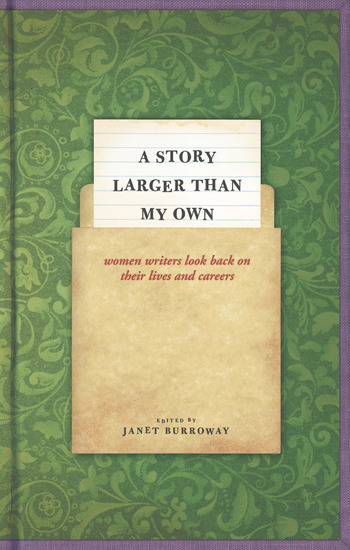
A Story Larger than My Own - Women Writers Look Back on Their Lives and Careers - cover

A Story Larger than My Own - Women Writers Look Back on Their Lives and Careers

Janet Burroway

Verlag: The University of Chicago Press

  • 0
  • 0
  • 0

Beschreibung

In 1955, Maxine Kumin submitted a poem to the Saturday Evening Post. “Lines on a Half-Painted House” made it into the magazine—but not before Kumin was asked to produce, via her husband’s employer, verification that the poem was her original work. Kumin, who went on to win the Pulitzer Prize for poetry, was part of a groundbreaking generation of women writers who came of age during the midcentury feminist movement. By challenging the status quo and ultimately finding success for themselves, they paved the way for future generations of writers. In A Story Larger than My Own, Janet Burroway brings together Kumin, Julia Alvarez, Jane Smiley, Erica Jong, and fifteen other accomplished women of this generation to reflect on their writing lives. The essays and poems featured in this collection illustrate that even writers who achieve critical and commercial success experience a familiar pattern of highs and lows over the course of their careers. Along with success comes the pressure to sustain it, as well as a constant search for subject matter, all too frequent crises of confidence, the challenges of a changing publishing scene, and the difficulty of combining writing with the ordinary stuff of life—family, marriage, jobs. The contributors, all now over the age of sixty, also confront the effects of aging, with its paradoxical duality of new limitations and newfound freedom. Taken together, these stories offer advice from experience to writers at all stages of their careers and serve as a collective memoir of a truly remarkable generation of women.
Verfügbar seit: 07.02.2014.
Drucklänge: 210 Seiten.

Weitere Bücher, die Sie mögen werden

  • The Wisdom of Solomon - Timeless Insights on Justice Faith and Virtue - A Modern Translation - Adapted for the Contemporary Reader - cover

    The Wisdom of Solomon - Timeless...

    Attributed to King Solomon

    • 0
    • 0
    • 0
    Are you searching for wisdom that endures the test of time? Do you long to deepen your understanding of faith, virtue, and the mysteries of life? 
    The Wisdom of Solomon is one of the most profound and poetic works of ancient wisdom literature. Traditionally attributed to King Solomon, this sacred text explores themes of morality, divine justice, and the transformative power of wisdom as the foundation of a meaningful life. 
    Now available in a modern, accessible translation, this edition brings clarity to its timeless truths—making it relevant and inspiring for today’s listener. 
    What you'll discover inside:Embrace the Path of Wisdom – Reflections on knowledge, virtue, and the divineUnderstand Justice and Righteousness – Insights into fairness, ethical leadership, and the moral orderStrengthen Your Faith – Uplifting passages that connect you more deeply to the divineFind Guidance for Modern Life – Ancient truths for navigating today’s world with clarity and integrity 
    Whether you’re a seeker of truth, a student of scripture, or simply in need of inspiration, The Wisdom of Solomon offers a powerful guide to living with purpose and spiritual depth. 
    Start your journey today and uncover the enduring insights of King Solomon’s timeless wisdom.
    Zum Buch
  • Mary E Mann - A Short Story Collection - A selection of stories from the underrated author Mary E Mann who wrote primarily about poverty and the struggle of rural life - cover

    Mary E Mann - A Short Story...

    Mary E Mann

    • 0
    • 0
    • 0
    Mary Rackham was born in Norwich on 14th August 1848 to a merchant family.  Little is known of her early life and her biography only re-appears in September 1871 with marriage to Fairman Joseph Mann, a farmer with 800 acres.   
     
    Mary moved to Shropham, Norfolk and became involved with the workhouse, visiting the sick and other unfortunates of the parish, her observations and experiences a valuable source for her later stories.  
     
    She took up writing, partly to offset the dreary village life of her surroundings, in the 1880s and published her first novel, ‘The Parish of Hilby’ (1883) at her own expense. It was well received by the critics.  
     
    Thus began a career that spanning three decades provided thirty-three novels, hundreds of short stories, and fourteen plays.? Her work was largely focused on rural life in Norfolk and centered on the fictional town of Dulditch, with grim but authentic accounts of poverty and deprivation.  
     
    Her marriage produced one boy and three girls. With her husband's death in 1913, she moved to Sheringham.  
     
    She is regarded as a major contributor to East Anglian literature with particular praise given to her short stories. 
     
    Mary E Mann died on 19th May 1929.  She was 80.  Her grave-marker is a carved open book with the epitaph ‘We bring our years to an end, as if it were a tale that is told’. 
     
    1 - The Short Stories of Mary E Mann - An Introduction 
    2 - Wolf Charlie by Mary E Mann 
    3 - Ben Pitcher's Elly by Mary E Mann 
    4 - Some of the Shipwrecked by Mary E Mann 
    5 - Rats by Mary E Mann 
    6 - Clomayne's Clerk by Mary E Mann 
    7 - The Country Doctor by Mary E Mann 
    8 - Little Brother by Mary E Mann
    Zum Buch
  • You Talk We Die - cover

    You Talk We Die

    Judy Ryan

    • 0
    • 0
    • 0
    ‘They should do something,’ I groaned. Then a frightening prospect — they might be me! What the hell could I do? 
     
    In July 2016, inner-city resident Judy Ryan found a young man — one of ‘her regulars’ — slumped and quiet at her gate. He had overdosed from heroin. Fortunately, that man lived. But Judy had reached breaking point. After four years in a ‘war zone’, where children might encounter a body on the streets, enough was enough. 
     
    Knowing little about what she was getting into, but fired with resolve, Judy launched a grassroots campaign against apathy and prejudice. While the residents fought for their neighbourhood and for the right of those suffering from addiction to be treated with the needed care and respect, they would see three coroners’ reports, two elections, a private member’s bill, the police finally acknowledging that arresting their way out of the problem didn’t work, and more unnecessary deaths before the trial of a safe injecting facility was agreed to. 
     
    A story of drugs, addiction, and a health crisis that touches people from all walks of life, You Talk, We Die is also a highly personal yet practical account of how an authentic local voice and an inclusive campaign can change the minds of business and political leaders to improve the lives of everyone in a community. 
     
    ‘Anyone who cares about humanity should read this inspiring story.’ JOHANN HARI
    Zum Buch
  • Hidden Demons - Evil Visits A Small New England Town - cover

    Hidden Demons - Evil Visits A...

    Margery B. Metzger

    • 0
    • 0
    • 0
    A New England community is rocked by a serial killer, a mass shooter, and a sexual predator—all in a single day—in this true crime chronicle. On January 7, 1994, residents of Berkshire Hills woke up to a typical winter day in the majestic woods of Western Massachusetts. But as that fateful day unfolded, three separate crimes—each unsettling in its own way—would converge in this quaint corner of New England. That day, a trial began for college student, Wayne Lo, who celebrated his 18th birthday by purchasing an assault rifle and opening fire on campus—killing two and wounding four others. Elsewhere, two young girls were accosted in the changing room at the local pool. And another young girl narrowly escaped being abducted at gunpoint on her way to school. Her quick thinking later resulted in profound repercussions regarding another case—that of a young boy who vanished from a strip mall. Though these events appeared unrelated, it seemed as though the world had suddenly gone mad. In Hidden Demons, Margery B. Metzger details these events and reveals a savage serial killer, Lewis Lent, Jr., who lurked in the shadows. It was the bravery of a father and daughter, and the remarkable work of law enforcement officers, that would see justice done.
    Zum Buch
  • A Legend - From their pens to your ears genius in every story - cover

    A Legend - From their pens to...

    Alexander Kuprin

    • 0
    • 0
    • 0
    Alexander Kuprin was born in Narovchat, Penza in Russia on 7th September 1870. 
    At 3 his Father died and he and mother moved to Moscow. By 10 he was enrolled at the Second Moscow Military High School and there his interest in literature began. The Alexander Military Academy followed and two years later he was a sub-lieutenant and posted to an Infantry Regiment for a further four years. 
    Despite his duties he was a now a keen writer and published his first short story at this time. His military duties also garnered him experiences for his breakthrough work ‘The Duel’.  Leaving the military he left for Kiev to work for local newspapers.  He continued to publish both stories and novels and by 1901 he was in St Petersburg becoming part of a group that included Chekhov, Ivan Bunin, Maxim Gorky and Leonid Andreyev.  
    In the years that followed further controversial works and acclaim followed.  His comments on the regime meant he was also put under secret police surveillance.   
    As World War I erupted, Kuprin opened a military hospital but was then given command of an infantry company in Finland. He was soon discharged on grounds of ill health.  
    The October Revolution saw him praise Lenin, but he warned that the Bolsheviks threatened Russian culture and might cause further widespread suffering to the peasants.  As Civil War raged he took his family to Helsinki and then on to Paris. 
    Exile saw his talents decline further and his succumbing to alcoholism. He became lonely and withdrawn. The family's poverty increased his malaise.   
    In May 1937, the Kuprin’s returned to Moscow.  He now saw his work published but wrote almost nothing new.  In 1938 his health rapidly deteriorated.  Already suffering from a kidney problems and sclerosis, he had now developed cancer of the oesophagus.  
    Alexander Kuprin died on 25th August 1938.
    Zum Buch
  • Bits & Bites - The Invention of Food - Why Carrots are Orange and Napoleon Loved the Can - cover

    Bits & Bites - The Invention of...

    Tom Hillenbrand

    • 0
    • 0
    • 0
    What determines what we eat today? Who decides what ends up on our dinner tables tomorrow? And what are the real origins of our favorite foods? Tom Hillenbrand takes readers on a fast-paced journey through the culinary history of the world—from the campfires of many thousands of years ago to the invention of corn to the hamburgers of the future. Filled with astonishing insights and surprising connections, Hillenbrand's essay is a highly entertaining and thought-provoking portrayal of what lies behind the food we consume every day.
    Zum Buch